

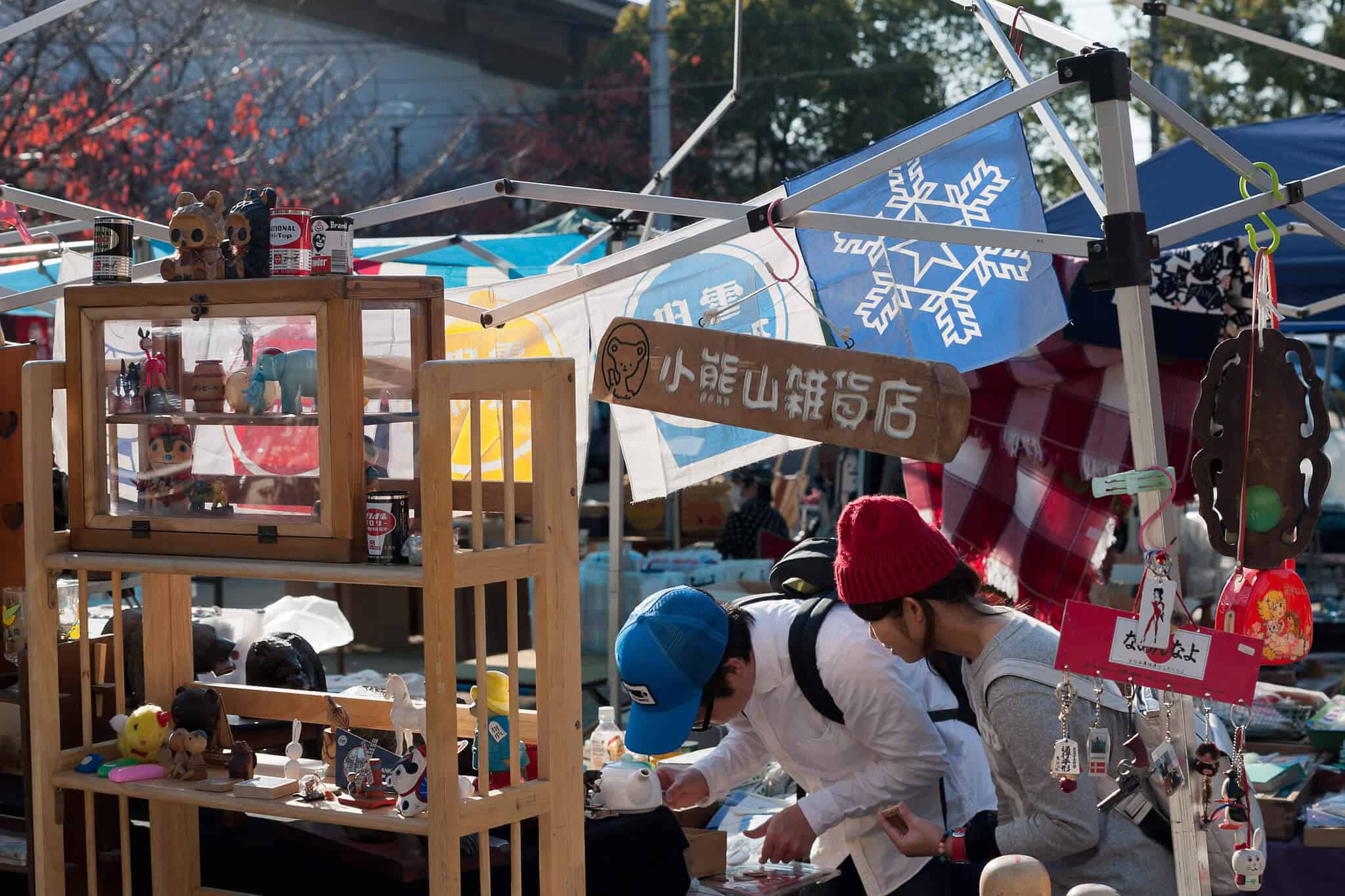

The best flea markets in Japan are woven into the fabric of temple grounds, stadium car parks and open city plazas from Hokkaido to Kyushu. They range from Tokyo’s massive weekend markets with 600 stalls to intimate monthly shrine fairs where a single dealer might have spent a lifetime accumulating Edo-era ceramics. What they have in common is the particular pleasure of hunting through genuinely old, genuinely Japanese things — vintage kimono, Imari porcelain, woodblock prints, lacquerware, retro Showa-era toys — at prices that still, occasionally, feel improbable. This guide covers the best markets across the country, city by city, with everything you need to visit them well.
A few things are true of almost every flea market in Japan: most outdoor markets cancel in rain, schedules can shift without much notice, and cash is king at the stalls. Always verify dates on the market’s official website or social media before making the trip. For a live, regularly updated map covering hundreds of markets across Japan, the Fleamapket Japan directory is the most comprehensive resource available.
Flea Markets in Tokyo
Tokyo has more flea markets per square kilometre than almost any city on earth. The scene divides neatly into two types: shrine and temple antique fairs, where professional dealers sell genuinely old stock, and large weekend markets, which are closer in spirit to a car boot sale and better suited to bargain hunters and first-time visitors.
The standout for quality and scale is the Oedo Antique Market at the Tokyo International Forum — Japan’s largest outdoor antique fair, held on the first and third Sunday of every month (not August), with around 250 dealers selling everything from Edo-era ceramics and vintage kimono to Western antiques and ukiyo-e prints. It’s a 1-minute walk from Yurakucho Station. For sheer size, the Ohi Racecourse Flea Market in Shinagawa fields up to 600 stalls two or three times a month, rain or shine — the closest Tokyo comes to a proper car boot sale, and one of the best places to stumble on unexpected finds. The Yoyogi Park Flea Market, first held in 1981 and still running monthly, leans younger and more fashion-forward, with 180 stalls of vintage clothing, sneakers and vinyl records near Harajuku.
Among the shrine markets, Tomioka Hachimangu (15th and 28th of every month, Koto-ku) and Hanazono Shrine (most Sundays, Shinjuku) are the most accessible, while the Gokokuji Antique Fair (second Saturday each month, Bunkyo-ku) and Arai Yakushi Temple (first Sunday each month, Nakano) attract serious collectors in quieter surroundings. For something truly large-scale and seasonal, the Heiwajima Antiques Fair at the Tokyo Ryutsu Center brings together over 500 dealers from across Japan several times a year — the event serious collectors plan their trips around.
→ Full guide: Flea Markets in Tokyo — shrine fairs, weekend markets and seasonal events
Flea Markets in Yokohama
Yokohama, just 30 minutes south of Tokyo by train, has its own well-established market scene — less famous than the capital’s, but worth combining with a day in one of Japan’s most atmospheric port cities. The Yokohama Kottoichi is the city’s most respected antique market, held on the third Saturday and Sunday of each month, with a strong reputation among collectors for the quality and authenticity of its stock. Its location near Yamashita Park and Yokohama’s Chinatown makes it easy to build into a full day out.
For larger events, the Yokohama Arena Antiques Fair brings together over 400 vendors from across Japan several times a year, covering both Japanese and Western antiques in an indoor setting — useful when the weather is uncertain. The Minato Mirai Flea Market, held at Nippon-maru Memorial Park near the waterfront shopping district, offers around 300 stalls with views across Yokohama Bay. Admission to most Yokohama markets is free; the Yokohama Kottou World event at Pacifico Yokohama, one of the largest indoor antique fairs in the region, charges a modest entry fee.
Flea Markets in Kyoto
Kyoto’s market scene is shaped entirely by its temples and shrines, and three monthly markets dominate — each with its own personality, held in grounds that are worth visiting regardless of the stalls.
The largest is Toji Kobo-ichi (東寺弘法市), held on the 21st of every month at Toji Temple — a UNESCO World Heritage Site a 15-minute walk from Kyoto Station’s Hachijo exit. Between 800 and 1,300 stalls fill the temple grounds beneath the five-storey pagoda, selling antiques, vintage kimono, ceramics, calligraphy scrolls, tools, fresh produce and street food. The market commemorates Kukai (Kobo Daishi), founder of Shingon Buddhism, whose memorial day falls on the 21st. It opens from early morning until around 16:30 and runs every month without exception — the closest thing Kyoto has to a permanent fixture on the market calendar.
On the 25th of every month, Kitano Tenmangu Shrine hosts the Tenjin-san Market — around 1,000 stalls along the shrine’s long approach and across its grounds, selling antiques, kimono fabrics, pottery, woodblock prints and seasonal plants. The market honours Sugawara no Michizane, the deified scholar enshrined here, and the atmosphere during plum blossom season (late February to early March) is particularly memorable. Food vendors sell takoyaki, sweet mochi and other Kyoto staples. Hours run from 06:00 until sunset.
The third major Kyoto market is the Hyakumanben Tezukuri Ichi (Handicraft Market) at Chion-ji Temple, held on the 15th of every month from 08:00 to 16:00. Unlike the antique-heavy markets at Toji and Kitano, this one focuses on handmade contemporary goods — ceramics, textiles, jewellery, woodwork, natural soaps and organic food, sold directly by the people who made them. It draws a younger, more community-oriented crowd, and the temple grounds north of Kyoto University give it a relaxed, neighbourhood feel. Around 10,000 visitors come each month.
For antique collectors specifically, keep an eye out for the Toji Garakuta-ichi, an additional antique-focused market held at Toji Temple on the first Sunday of every month alongside the regular Kobo-ichi schedule.
Flea Markets in Osaka
Osaka’s market scene is anchored by two temple markets on opposite ends of the city, both of which reward a visit with good stock, food stalls and a distinctly Osakan energy — louder and less formal than Kyoto’s equivalent events.
The main event is the Shitennoji Kotto-ichi, held on the 21st and 22nd of every month at Shitennoji Temple in Tennoji Ward — one of the oldest Buddhist temples in Japan, founded in 593 AD by Prince Shotoku. Around 300 vendors set up across the temple grounds selling antique tools, pottery, kimono, accessories and the full range of Showa-era curiosities. The surrounding area has good food options, and the temple architecture itself is worth the visit. Hours run from 08:00 to 16:00; admission to the market is free, though the temple’s inner sanctuary charges a separate fee.
In Kita Ward, the Ohatsu Tenjin Flea Market at Tsuyutenjin Shrine runs twice a month on the shrine grounds, with 30 to 40 stalls focused on antiques, pottery and Showa goods. It’s a smaller, quieter affair than Shitennoji — good for browsing without crowds. The shrine is also known as the setting of a famous 18th-century love story, which gives the whole visit an oddly romantic undertone.
For vintage and second-hand goods rather than antiques, the Banpaku Omatsuri Hiroba Garage Sale at Expo Commemoration Park (万博記念公園) runs two or three times a month on Sundays, with most vendors being private individuals rather than professionals — the kind of market where genuinely random finds turn up.
Flea Markets in Fukuoka
Fukuoka, the largest city on Kyushu island, is underrated as a flea market destination — partly because it’s less visited by foreign tourists than Tokyo, Kyoto or Osaka, and partly because its markets tend to operate below the radar of most English-language guides. The Gokoku Jinja Flea Market, held monthly at Gokokuji Temple in Chuo Ward, draws dozens of stalls selling antiques, furniture, handmade accessories and artwork, with food vendors on site. It’s a thoroughly local experience, and the kind of market where vendor conversations — gestures and goodwill bridging any language gap — are part of the point.
Fukuoka’s compact city centre, excellent food scene and position as a gateway to the rest of Kyushu make it a strong base for combining flea market visits with broader travel across western Japan.

Tips for Visiting Flea Markets in Japan
Go early. At shrine and temple antique markets, the most sought-after pieces — good ceramics, genuine vintage kimono, woodblock prints — tend to disappear before 10:00. Serious dealers often arrive before official opening time. At larger car boot-style markets, early arrival also means less competition for the interesting finds buried under the more obvious stock.
Bring cash, and bring small notes. Most flea market stalls in Japan don’t accept cards, and while convenience stores with ATMs are usually nearby, it breaks the flow of browsing to leave mid-stall. Stock up on ¥1,000 notes and ¥100 coins — the latter are useful when negotiating small adjustments to a price.
On haggling: it happens, but Japan is not a haggling culture in the way some markets in Europe or Asia are. The standard phrase is “Yasuku naranai?” — roughly, “Could you make it a little cheaper?” — and it’s understood and accepted at most stalls. Showing genuine interest in a piece before asking is the right approach; pushy counter-offers tend to end conversations. If you’re buying multiple items from the same vendor, a combined discount is often offered without prompting.
Check before you go. Almost all outdoor markets in Japan cancel in rain, and antique fair schedules — particularly in Tokyo and Yokohama — can shift or skip months without much notice. The market’s official website or Instagram account is the most reliable source of current information. For a full, up-to-date map of flea markets and antique events across Japan, the Fleamapket Japan directory is updated regularly.
Book Your Stay in Japan
Most of Japan’s best flea markets cluster around its three largest cities — Tokyo, Kyoto and Osaka — which are connected by the Shinkansen bullet train in under three hours. Staying centrally in any of the three puts you within easy reach of several markets, and a multi-city itinerary built around market schedules (Toji on the 21st, Oedo on the first Sunday, Tomioka on the 15th and 28th) is a rewarding way to see the country. Yokohama is 30 minutes from Tokyo and easy to fold into a longer stay. Fukuoka is the natural base for exploring Kyushu.
Frequently Asked Questions
Where are the best flea markets in Japan?
The strongest concentration of quality markets is in Tokyo and Kyoto. In Tokyo, the Oedo Antique Market (Tokyo International Forum, first and third Sunday of the month) is the most recommended starting point — Japan’s largest outdoor antique fair, with around 250 dealers. In Kyoto, the Toji Kobo-ichi on the 21st of every month is unmissable: up to 1,300 stalls in a UNESCO World Heritage temple. Osaka’s Shitennoji Kotto-ichi (21st and 22nd of the month) is the best market in western Japan for antiques. For the biggest single event in Japan, the Heiwajima Antiques Fair in Tokyo brings over 500 dealers together several times a year.
What can you buy at flea markets in Japan?
At antique and shrine markets: vintage kimono and obi sashes, Imari and Arita porcelain, lacquerware, ukiyo-e woodblock prints, kokeshi dolls, tea ceremony sets, old coins, folding screens, small furniture and tansu chests. At larger general flea markets: second-hand clothing, vintage vinyl records, cameras, retro toys, Famicom games and consoles, manga, household items and the occasional Western antique that has found its way into a Japanese collection. Street food stalls are common at the larger markets — taiyaki, yakisoba and seasonal snacks are standard.
When are flea markets open in Japan?
Most temple and shrine markets follow a fixed monthly schedule — typically on a specific date (the 21st, the 25th, the 15th) or a specific Sunday (the first, the third). Large weekly markets like the Ohi Racecourse run two or three times a month on weekends. Opening hours generally run from early morning (06:00–09:00) through to mid-afternoon (15:00–16:30). Almost all outdoor markets cancel in rain — always check the market’s official website or social media on the day before attending.
Do you need cash at Japanese flea markets, and can you haggle?
Cash is essential — the vast majority of stalls don’t accept cards or mobile payment. Bring ¥1,000 notes and some ¥100 coins. Haggling is accepted at most markets but should be done politely and without pressure. “Yasuku naranai?” (“Could you make it a little cheaper?”) is the standard opener. Discounts are more likely when buying multiple items from the same vendor, and more common at larger general markets than at specialist antique fairs where prices reflect genuine rarity.