

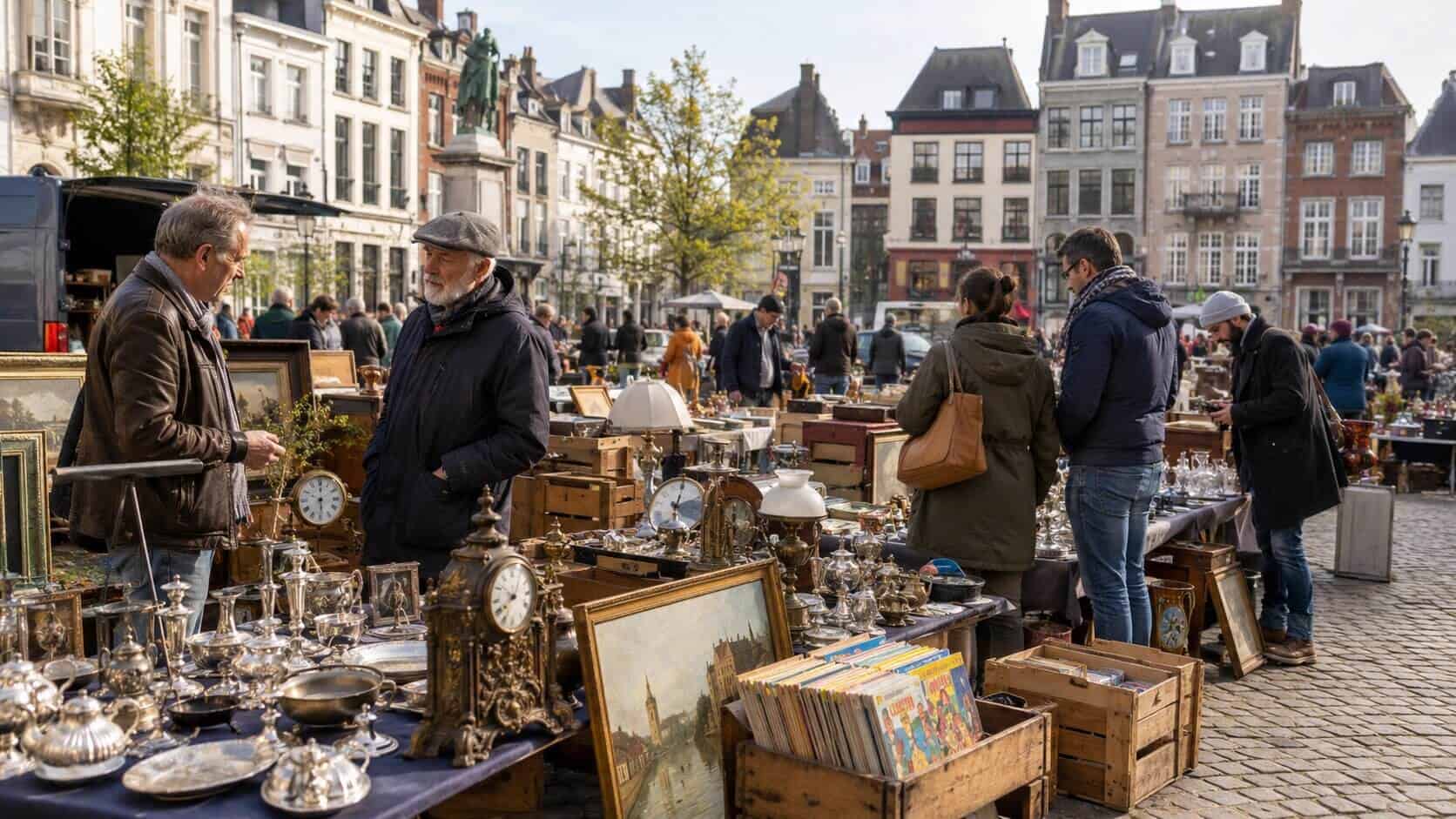

On any morning at Place du Jeu de Balle, dealers have their tables out before the city wakes up — silverware, old clocks, oil paintings, stacks of Belgian comic books. The Brussels flea markets scene is genuinely one of the best in northern Europe, and this square in the Marolles neighbourhood is only the beginning. With a single afternoon or a full weekend, the city rewards anyone willing to look properly.
Brussels sits at a useful crossroads for antiques: close enough to the French brocante circuit to share its sensibility, Dutch enough in its trading culture to keep prices honest, and cosmopolitan enough that the stock turns over constantly. For a broader picture of what the country offers, see our guide to the best flea markets in Belgium.
Place du Jeu de Balle
Often called the Old Market — Vieux Marché in French — the Place du Jeu de Balle is one of the oldest and most atmospheric flea markets in Europe. It has a fictional admirer, too: it’s the market where Tintin found the model ship La Licorne in Hergé’s The Secret of the Unicorn (1943) — a cameo that says something about the place’s reputation for unlikely finds.
The market runs daily, which is unusual at this scale. Dealers set up from 6 a.m., and the best stock — furniture, ceramics, African art, architectural salvage, the kind of bric-à-brac that actually rewards digging — tends to go early. By mid-morning on a weekend, the square is busy enough that serious hunters are already on their second pass. Arrive before 8 a.m. if you mean business.
The square itself is worth a moment. The Place du Jeu de Balle sits in the Marolles, one of Brussels’ oldest working-class neighbourhoods, and the market has been part of its fabric since the 1870s. The surrounding streets — Rue Blaes and Rue Haute in particular — are lined with antique shops and dealers that complement the open-air stalls, making the whole quarter worth a longer visit rather than a single pass through the square.
Two things to know before you go. First, the mix here leans more eclectic than specialist — you’ll find genuine antiques alongside recent junk, and distinguishing between them is part of the skill. Second, negotiation is standard and expected, but the best pieces on the better stalls are priced by people who know what they have. A reasonable offer lands better than an aggressive one.
📍 Where: Place du Jeu de Balle, Brussels (near Rue Blaes and Rue Haute)
📅 Days: Monday to Sunday
🕐 Hours: Monday–Saturday 06:00–14:00 | Sunday 06:00–15:00
🚇 How to get there: Bus 27, 48 (Chapelle, Jeu de Balle) · Tram 52, 55, 56, 81 (Anneessens, Lemonnier) · Métro 2, 6 (Louise, Gare du Midi, Porte de Hall)
🌐 Website: marcheauxpuces.be
Le Sablon: Antiques for Serious Buyers
If Place du Jeu de Balle is the democratic heart of the Brussels flea market scene, the Marché des Antiquaires du Grand Sablon is its more refined counterpart. Every weekend morning, the square fills with covered stalls run by professional antique dealers — the kind who know exactly what they have and price accordingly.
The stock here leans toward the upper end: silverware, decorative ceramics, Art Nouveau glassware, gilt-framed paintings, and Belgian furniture from the 18th and 19th centuries. You won’t stumble across a €2 paperback or a box of mismatched crockery. What you will find is well-sourced, well-displayed, and usually well-documented.
That doesn’t mean bargaining is off the table. Dealers at Le Sablon are traders first, and a polite, informed conversation about price is rarely unwelcome — particularly later in the morning when footfall starts to thin. Brush up on your approach with our guide to flea market haggling technique before you go.
The square itself is worth the detour regardless of what you buy. The Gothic church of Notre-Dame du Sablon forms the backdrop, and the surrounding streets are lined with permanent antique galleries and chocolate shops. Allow time to browse both the market and the shop windows — the distinction between the two often blurs pleasantly.
Le Sablon tends to attract a mixed crowd: local collectors, dealers scouting stock, tourists who’ve done their research, and the occasional interior designer filling a client brief. It is the kind of market where a single find can justify the whole trip.
📍 Where: Place du Grand Sablon, Brussels
📅 Days: Saturday, Sunday
🕐 Hours: Saturday 09:00–17:00 | Sunday 09:00–14:00
🚇 How to get there: Métro line 2 (Place Louise) · Tram 92, 93, 94 (Régence–Sablon) · Bus 20, 21
🌐 Website: sablon-antiques-market.com
Westland Shopping Centre Flea Market
Not every good market in Brussels requires cobblestones and a historic square. The flea market at Westland Shopping Centre — held in and around the car park of a retail complex on the western edge of the city — is a practical, unpretentious affair that draws a strong local crowd and regularly turns up decent stock.
The format is straightforward: a mix of private sellers clearing house and semi-regular dealers who know the circuit. That combination tends to produce the most interesting results — estate clearances sit alongside stalls of mid-century Belgian ceramics or vintage denim, with enough variation to make a proper circuit worthwhile.
Because it isn’t tourist-facing, prices stay grounded. Sellers here aren’t pricing for visitors who’ve just come from Le Sablon. Arrive early for the best selection; by late morning the crowd thins and the real finds are usually gone.
It’s a useful addition to a Brussels flea market weekend, especially if you’re staying near the Ring or have a car. Less photogenic than Jeu de Balle, undeniably — but occasionally more rewarding for the serious hunter.
📍 Where: Westland Shopping Center, Boulevard Sylvain Dupuis 433, 1070 Anderlecht 📅 Days: Sunday
🕐 Hours: Sunday 07:00–13:00
🚇 How to get there: Bus STIB 46, 75, 89 · De Lijn 116, 117, 118, 571, 572, 810 · Métro: Saint-Guidon
🌐 Website: brocantewestland.be
Auderghem and the Neighbourhood Circuit
Beyond the city centre, Brussels rewards explorers who venture into its outer communes. The Auderghem flea markets — held in this leafy southeastern municipality — are a fixture of the local calendar rather than a destination marketed at visitors, which is precisely what makes them worth knowing about.
The atmosphere is relaxed and genuinely residential. You’ll find the kind of stock that comes straight from nearby houses: old Flemish linen, mid-century furniture, stacks of Belgian prints, the occasional piece of Art Deco glassware buried under a tablecloth. Prices reflect the local-seller dynamic — rarely inflated, occasionally very good indeed.
This sort of neighbourhood market is part of what gives the Brussels flea markets scene its texture. Not every find happens on a famous square. Sometimes it’s a folding table outside a community hall in Auderghem at nine in the morning.
📍 Where: Rotating Sunday locations across Auderghem
📅 Days: Sunday (rotating schedule)
🕐 Hours: ⚠️ Schedule and frequency is subject to change — check local commune listings or Brussels flea market community groups before planning a visit.
📆 Schedule: 1st Sunday → Place Pinoy · 2nd Sunday → Boulevard du Souverain · 3rd Sunday → Carrefour supermarket car park · 4th Sunday → Herrmann-Debroux Viaduct 🌐 Website: auderghem.be
Place Saint-Denis and the Quieter Finds
The market at Place Saint-Denis is the least-known entry on this list and, in some ways, the most interesting for that reason. It sits outside the well-trodden tourist circuit, draws a predominantly local crowd, and has the unhurried pace of a market where nobody’s pretending to rush.
Stock tends toward the everyday-vintage category: household objects, old postcards and ephemera, tools, books, glassware, the kind of objects that don’t survive long at the more prominent markets because dealers scoop them up first. Here, they make it to the table.
It’s a good counter-programme to Le Sablon — visit one for the polish, the other for the discovery. If you’ve spent a Saturday morning working the Marolles and want to see Brussels through a different lens in the afternoon, this is a reasonable direction to point yourself.
📍 Where: Place Saint-Denis, Forest, Brussels
📅 Days: Sunday
🕐 Hours: Sunday 06:00–13:00
⚠️ No website listed — verify current status before publishing
Current operating status and schedule should be confirmed locally before visiting. This market has limited recent online visibility — verify via Brussels commune notices or local Facebook groups.
Dandelion: Vintage Design Worth a Detour
Not everything worth finding in Brussels happens at a weekend market. Dandelion occupies a different niche: a curated, fixed-address space where the selection is tighter and the presentation considerably more deliberate.
The focus is design-led vintage: 20th-century furniture, lighting and decorative objects with a strong eye for line and period. Think Scandinavian-influenced pieces, Belgian industrial finds, and the occasional Italian design classic that somehow made it this far north. It’s the kind of shop that serious collectors use as a benchmark — not for bargains, but for quality and curation.
Worth combining with a Sablon visit if you’re in the area, or as a standalone detour for anyone whose interest runs toward mid-century and post-war design rather than the older antique categories.
📍 Where: 187 rue de la Victoire, 1060 Brussels (Saint-Gilles)
📅 Days: Thursday, Friday, Saturday (and by appointment)
🕐 Hours: 11:00–18:30
📞 Tel: +32 (0) 497 220 820
🛋️ Stock: Furniture, lighting, ceramics, drawings, paintings and decorative objects
🌐 Facebook: dandelionvintagedesign / Instagram: dandelionbrussels187
Address and opening hours require verification before visiting — confirm via the shop’s own website or social media, as details may change.
Planning Your Brussels Flea Market Weekend
The most rewarding Brussels flea market visits are the ones that combine two or three stops rather than treating each as a separate day trip. The city is compact enough to manage this on foot or by tram — and the markets cluster loosely enough that a logical circuit exists.
Saturday morning is the strongest single slot. Le Sablon and Place du Jeu de Balle both run on Saturdays, and the two squares are less than ten minutes apart on foot through the Marolles. Start early at Jeu de Balle — dealers begin packing up well before noon — then move up to Le Sablon once the stalls there are fully open. If you want to add Dandelion, it sits close enough to the Sablon to make the detour easy.
Sunday works almost as well. Le Sablon runs again, and the neighbourhood markets at Auderghem and Place Saint-Denis tend to draw a slightly different, more local crowd — less tourist pressure, occasionally better prices.
A few practical notes worth keeping in mind:
- Cash still preferred. Most outdoor stall traders at Jeu de Balle and the neighbourhood markets work in cash. Le Sablon dealers are more likely to accept card, but don’t count on it.
- Arrive early for the best stock. At Jeu de Balle especially, the most interesting pieces move fast. By 10am the best of it is often gone.
- Carry a bag. Packaging is minimal at outdoor markets. A sturdy tote or a folding bag saves you negotiating awkward parcels on the tram home.
- Bargaining is normal, aggression is not. A calm, specific offer — particularly toward the end of a market morning — is almost always worth trying. For more on technique, see our guide to flea market haggling.
- Check schedules before you go. Market days, hours and locations change. Always confirm via official websites or social media before building a trip around a specific market.
Brussels is also a natural base for wider flea market travel. Ghent, Liège and Bruges all have their own strong markets within an hour by train. If you want the full picture, our guide to flea markets in Belgium covers the country in more depth.
Book Your Stay in Brussels
Brussels rewards an early start — and an early start is much easier when you’re already in the city. The Marolles and Sablon neighbourhoods sit close to a wide range of central hotels, from budget options near the Midi station to more characterful stays in the Upper Town. Booking a night either side of your market day gives you time to explore without rushing.
Frequently Asked Questions
What is the best flea market in Brussels?
Place du Jeu de Balle in the Marolles neighbourhood is the most famous and the most atmospheric — a daily outdoor market with a genuinely broad mix of antiques, bric-a-brac and vintage finds. Le Sablon is the better choice if you’re looking for high-quality, professionally curated antiques and are prepared to pay accordingly. For a full comparison, see our dedicated guide to Place du Jeu de Balle.
When do the Brussels flea markets run?
Place du Jeu de Balle runs every day of the year, including public holidays — typically in the morning until early afternoon. Le Sablon’s antiques market runs on weekend mornings. Neighbourhood markets like Auderghem and Place Saint-Denis generally run on weekends, though schedules vary. Always verify current hours and dates directly with each market before visiting, as these details change.
Is it worth visiting Le Sablon and Jeu de Balle on the same day?
Yes — and it’s one of the better half-days you can spend in Brussels. The two squares are a short walk apart through the Marolles. Start at Jeu de Balle early, when the selection is at its best, then walk up to Le Sablon once dealers there are fully set up. The contrast between the two — one sprawling and unpredictable, the other precise and professional — makes for an interesting morning even if you leave empty-handed.
Do I need cash for Brussels flea markets?
Cash is strongly advisable, especially at outdoor markets like Jeu de Balle and the smaller neighbourhood markets. Le Sablon dealers are more likely to accept card payments, but there’s no guarantee. Drawing cash before you arrive will save time and give you more flexibility when bargaining.