

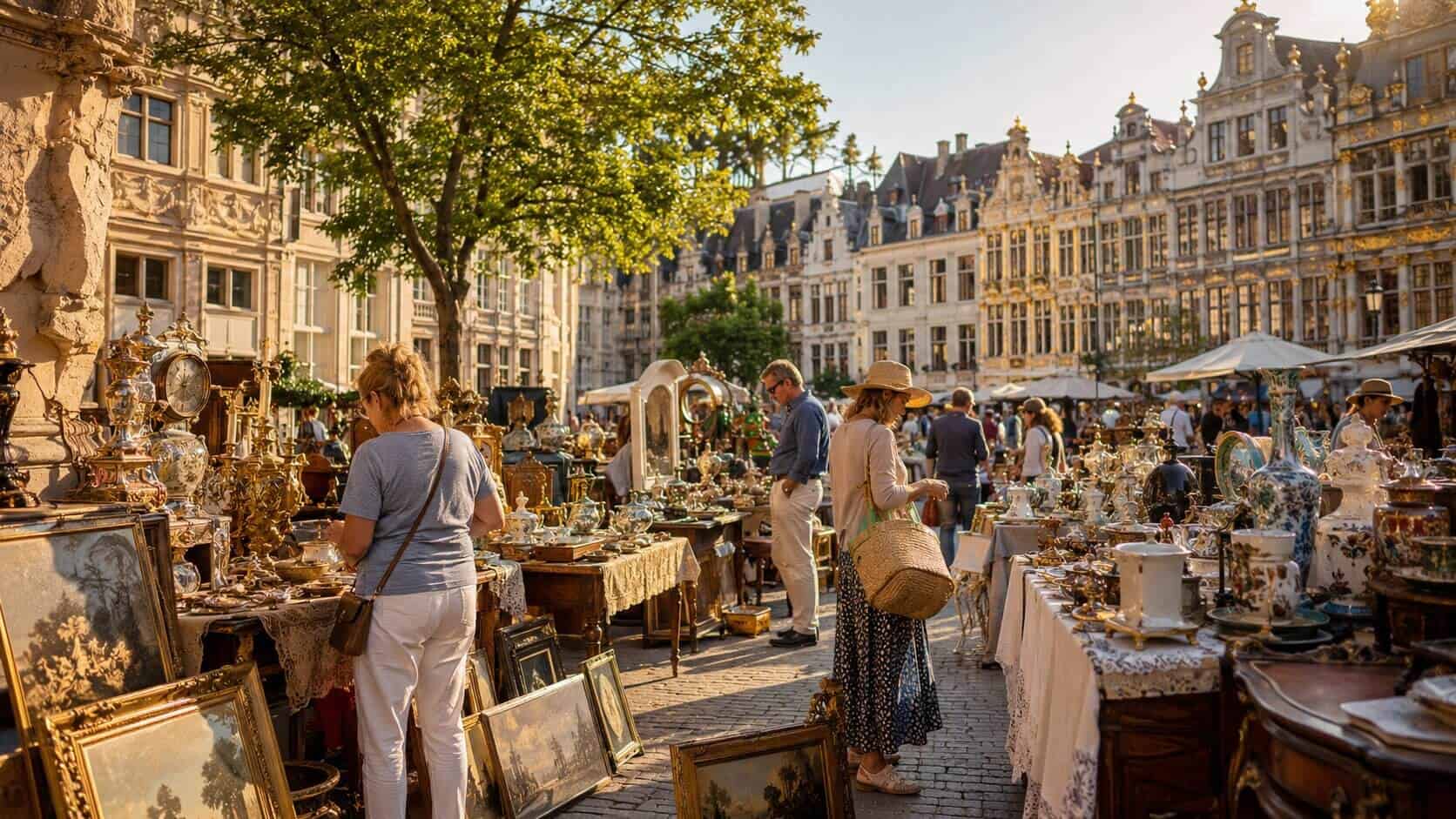

On the first Sunday of July, somewhere between 800 and 900 vendors spread their stalls across five hectares of meadows in a small corner of Burgundy — and more than 12,000 visitors show up before noon. That’s the Puces de la Grange Rouge. It’s one of the best summer flea markets in Europe, and most people outside France have never heard of it.
This guide covers 17 flea markets and antique fairs across Europe worth planning a trip around — from weekly city markets in Berlin and Copenhagen to once-a-year events that draw serious collectors from across the continent. They run from June through early September, and a few stretch into the first weekend of autumn.
Dates and schedules are listed under each entry. Markets shift their calendars from year to year, so always confirm directly with the official website before you book travel.
Not sure what a brocante is, or how it differs from a vide-grenier? We’ve got a full explainer if you’re new to the French flea market vocabulary.
Puces de la Grange Rouge (La Chapelle-Naude, France)
Three Sundays a year — one each in July, August and September — the village of La Chapelle-Naude in Saône-et-Loire hosts one of the most impressive outdoor flea markets in France. The Puces de la Grange Rouge spreads across five hectares of meadows and orchards, with between 800 and 900 exhibitors spread over 3.5 km, welcoming more than 12,000 visitors at each edition.
The stock is genuinely mixed, in the best way. Antique farm tools and garden equipment compete for space with French country furniture, vintage glassware, comic books, lamps and retro clothing. The quality varies considerably from stall to stall — that’s part of the appeal, and part of the skill. Serious collectors tend to walk the whole site before committing to anything.
It’s a particularly good destination if you’re after French antiques in their natural context — priced locally, not marked up for export.
When: First Sunday in July, August and September — 06:00 to 18:00 (Next dates: 5 July, 2 August and 6 September 2026 — 06:00 to 18:00)
Website: lagrangerouge.org
More information: Read our full listing on Fleamapket
Auer Dult (Munich, Germany)
Three times a year, the Au neighbourhood in Munich hosts one of the oldest and most characterful antique markets in Bavaria. The Auer Dult has been running since 1310, when it was first mentioned in the town’s charter book. With around 300 stalls spread across the Mariahilfplatz, the nine-day fair draws an estimated 100,000 visitors per run.
The stock is genuinely eclectic. Rare books and haberdashery sit alongside silverware, vintage kitchenware, antique prints, coins, stamps and war memorabilia. Quality varies — that’s part of the appeal. Dealers who know what they’re looking for tend to arrive early on the opening Saturday; by mid-week the crowds thin and the bargaining gets a little easier.
The summer edition falls in late July. If you miss it, the October Dult overlaps neatly with the end of Oktoberfest season — a reasonable excuse for a return trip.
When: Last Saturday in April and July; 3rd Saturday in October (Nex dates: Maidult 25 April–3 May 2026 | Jakobidult 25 July–2 August 2026 | Kirchweihdult 17–25 October 2026 — 10:00 to 20:00)
Website: muenchen.de — Auer Dult
More information: Read our full listing on Fleamapket
Brugge Zandfeesten (Bruges, Belgium)
Every August, the Zand Square in the centre of Bruges becomes one of the most atmospheric antique and brocante markets in Belgium. The Brugge Zandfeesten draws dealers and browsers from across Flanders and northern France, with stalls spreading across the square’s cobbles and into the surrounding streets.
The setting does a lot of the work. Bruges in summer is already handsome to the point of distraction, and hunting for Flemish ceramics, vintage lace, Art Nouveau glassware and old prints while the medieval towers rise above you is a particular kind of pleasure. The stock skews more decorative than industrial — this isn’t a market for farm-salvage enthusiasts, but it’s very good for smaller collectibles, silver, religious objects and textiles.
Arrive before 10:00 to catch the serious dealers before they pack up the better pieces. The square can fill quickly on a warm August morning, so an early start is practical as well as rewarding. Bruges is well connected by train from Brussels, Ghent and Antwerp, which makes a day trip straightforward even without a car.
When: First Sunday of July, first Sunday of August, fourth Sunday of September — 06:00 to 18:00. Stalls stretch from the station to ‘t Zand square and surrounding streets including Begijnenvest and Koning Albertpark.
Website: brugsezandfeesten.be
Gran Balon Flea Market (Turin, Italy)
Turin has one of the longest-running flea markets in Italy, and the Gran Balon is its biggest moment. The Gran Balon takes place every second Sunday of the month, from 08:00 to 18:00, in the streets of Borgo Dora — Via Lanino, Via Mameli, Canale Carpanini and Cortile del Maglio. The regular Saturday Balon runs alongside it weekly, but the Gran Balon is the main event for antique hunters.
The Gran Balon is unusually rich in proper antiques compared to most Italian street markets. You’ll find early 20th-century furniture, Liberty-style objects, vintage clothing, silver, militaria, old maps and prints alongside the usual flea-market mix of vinyl, kitchenware and bric-a-brac. The Piedmontese dealers here often know exactly what they have — don’t expect to stumble on an unpriced masterpiece, but the quality of the antique section is particularly strong for an open-air market of this type.
The Porta Palazzo neighbourhood around the market is worth exploring in its own right. The covered market buildings and the surrounding streets form one of the largest open-air markets in Europe — the flea market and antique section sits at the northern end, where the atmosphere shifts from fruit and vegetables to furniture and forgotten objects.
Turin is easy to reach by train from Milan, Genoa and Lyon. The market is walkable from Porta Palazzo, which is served by several tram lines from the city centre.
When: Second Sunday of every month, year-round — 08:00 to 18:00. Summer 2026 dates: 14 June, 12 July, 9 August, 13 September.
Website: balon.it
Brocante de Grandvilliers (Grandvilliers, France)
Grandvilliers is a small market town in the Oise department of Picardy, roughly midway between Beauvais and Amiens — not the kind of place most visitors put on a summer itinerary. That’s precisely why its annual brocante draws serious collectors. When a market hasn’t been discovered by the coach-tour circuit, the buying tends to be better.
The Brocante de Grandvilliers is a single-day summer event that brings a significant number of professional and semi-professional dealers into the town centre. The stock leans toward French provincial antiques and brocante rather than curated vintage — expect carved oak armoires, faïence pottery, old linens, enamel kitchenware and the kind of heavy country furniture that’s difficult to move but impossible to ignore.
Picardy has a strong tradition of this type of market, and the dealers here typically source locally — which means the stock reflects the region rather than the generic pan-European flea circuit. If you’re travelling between Paris and the Channel coast in summer, Grandvilliers is a realistic detour off the A16.
Beauvais, the nearest city with a train station, is around 25 kilometres south. A car makes the trip considerably more practical, both for reaching the market and for taking anything home.
When: Single-day summer event — exact 2025 date requires verification.
Foire aux Puces d’Aillant-sur-Tholon (Aillant-sur-Tholon, France)
The Yonne department of northern Burgundy punches well above its weight for summer flea markets. Aillant-sur-Tholon — a village of fewer than 2,000 people — hosts one of the more respected foires aux puces in the region each summer, drawing dealers and collectors from across Burgundy and beyond.
The market occupies the village centre and immediate surroundings, which gives it the relaxed, almost improvisational feel that distinguishes a genuine provincial foire from a managed antiques fair. Prices reflect that too — you’re more likely to negotiate here than at a dedicated antiques show.
The stock is typically broad: furniture, ceramics, vintage tools, old books and postcards, glassware, 20th-century decorative objects and the occasional piece of real quality buried among the bric-a-brac. The Yonne is rich in old farmhouses being cleared, which keeps the supply of genuine country antiques relatively fresh. It’s the kind of market where arriving early makes a genuine difference.
Auxerre, the departmental capital, is around 20 kilometres to the south-west and has good rail connections from Paris Bercy. The market itself is best reached by car. If you’re already visiting the brocantes of northern Burgundy or planning a trip around the Puces de la Grange Rouge — which sits in the same broad region — Aillant-sur-Tholon is a natural pairing.
Not familiar with terms like foire aux puces or brocante? Our guide to French flea market vocabulary covers the key differences.
When: Annual summer event — exact 2025 date requires verification.
Frederiksberg Loppetorv (Copenhagen, Denmark)
Copenhagen has no shortage of vintage shopping — the city does second-hand well, and it knows it. But Frederiksberg Loppetorv stands out from the weekend-market circuit for one simple reason: it runs through the summer on a regular schedule, giving visitors a reliable date to plan around rather than a one-off event to chase.
The market takes place in Frederiksberg, the independent municipality that sits within Copenhagen’s borders — affluent, quiet, leafy, and a good source of quality cast-offs. Expect Danish mid-century furniture and homeware, glassware, ceramics, vintage clothing, old postcards and the kind of well-made utilitarian objects that Scandinavian households tend to accumulate over decades. The overall quality leans higher than a typical city flea market, which is reflected in the stall-holder profile: a mix of experienced private sellers and occasional dealers.
For collectors with a specific interest in Danish design — Georg Jensen silver, Royal Copenhagen porcelain, Holmegaard glass — a market like this is worth a morning of patient looking. You won’t find bargains on the named pieces, but the context pieces and supporting objects often slip through at sensible prices.
Frederiksberg is easily reached by metro or bus from central Copenhagen, and the neighbourhood itself is pleasant enough to make an afternoon of it. The market is well suited to visitors combining it with other city stops rather than making it the sole purpose of a trip.
When: Every Saturday from 4 April to 17 October 2026, 09:00–15:00. Note: no market on Saturday 15 August 2026 due to Copenhagen Pride Parade.
Admission: Free.
Where: Parking lot behind Frederiksberg City Hall (Smallegade 1, 2000 Frederiksberg). Website: frederiksberg.dk/loppetorv
Ardingly International Antiques & Collectors Fair (Ardingly, UK)
The South of England Showground in Ardingly, West Sussex, hosts one of the largest outdoor antiques fairs in Britain several times a year — and the summer edition draws dealers and collectors from across the UK and continental Europe. If you’ve spent time at French brocantes or Belgian antique fairs, Ardingly will feel familiar in scale, though the stock and atmosphere are distinctly British.
The fair typically runs across two days and covers enormous ground. The range is broad by design: Georgian and Victorian furniture, architectural salvage, Art Deco ceramics and glass, vintage textiles, jewellery, militaria, books, maps, toys, and a strong representation of 20th-century decorative arts. Serious buyers tend to arrive at the trade preview — early admission before the general public — where the best pieces move quickly. General admission still offers plenty, particularly for collectors who enjoy the search more than the sprint.
Ardingly is a village rather than a town, which means the showground is effectively the event’s entire infrastructure. Most visitors drive; The nearest train station is Haywards Heath (around five miles away), with taxi links available. No dedicated shuttle service currently confirmed — check with the organiser.
The fair is organised on a commercial basis with paid admission at multiple tiers — general entry, early entry and trade preview each carry different prices. Admission is £20 per person on Tuesday (early entry day) and £6 per person on Wednesday. Under-16s enter free. Free parking on site.
For collectors visiting from Europe, Ardingly makes most sense combined with time in London — it’s around an hour south of the city by train to Haywards Heath. A summer visit pairs well with the London antiques market circuit: Portobello Road on Saturday, Ardingly on Sunday. The logistics take some planning, but the scale of the fair justifies it for anyone serious about British antiques and collectables.
When: Six editions in 2026 — 3–4 March, 21–22 April, 23–24 June, 21–22 July, 1–2 September, 3–4 November. Summer editions: 23–24 June and 21–22 July.
Website: iacf.co.uk/ardingly
Ciney Expo Flea Market and Antique Fair (Ciney, Belgium)
Belgium punches well above its weight for antique fairs, and Ciney is a good example of why. Held at the Ciney Expo exhibition centre in the Namur province of Wallonia, this fair combines a large-scale flea market with a proper antique dealers’ section — a format the Belgians have long done better than most.
The indoor setting matters more than it might seem. Unlike outdoor brocantes that live or die by the weather, Ciney runs regardless of what July or August decides to throw at southern Belgium. The exhibition halls are big enough to host a serious range of stock: 18th- and 19th-century furniture, silverware, clocks, porcelain, vintage tools, textiles, vinyl, and the kind of mid-century Belgian domestic objects that rarely make it outside the country’s own circuit.
The mix of professional antique dealers and private sellers gives the fair a useful two-speed quality. The dealer section rewards collectors with specific knowledge and specific budgets; the flea market section rewards patience and an eye for the overlooked. Both are worth your time.
Ciney itself is a small market town — not a destination in its own right — but it sits within easy reach of Namur, Dinant and the wider Ardennes. For collectors touring Belgium in summer, it fits naturally into a route that might also include Antwerp or Brussels. ⚠️ Verify current 2025 dates, admission prices and exhibitor numbers with the official organiser before publishing.
When: Three times a year — spring, summer and autumn. Next confirmed summer edition: 17–19 July 2026. Hours: Friday 10:00–19:00 | Saturday 10:00–18:00 | Sunday 10:00–17:00.
Admission: €10 Friday (includes outdoor unpacking) | €8 Saturday–Sunday | 3-day pass €21 | under 15s free.
Website: cineyexpo.be
Vlooienmarkt IJ-Hallen (Amsterdam, Netherlands)
The IJ-Hallen flea market in Amsterdam is the largest indoor flea market in Europe — or claims to be, and the scale makes the claim credible. It takes place inside the former NDSM shipyard on the north bank of the IJ, a vast industrial shell that once built ocean-going vessels and now hosts something like 750 stalls across a single weekend each month.
The summer editions — typically running through June, July and August — are among the most popular. Amsterdam draws visitors year-round, but the longer days and the outdoor overflow that spills onto the wharf in good weather give the summer market a different energy. The building itself is part of the experience: raw concrete, corrugated iron, exposed steel, and the particular light that comes off the IJ on a clear morning.
Stock ranges from serious vintage furniture and Dutch colonial antiques to secondhand clothing, vinyl, bikes, kitchenware and general market bric-a-brac. The furniture and design sections tend to be strong — Dutch mid-century pieces, Scandinavian imports, brutalist ceramics and industrial lighting all surface here with some regularity. It’s a market that rewards an early start and a patient circuit of the full floor.
Getting there is straightforward from central Amsterdam: a free ferry from behind Centraal Station crosses to the NDSM Werf in around 15 minutes. The crossing is part of the ritual for regulars, and it keeps the market feeling slightly removed from the tourist centre of the city — a useful quality for a place that depends on genuine stock rather than souvenir trade.
Tickets have historically been required in advance, particularly on busy summer weekends, but booking policy and pricing change from season to season. Admission is €6 for adults, €2.50 for children under 11. Early entry tickets (before official opening) cost €10. Tickets should be booked online in advance for busy summer weekends.
When: Approximately every three weeks, year-round — outdoors in spring and summer, indoors in the NDSM Loods in autumn and winter.
Hours: Saturday and Sunday 09:00–16:30.
Website: ijhallen.nl
Bleší Trhy Praha Vysočany (Prague, Czech Republic)
Prague has several flea markets scattered across its districts, but the one in Vysočany — long associated with the former Kolbenova site — has built a reputation as the city’s most serious secondhand destination. It operates on weekends and draws a mix of local dealers, private sellers clearing out flats, and a growing number of visitors who’ve started treating it as a detour on the standard Prague itinerary. The market is currently operating under the name Bleší trhy Praha at the Kolbenova site in Vysočany. The address is Na Harfě 9, Prague 9.
The stock leans heavily Czech and Central European: socialist-era ceramics, Bohemian glass, vintage Škoda memorabilia, pre-war postcards, enamelware, military surplus and the particular category of mid-century domestic objects that East Bloc apartment clearances still occasionally surface. Western European collectors who know their way around this kind of material will find prices considerably lower than equivalent stock at German or Belgian fairs.
Summer is a good time to visit — the market benefits from the longer days, and Prague in July and August sees enough international traffic that the dealer mix tends to sharpen slightly. That said, it remains primarily a local market in character. Most signage is in Czech. Bargaining is normal, but reserved rather than theatrical.
Getting there from the city centre takes around 20 minutes by metro. The Vysočany district sits northeast of the old town and lacks the architectural showmanship of Malá Strana or Vinohrady — which is precisely why the market works. It isn’t competing for tourist footfall; it’s just a market.
When: Saturdays and Sundays, year-round — 08:00 to 14:00.
Admission: Free.
Where: Na Harfě 9, Prague 9 (Vysočany). Metro: Line B to Invalidovna, then tram. ⚠️ Verify hours and any seasonal changes directly with the market’s social media before visiting — schedules can shift.
Flohmarkt am Mauerpark (Berlin, Germany)
The Flohmarkt am Mauerpark is probably the most famous outdoor flea market in Berlin, and possibly the most photographed. That reputation is a double-edged thing. On a warm Sunday in July, the market is undeniably good — a long stretch of stalls running alongside what was once the death strip between East and West Berlin, with the Prenzlauer Berg skyline visible to the south and a crowd that ranges from serious vinyl hunters to first-time visitors who’ve stumbled over from Mauerpark’s weekend karaoke. It’s lively without trying to be. The history is written into the ground.
The stock covers the full spectrum: GDR-era objects, East German ceramics and glassware, Cold War ephemera, vintage clothing, records, cameras and secondhand books in a dozen languages. The antique-to-junk ratio shifts stall by stall. Some dealers are specialists who travel the German fair circuit; others are local residents clearing out a storage unit. Both categories are worth your time, for different reasons.
Arrive early if you’re hunting seriously — by midday the crowds make methodical browsing difficult, and the better pieces tend to move in the first two hours. Sunday morning, before 10am, is when the market belongs to collectors rather than tourists. After lunch it’s still enjoyable, but the energy shifts.
The Mauerpark area has changed substantially over the past decade. New development around the park has altered the feel of the surrounding neighbourhood, and the market itself has been through various disputes over its future site and layout. The market runs every Sunday at Bernauer Strasse 63–64, 13355 Berlin. Entry is free.
Berlin has other flea markets worth knowing — the Sunday market at Boxhagener Platz in Friedrichshain is smaller and quieter, and often delivers comparable finds without the crowds. But for a first visit, or for the particular combination of history and market culture that Berlin does better than almost anywhere, Mauerpark on a summer Sunday remains the obvious starting point.
When: Every Sunday, year-round — 09:00 to 18:00 (summer hours; shorter in winter). Admission: Free.
Website: flohmarktmauerpark.de
→ Planning time in Berlin? See our full guide to the best flea markets in Berlin.
Brocante de L’Isle-sur-la-Sorgue (Isle-sur-la-Sorgue, France)
The town of L’Isle-sur-la-Sorgue, about thirty kilometres east of Avignon, has built its entire identity around antiques. The weekly Sunday brocante running along the canal-side quays is the baseline — pleasant, well-stocked, and busy enough to warrant an early start. But it’s the two grand fairs that draw dealers from across Europe: the Easter weekend event and the summer flea market held over the long weekend around 14 July, France’s Bastille Day.
The major summer fair typically runs over the 14 July long weekend — confirm exact 2026 dates at islesurlasorgue.fr before booking travel.
During the summer fair, several hundred dealers occupy the streets, squares and riverside terraces of the old town. The permanent antique shops and galleries — and there are a lot of them, clustered particularly around the Place Gambetta and along the Avenue des Quatre Otages — open their doors fully and often put stock outside. For a few days, the whole town functions as a single extended market.
The stock skews towards proper antiques rather than bric-à-brac: Provençal furniture, faience pottery, ironwork, mirrors, vintage linen and the kind of decorative French country pieces that travel well and retain value. Prices are not charitable — this is an internationally known fair, and dealers know their audience — but the sheer concentration of quality in one place makes it worth the trip even for serious collectors who walk away empty-handed.
Accommodation in and around L’Isle-sur-la-Sorgue books up fast for the July fair weekend. If you’re planning around it, sort your stay well in advance. The surrounding Luberon villages — Gordes, Roussillon, Bonnieux — are within easy driving distance and offer plenty of places to stay if the town itself is full.
The Sunday morning canal market runs year-round and is a gentler introduction if you’re arriving outside the fair dates. It won’t have the same depth of stock, but the town repays a slow morning regardless.
When — Summer fair: Around 14 July long weekend (Bastille Day) — confirm exact 2026 dates directly with the tourist office. Sunday brocante: Year-round, every Sunday morning along the canal quays.
→ Looking for more markets in the south of France? See our guide to flea markets in Provence.
Lincolnshire International Antiques and Home Show (Lincoln, UK)
The Lincolnshire International Antiques and Home Show draws dealers and collectors to the Lincolnshire Showground, just outside Lincoln, for one of the larger antiques fairs on the UK summer calendar. It sits in a different register to the more famous Ardingly or Newark events — slightly lower profile, which in practice means less competition for the better pieces and a more relaxed pace on the floor.
The mix typically covers furniture, ceramics, silverware, jewellery, vintage textiles and collectables, with a spread of dealers ranging from specialist antique traders to general vintage sellers. Lincoln itself is a worthwhile destination independently — the cathedral quarter, the steep Steep Hill lined with independent shops, and the castle make a full day of it easy to justify even if the fair turns out quieter than expected.
For collectors working the UK fair circuit, pairing a Lincolnshire visit with Newark — the Newark International Antiques and Collectors Fair runs several times a year at the Newark Showground, roughly an hour south — is a logical combination. The two events don’t always fall on the same weekend, but when the schedules align it’s a productive run.
When: Four times a year — 09:00 to 16:00. (next dates: June 3,2026, August 12,2026, October 14,2026, December 9,2026)
Admission: £5.00 per person.
Where: Lincolnshire Show Ground, A15, Lincoln LN2 2NA, UK
Website: https://asfairs.com/locations/lincoln/
Planning Your Summer Flea Market Trip in Europe
Most of the markets in this guide require some advance planning — not because they’re hard to find, but because turning up without checking the calendar first is an easy mistake to make. Several of the French brocantes and rural fairs run on fixed Sundays in July or August only; miss that weekend and you’re waiting a full year. Others, like Ardingly and IJ-Hallen, schedule multiple events across the year, which gives you more flexibility.
A few practical habits that make a difference on the day:
- Arrive early. For serious buying, the first hour matters. Dealers pick the best pieces before the general public gets in at larger fairs. At markets with early-buyer tickets — Ardingly is a good example — the premium entry fee is often worth it.
- Carry cash. Most European outdoor markets still prefer cash, even where card readers have become common. French rural brocantes in particular are almost entirely cash-based. Knowing the local currency and having small denominations ready makes negotiation easier.
- Bring your own bags. Tote bags, bubble wrap for fragile pieces, and a folding trolley if you’re planning serious purchases. Packing materials are rarely supplied by vendors at outdoor events.
- Check parking and access in advance. The larger showground fairs — Ciney, Ardingly, Lincolnshire — tend to have organised parking on site. Urban markets like IJ-Hallen or Mauerpark are better reached by public transport. Don’t assume either way.
- Confirm dates every year. This is non-negotiable. Several markets in this guide have shifted their calendars in recent years, and schedules published on third-party sites are often out of date. Go directly to the official website or the market’s own social media channels for 2025 dates.
If you’re combining multiple markets in one trip — a week in northern France hitting Grandvilliers, Aillant-sur-Tholon and a vide-grenier or two in between, for instance — build in rest days. Market fatigue is real, and browsing carefully takes more concentration than it looks.
New to the terminology? Our guide to French flea market vocabulary covers the difference between a brocante, a vide-grenier, a marché aux puces and an antiquaire — useful context before you travel.
Frequently Asked Questions
When is the best time to visit flea markets in Europe?
Late spring through early September is the peak season for outdoor flea markets and antique fairs across Europe. June, July and August bring the largest rural brocantes in France, the big Belgian fairs and the major UK showground events. Some markets — Berlin’s Mauerpark, Amsterdam’s IJ-Hallen, Copenhagen’s Frederiksberg Loppetorv — run year-round or across multiple seasons, so summer isn’t the only window. That said, the outdoor rural events in France and Italy are almost exclusively summer affairs, and missing the fixed Sunday they fall on means waiting until the following year.
What is the difference between a brocante, a vide-grenier and an antique fair?
A brocante is a market selling second-hand and vintage goods, typically run by professional or semi-professional dealers. A vide-grenier — literally “empty the attic” — is closer to a car boot sale, where private individuals clear out household items. An antique fair generally implies a higher standard of curation, with vetted dealers selling genuinely old or collectible pieces, often with stricter entry requirements for vendors. In practice the lines blur, especially at larger French events that mix all three. For a full breakdown, see our French flea market vocabulary guide.
Do I need to book tickets in advance for European antique fairs?
It depends on the event. Free outdoor markets like Mauerpark or Frederiksberg Loppetorv need no ticket at all. Larger showground fairs — Ardingly, Ciney, IJ-Hallen — typically charge an entry fee, and some offer discounted online booking in advance. Early-buyer or trade-entry slots at fairs like Ardingly usually require pre-purchase and sell out. For the French rural brocantes, entry is often free or inexpensive and walk-up on the day is normal. Check the official website for each event well before you travel.
Can I ship or export antiques bought at European flea markets?
For most vintage and second-hand goods, there are no restrictions on taking purchases home within the EU or back to the UK. For genuinely old antiques — particularly items over 100 years old, artworks or objects made from protected materials — export rules can apply, and it’s worth checking before you buy something significant. Many dealers at established fairs are experienced with international buyers and can advise on paperwork or shipping options. If you’re buying to resell or importing commercially, check the customs regulations for your home country in advance.