

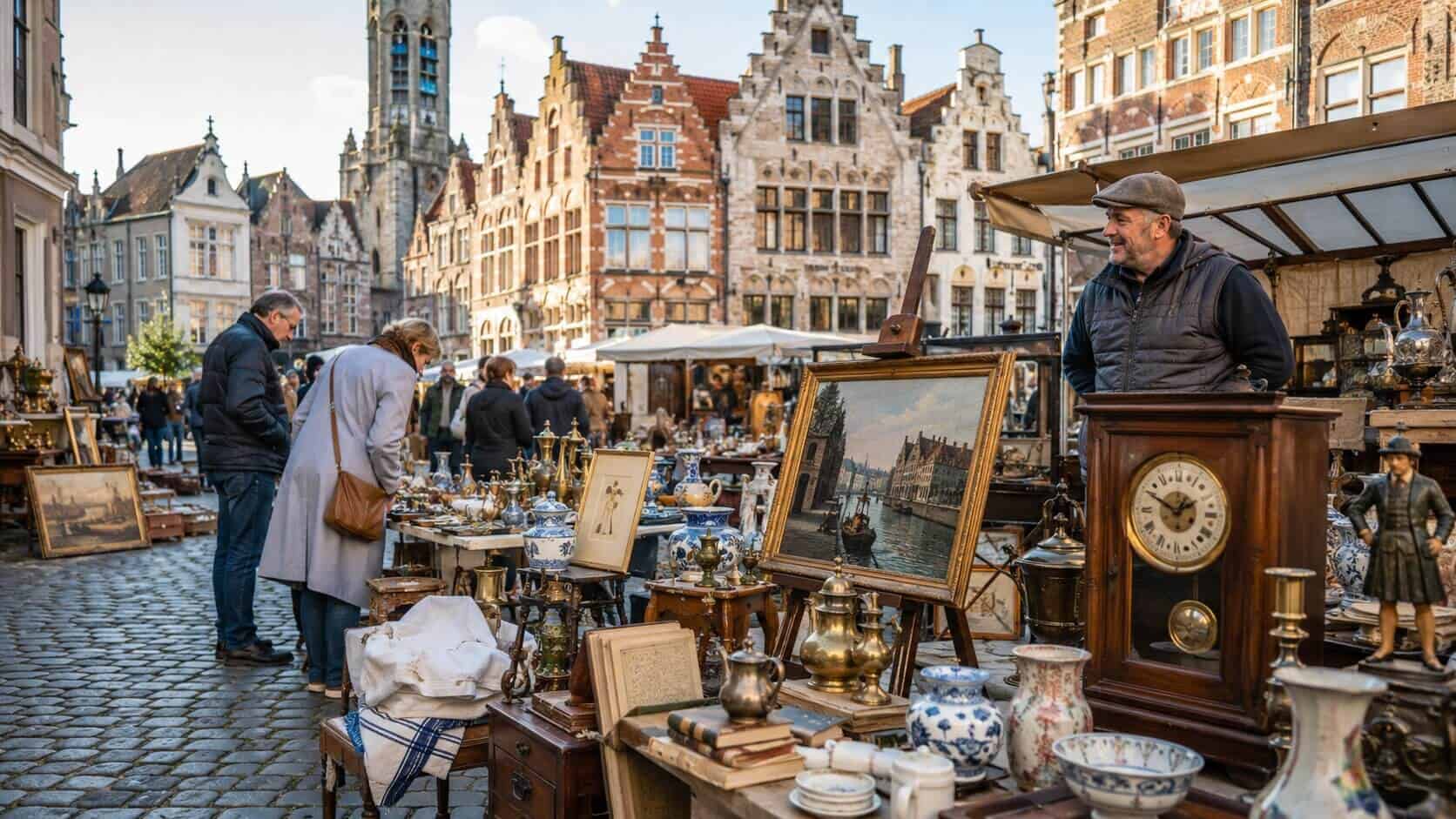

It often starts with a single visit to the Place du Jeu de Balle in Brussels — just a quick look, you tell yourself. An hour later you’re on your third lap of the square, reconsidering a brass lamp you put back down twenty minutes ago. That’s the particular pull of flea markets in Belgium. The country has been a crossroads between France, Germany, the Netherlands and Britain for centuries, and the goods that have washed through it — Art Deco ceramics, Flemish silverware, mid-century furniture, Roman-era artefacts — have a habit of resurfacing on Sunday mornings, spread across cobblestones and folding tables.
Belgium is compact enough that you can combine two or three markets in a single weekend trip. It’s also a country where weekly street markets sit alongside major annual antique fairs — quite different experiences, worth planning separately. This guide covers both. We’ve focused on the markets with the strongest reputations and the most reliable schedules, and noted where details need current verification before you travel.
For a visual overview, Fleamapket maps flea markets and antique fairs across Belgium — useful for planning a route before you leave home. And if you want to go further, the Flea Market Trip Planner can build a full Belgium itinerary in seconds: enter your destination, travel dates and maximum distance, and it maps the best markets along your route — drawing on a database of over 1,200 major flea markets and antique shows worldwide.
Weekly Flea Markets in Belgium
If a weekly market is what you’re after — somewhere reliable enough to build a Sunday around — Belgium has several worth the journey. The two strongest are in Tongeren and Brussels. Both draw serious collectors and casual browsers in roughly equal measure, and both reward an early start.
Tongeren Flea Market
Tongeren is Belgium’s oldest city, which is either a coincidence or a perfectly logical reason for it to host one of the country’s best antique markets.
The Roman fortification wall runs along the edge of town; the stalls spread out along it and into the surrounding streets, which gives the market a particular atmosphere that purpose-built fair venues never quite replicate. Around 350 exhibitors and some 40 antique shops display their stock every Sunday morning, covering furniture, silverware, ceramics, vintage clothing, coins and the full range of European decorative arts from the seventeenth century onward.
The streets around Leopoldwal, Veemarkt, Maastrichterstraat and the surrounding blocks fill with exhibitors and a cluster of permanent antique shops. The market has an international following — Dutch, German, French, British and American buyers are regulars — which means competition for the better pieces is real. Prices here are generally higher than at smaller Belgian markets. Bargains exist, but don’t expect to find them without patience.
The permanent antique shops around the market perimeter are worth exploring alongside the outdoor stalls — some carry stock that doesn’t make it out to the tables. Finish with coffee or lunch at one of the nearby cafés before the drive home; Tongeren has decent options within walking distance of the market.
📍 Where: Leopoldwal, Veemarkt, Maastrichterstraat, Clarissenstraat, Eburonhal & 1st floor of Julianus car park, Tongeren
📅 Days: Sunday (year-round)
🕐 Hours: 06:00–13:00
🚇 How to get there: Train to Tongeren station (connections from Brussels, Liège, Hasselt). The market is a short walk from the station. By car: motorway E40/E313, exit Tongeren. Street parking and car parks available — arrive early on Sundays.
🌐 Website: https://www.antiekmarkt-tongeren.be/
Place du Jeu de Balle Flea Market, Brussels
The opening of this guide is not an exaggeration. The Place du Jeu de Balle flea market in the Marolles neighbourhood has been running every morning of the year since 1873 — one of the longest-running daily markets in Europe. That consistency is part of its character. Turn up on a Tuesday in November and you’ll still find dealers spread across the cobblestones, though the real action happens on weekend mornings, when the square fills properly and the better stock comes out.
The Marolles sits between the Palais de Justice and the Porte de Hal, a working-class quarter that has absorbed waves of immigrants and artisans for centuries. The market reflects that layered history — you’ll find Art Nouveau glassware next to Soviet-era cameras, Flemish oil paintings propped against cardboard boxes of paperbacks, and mid-century Belgian furniture hauled out of local apartments. The mix is genuinely unpredictable, which is either frustrating or the whole point, depending on your temperament.
Sunday is the day most serious visitors choose. Arrive before 8 a.m. if you want first pick; the square gets crowded by mid-morning and the better dealers start packing up around noon. Bring cash — card terminals are the exception rather than the rule. The surrounding streets have several antique and bric-a-brac shops that are worth checking on the same visit, and there’s no shortage of cafés in the Marolles for a coffee between laps.
For a more detailed guide — transport, what to look for, where to eat nearby — see the dedicated Place du Jeu de Balle guide.
📍 Where: Place du Jeu de Balle, Brussels (near Rue Blaes and Rue Haute)
📅 Days: Monday to Sunday
🕐 Hours: Monday–Saturday 06:00–14:00 | Sunday 06:00–15:00
🚇 How to get there: Bus 27, 48 (Chapelle, Jeu de Balle) · Tram 52, 55, 56, 81 (Anneessens, Lemonnier) · Métro 2, 6 (Louise, Gare du Midi, Porte de Hall)
🌐 Website: marcheauxpuces.be
Smaller Weekly Markets Worth the Detour
Beyond Tongeren and Brussels, Belgium has a handful of regional markets that don’t attract the same international crowds but are often more rewarding for exactly that reason. Three in particular have solid reputations among Belgian collectors.
Lokeren, in East Flanders, holds a regular flea market that draws a loyal local following. The stock leans toward household goods, vintage clothing and affordable bric-a-brac rather than high-end antiques — useful if you’re after everyday finds rather than investment pieces. It’s compact enough to cover quickly and pairs well with a drive through the Waasland region.
📍 Where: Lokeren, East Flanders
📅 Days: Periodic — verify current schedule
⚠️ Confirm with local tourism office before visiting.
Saint Pholien in the Outremeuse district of Liège has a different feel entirely. Outremeuse is the island neighbourhood between two arms of the Meuse — fiercely local in character, and proud of it. The market here tends to reflect that: eccentric, mixed and priced for residents rather than tourists. If you’re already visiting Liège, it’s an easy addition to a Sunday morning.
📍 Where: Place Saint-Pholien, Outremeuse district, Liège
📅 Days: Sunday
⚠️ Frequency and current status require verification — check local Liège tourism sources before visiting.
Les Bastions in Tournai is another regional fixture. Tournai is one of Belgium’s oldest cities — its Romanesque cathedral dates to the twelfth century — and the market has the feel of a town that has been trading second-hand goods for a very long time. The selection is uneven, as smaller markets always are, but the setting and the lack of tourist pressure make it an appealing stop if you’re travelling through Hainaut.
Where: Les Bastions area, Tournai city centre
📅 Days: Sunday (periodic)
⚠️ Operating days and current status require verification before visiting.
🌐 For Wallonia market schedules: https://visitwallonia.com/
All three reward an early arrival and a willingness to look properly rather than skim. None of them are destination markets on their own, but combined with a regional drive they make for a satisfying day out.
Major Antique Fairs: Ciney, Temploux and the Big Annual Events
Weekly markets are one thing. Belgium’s major antique fairs are a different proposition entirely — larger in scale, more focused in stock and worth planning a trip around rather than slotting into one.
The Ciney Expo Antique Fair is among the most significant in the country. Held at the Ciney Expo exhibition centre in the province of Namur, it draws professional dealers from across Belgium and neighbouring countries, with a strong emphasis on furniture, silverware, paintings and decorative objects. The scale makes it genuinely useful for serious buyers — you’ll see a wider range of quality pieces in a single morning than you would across several Sunday markets combined. That said, prices reflect the professional context. This is not a place to stumble across an overlooked bargain; it’s a place to buy something you’ve been looking for deliberately.
📍 Where: Ciney Expo, Rue du Marché Couvert, 5590 Ciney, province of Namur
📅 When: Three times a year — spring, summer and autumn (typically April, July and October)
🕐 Hours: Friday 10:00–19:00 | Saturday–Sunday 10:00–18:00
💰 Admission: €8–10 (Friday: €10 incl. outdoor unpacking; Saturday–Sunday: €8; 3-day pass: €21; under 15s free)
🚗 Access: By car from the Namur–Dinant corridor. Free parking on site.
🌐 Website: https://cineyexpo.be/
⚠️ Dates vary each year — always verify the current schedule at cineyexpo.be before booking travel.
Temploux, a small village just outside Namur, hosts one of Belgium’s best-known large-scale flea markets. It has a reputation for sheer volume — hundreds of sellers, a wide mix of periods and price points, and enough ground to cover that a single visit rarely feels complete. The atmosphere is more market fair than curated antique show, which suits browsers as much as collectors. Furniture, vintage kitchenware, old tools, books and curiosities of every kind tend to appear in quantity.
📍 Where: Village of Temploux, sub-municipality of Namur (6 km route through village streets)
📅 When: Once a year, third weekend of August
🕐 Hours: Saturday from 07:00 — runs nonstop 36 hours through Sunday evening. Fireworks Saturday midnight.
💰 Admission: Free
🚇 How to get there: Bus line 23 reinforced between Namur and Temploux during the market. By car: parking on farmers’ fields surrounding the village — arrive early.
🌐 Website: https://temploux.be/
Both Ciney and Temploux sit within easy reach of Namur and the broader Wallonia region, making them natural companions for a longer southern Belgium trip. If your interest runs to higher-end antiques and you want something with a more international flavour, the Bruges Zandfeesten — a periodic antique and flea market event held in Bruges — draws a different crowd again, leaning toward decorative arts and collectibles in a setting that needs little introduction.
📍 Where: ‘t Zand square and surrounding streets, Bruges (stalls stretch ~5 km from
the station to Begijnenvest and Koning Albertpark)
📅 When: Three Sundays per year — 1st Sunday of July | 1st Sunday of August |
4th Sunday of September
🕐 Hours: 06:00–18:00
🚇 How to get there: Train to Bruges station — the market starts at the station exit. Walking distance from the city centre.
💰 Admission: Free
🌐 Website: https://brugsezandfeesten.be/
Brussels Vintage Market and the City’s Other Options
The Place du Jeu de Balle gets most of the attention in Brussels, and fairly so — but the city has more than one option for vintage and second-hand shopping, and the Brussels Vintage Market offers something distinctly different in character.
Where Jeu de Balle is unpredictable and sprawling — the kind of market where you might find a Murano glass chandelier propped against a crate of old postcards — the Brussels Vintage Market tends toward a more curated selection of mid-century furniture, vintage clothing and design objects. Stalls are typically run by dealers with a specific focus rather than general pickers, which means less noise to sift through and a higher baseline of quality. It attracts a noticeably younger crowd, more interested in 1960s and 1970s design than in nineteenth-century silver.
📍 Where: Reset, 8 Rue de Ligne,
1000 Brussels (city centre, near the administrative
district)
📅 When: Monthly — first Sunday of
every month
🕐 Hours: VIP entry 10:00–11:00
(pre-registration required) | General 11:00–18:00
💰 Admission: Free
🚇 How to get there: Central Brussels
— accessible by most metro and tram lines.
Check the market’s social media for any venue
changes before visiting.
🌐 Website / social:
Brussels Vintage Market
on Facebook — always check here for confirmed
monthly dates, as occasional special editions and venue
changes are announced here first.
For visitors spending a full weekend in Brussels, the two markets complement each other well rather than competing. Start early at Jeu de Balle for the unpredictability and the atmosphere; save the Vintage Market for a more deliberate browse later in the day, or on a separate visit.
Beyond these, Brussels has a concentration of antique shops and galleries in the Sablon district — the area around the Place du Grand Sablon — that functions as a year-round alternative when the outdoor markets are quiet — older, more formal, and focused squarely on antiques rather than vintage fashion.
Running every Saturday and Sunday since 1960 on the Place du Grand Sablon, it brings together around 40 professional dealers specialising in silverware, jewellery, paintings, ceramics, clocks and decorative objects. Prices are higher than anywhere else in Brussels, but the quality is consistent and the setting — a cobblestone square flanked by historic buildings and surrounded by chocolatiers and antique shops — makes it one of the more agreeable places in the city to spend a weekend morning regardless of whether you buy anything.
📍 Where: Place du Grand Sablon, 1000 Brussels
📅 When: Every Saturday and Sunday, year-round
🕐 Hours: Saturday 09:00–17:00 | Sunday 09:00–14:00
💰 Admission: Free
🚇 How to get there: Tram 92, 93, 94 (Régence–Sablon) · Métro line 2 (Place Louise) · Bus 20, 21
🌐 Website: https://sablonantiquesmarket.be/
Regional Markets Worth the Journey: Liège, Tournai and Beyond
Belgium’s regional markets tend to get overlooked in favour of Tongeren and Brussels, which is partly why they can be more rewarding. The crowds are thinner, the dealers are often local, and the prices reflect that.
In Liège, the long-running La Batte market stretches along the bank of the Meuse on Sunday mornings — a broad, chaotic stretch of stalls that mixes antiques and collectables with fresh produce, clothing and general bric-à-brac. It’s one of the oldest Sunday markets in Europe by some accounts, and it shows: the scale is serious, and serious collectors have been known to come away with good finds precisely because the sheer volume keeps competition lower than at a specialist fair. A short walk away in the Outremeuse district, the Saint Pholien Flea Market runs on a different rhythm — smaller, more neighbourhood in character, and focused more squarely on second-hand goods and antiques. The two markets work well together as a single Liège morning.
📍 Where: Along the Meuse riverbank, Liège (Quai de la Batte)
📅 Days: Sunday
🕐 Hours: Approximately 08:00–14:00
⚠️ Verify current hours and vendor mix before visiting — schedule and character can vary seasonally.
Tournai, close to the French border in Wallonia, has a flea market tradition tied to the city’s medieval centre. The Les Bastions market takes its name from the old fortifications nearby and draws a mix of local dealers and pickers. Tournai is an easy addition to a cross-border trip that might also take in Lille’s famous markets — the drive between the two cities takes under half an hour. If you’re coming from the UK or northern France, this southwestern corner of Belgium is significantly more accessible than Brussels or Tongeren.
In Flemish Belgium, Kortrijk (Courtrai in French) has a flea market that tends to attract a local collector base rather than international visitors — which is often a mark in its favour. The city itself is worth a half-day, and combining the market with a visit to the Groeningemuseum’s collection or the textile history sites makes for a fuller trip. Over in Lokeren, east of Ghent, a smaller periodic market rounds out the options in that part of East Flanders.
📍 Where: City centre, Kortrijk
📅 Days: Periodic — verify current schedule
⚠️ Confirm with local tourism office before visiting.
How to Plan a Belgium Flea Market Weekend
Belgium is small enough that a two-night trip from London, Paris or Amsterdam can realistically take in two or three markets — provided you plan around the schedules rather than the geography. The geography is easy. The schedules are the thing.
The most reliable pairing is Tongeren on Sunday combined with a weekday or Saturday stop in Brussels — either at the Place du Jeu de Balle or in the Sablon district. Tongeren’s market runs every Sunday morning year-round, and the town is well connected by train from Brussels in under an hour. Stay in either city, and you have a sensible base for both.
For the major fairs — Ciney Expo, Temploux — the same logic applies in reverse: fix the fair date first, book accommodation early, and plan any market visits around the remaining days. These events draw enough visitors that hotels in the region fill quickly, especially for the Ciney Expo weekend. Both fairs are covered in more detail in the antique fairs section above.
A few practical points worth keeping in mind:
- Cash is still expected at most outdoor markets, including Tongeren and Jeu de Balle. Card payment availability varies by stall but cannot be relied on.
- Arrive early. At Tongeren in particular, the best pieces move fast. Serious dealers are typically there well before 9am.
- Bring your own bag. Packing material and bags are rarely provided at Belgian outdoor markets.
- Check schedules before travelling. Weekly markets can be suspended for local holidays, bad weather or annual breaks. Annual fairs change dates. Always confirm with the official source or the market’s social media before booking transport.
- Bruges Zandfeesten is worth noting as a one-off annual event in the canal city — a large outdoor antique and brocante fair that turns Bruges into an even more improbable setting than usual. Dates and current status should be confirmed before planning a trip around it.
For a mapped view of Belgian markets and antique fairs, Fleamapket lets you filter by location and type — useful when you’re trying to work out which markets cluster near each other and which are genuinely worth the detour. And if you want to go further, the Flea Market Trip Planner can build a full Belgium itinerary in seconds: enter your destination, travel dates and maximum distance, and it maps the best markets along your route — drawing on a database of over 1,200 major flea markets and antique shows worldwide.
Frequently Asked Questions
What is the best flea market in Belgium?
For sheer range and collector depth, Tongeren is the most consistently recommended. Its Sunday market draws international dealers and buyers, and the surrounding antique shops extend the experience well beyond the outdoor stalls. If you’re based in Brussels, the Place du Jeu de Balle in the Marolles neighbourhood is the most accessible — and one of the few markets in Europe that runs every morning of the year. The right answer depends on what you’re looking for: Tongeren for serious antique hunting; Jeu de Balle for atmosphere and unpredictability.
When do flea markets in Belgium take place?
Most of Belgium’s best-known markets run on Sunday mornings. Tongeren operates every Sunday year-round, typically from early morning — arrive before 9 a.m. if you want first access to the better stock. Place du Jeu de Balle runs daily, with weekends drawing the largest crowds and the most interesting dealers. Regional markets in Liège, Tournai and Kortrijk follow their own schedules, which can vary by season. The major antique fairs — Ciney Expo and Temploux — are periodic events rather than weekly fixtures. Always check the official website or social media before travelling, as dates and schedules change.
Is Tongeren flea market worth the trip from Brussels?
Yes, for most collectors it is. The train journey from Brussels to Tongeren takes under an hour, making it a straightforward day trip. The market is larger and more focused on genuine antiques than anything you’ll find at a typical Belgian street market, with dealers who travel from the Netherlands, Germany, France and further afield. Prices are higher than at smaller regional markets, but the depth of stock justifies the effort. Combining it with a Sunday morning in Tongeren itself — Belgium’s oldest city, with its Roman wall and compact centre — makes the journey feel complete rather than purely transactional.
Are there any large annual antique fairs in Belgium?
Belgium has several, and they operate on a different scale to weekly street markets. The Ciney Expo Antique Fair, held at the Ciney Expo centre in the province of Namur, is among the most significant — professional dealers, serious stock and a strong emphasis on furniture, silverware and decorative arts. Temploux, near Namur, is better known for volume: hundreds of sellers, a broad range of periods and price points, and a fair atmosphere that suits browsers as much as specialists. The Bruges Zandfeesten is a periodic large-scale brocante and antique event set against one of Belgium’s most striking backdrops. Dates for all three events should be confirmed via official sources before booking travel.