

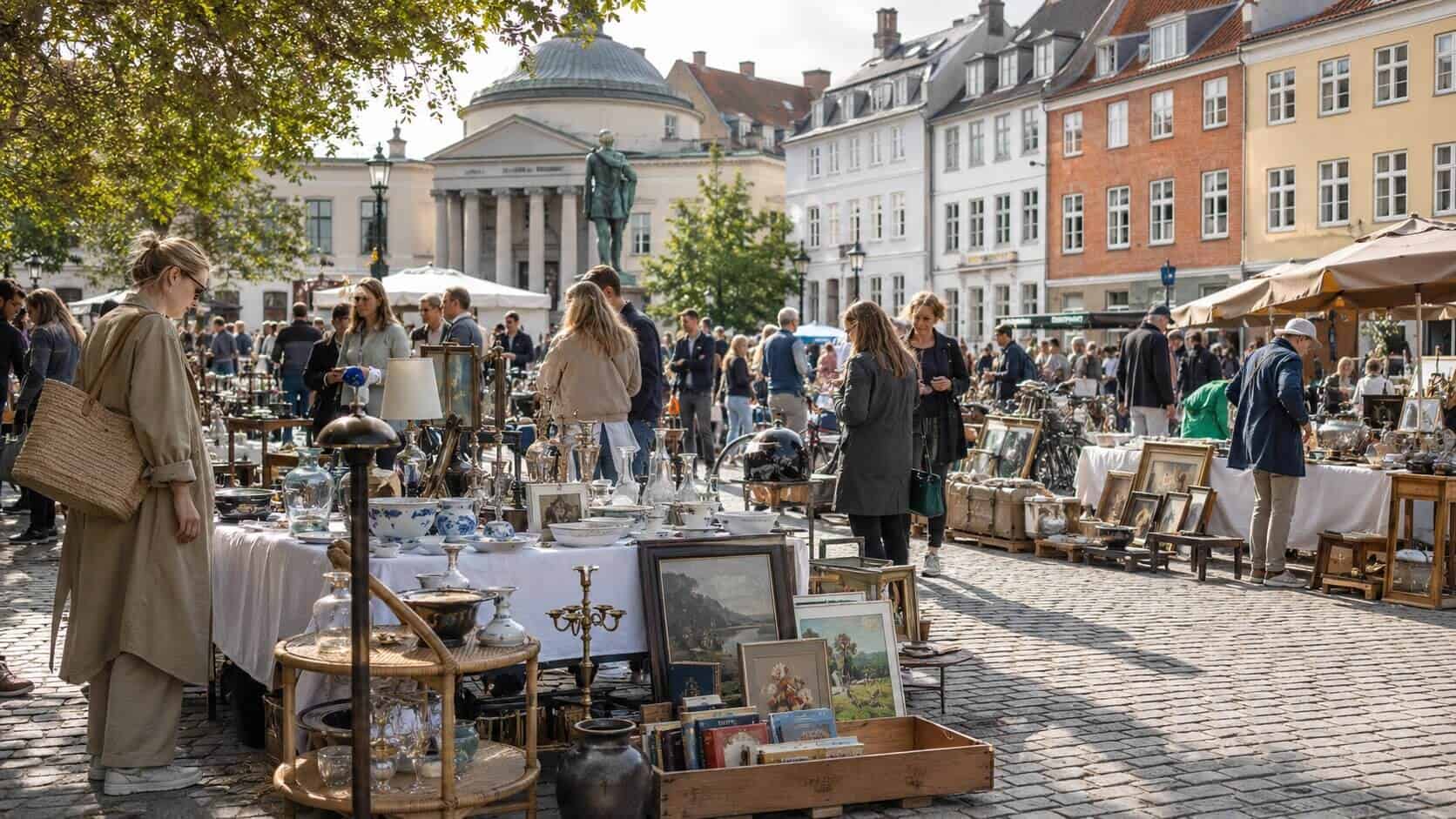

On a Friday morning at Thorvaldsen Plads, dealers lay out porcelain figures, silver candlesticks and framed oil paintings on fold-out tables in the shadow of Bertel Thorvaldsen’s neoclassical museum. It’s one of the quieter corners of central Copenhagen — until the collectors arrive. Flea markets in Copenhagen run roughly from late April through October, and the city has more of them, and more variety between them, than most visitors expect.
The range is genuine. At one end: a curated antique market with professionally sourced mid-century Danish design and Copenhagen porcelain. At the other: a neighbourhood street market in Nørrebro where old vinyl, vintage clothing and bric-a-brac spill out of cardboard boxes. In between, you’ll find covered indoor markets open year-round, quarterly street fairs in the Ravnsborggade antiques district, and a flea market attached to the old Carlsberg brewery.
One practical note before you start: arrive early. Copenhagen’s weekend markets draw regular crowds, and the better finds — Danish Mid-Century Modern pieces, Royal Copenhagen porcelain, quality silverware — tend to go fast. This guide runs through the best options, what each one is actually good for, and what to expect when you get there.
For a broader view of the Scandinavian second-hand scene, see our guide to spring flea markets across Europe. If you’re tracking down antique silver specifically, that guide covers identification and care.
What Copenhagen’s Flea Markets Are Actually Like
Copenhagen’s market scene divides into three distinct types, and knowing the difference saves wasted journeys.
Antique and collectibles markets — Thorvaldsen Plads and Den Blå Hal sit at this end of the spectrum. Stalls are curated, dealers are knowledgeable, and prices reflect that. These are the places to look for vintage Danish furniture, signed ceramics, mid-century lamps and quality jewellery. Bargains exist, but you’ll need to know what you’re looking at.
Neighbourhood street markets — Nørrebrogade, Ravnsborggade and Frederiksberg Loppetorv are more mixed. Prices are lower, the atmosphere is more informal, and the best finds often come from private sellers clearing out a flat rather than professional dealers. These markets reward patience and early arrival.
Occasional and seasonal events — Remisen and the Carlsberg-area Tap 1 market run on fixed but infrequent schedules. Missing their dates means waiting weeks or months. Check current schedules directly with each market before planning your trip around them.
Most outdoor markets run weekends from late April or early May through to October. Den Blå Hal is the main exception — it operates year-round on Saturdays and Sundays. If you’re visiting Copenhagen outside the summer season, that’s worth knowing.
One thing worth flagging: Denmark is almost entirely cashless, and that extends to most market stalls. A few private sellers at neighbourhood markets may still prefer cash, but don’t assume it. Check with individual vendors — and verify current payment practices at each market before you go, as this can change.
The Copenhagen flea markets directory on Fleamapket has individual listings with maps for most of the venues below. It’s a useful reference if you want to plan a route across multiple markets in a single weekend.
Thorvaldsen Plads, Ravnsborggade and Frederiksberg Loppetorv
These three are the backbone of Copenhagen’s outdoor market season — each one different enough that visiting all three on the same weekend makes sense.
Thorvaldsen Plads is the most polished of the three. Held on Fridays and Saturdays in the square in front of Thorvaldsens Museum on Slotsholmen island, it draws professional dealers with properly sourced stock. Expect Royal Copenhagen porcelain, silver flatware, oil paintings, brass candlesticks and the occasional signed piece of Danish furniture. Prices are honest rather than cheap — dealers here know what they have — but the quality is consistently high and the location, directly facing the canal, makes it a genuinely pleasant place to spend a morning. Arrive before 10am if you’re looking for anything specific.
Where: Thorvaldsen Plads 2, 1213 Copenhagen, Denmark
When: Every Friday and Saturday, 08:00 – 17:00 (end of April or early May until October)
Read: Full review of Thorvaldsen Plads antique market on Fleamapket
Website: antikmarked.com
Ravnsborggade in Nørrebro is a different proposition. The street itself is Copenhagen’s best-known antique strip — a run of permanent antique shops and second-hand dealers concentrated between Assistens Kirkegård and Blågårds Plads. On certain Sundays through the season, the street hosts a larger outdoor flea market that extends the regular shops out onto the pavement. It’s busier and more chaotic than Thorvaldsen, but that’s part of the appeal. Hunting through a box of old postcards or finding a mid-century Danish lamp for a fraction of its value at a design shop is exactly the kind of discovery Ravnsborggade still delivers. Verify the 2026 fair dates directly with the market or via the Fleamapket listings before planning your visit — the quarterly schedule tends to shift slightly year to year.
Where: Ravnsborggade, Norrebro, Denmark
When: four times a year on a Sunday
Read: Ravnsborggade antique shops and Ravnsborggade flea market on Fleamapket
Website: ravnsborggade.dk
Frederiksberg Loppetorv is the neighbourhood market of the three. Held in Frederiksberg — technically a separate municipality, though surrounded by Copenhagen on all sides — it has the feel of a community event rather than a curated fair. Private sellers mix with small dealers, and the stock is genuinely unpredictable in the best sense: vintage clothing, old toys, kitchenware, records, the odd piece of furniture. It draws a local crowd, which keeps prices reasonable. Check current dates and location before visiting, as details can vary between seasons.
Where: Frederiksberg Bredegade 13, 2000 Frederiksberg, Denmark
When: Every Saturday from early April to October (except on Copenhagen Pride Parade day)
Read: Read our full review of Frederiksberg Loppetorv on Fleamapket
Website: https://www.frederiksberg.dk/loppetorv
Remisen, Nørrebrogade and the Tap 1 Market at Carlsberg
These three are less central — geographically and in terms of how often they run — but each one is worth the effort if the timing works out.
Remisen is a flea market held at a former tram depot in Bispebjerg, and it has a following among Copenhagen collectors who like their markets a little rough around the edges. The industrial space adds atmosphere. The stock tends toward the eclectic: furniture, vintage clothing, records, tools, ceramics and the kind of miscellaneous household items that don’t fit anywhere else. It runs on a fixed but infrequent schedule — roughly monthly or less — so check current dates before making a trip specifically to get there. Missing it means waiting a while.
Where: Remisen Market, 132 Blegdamsvej, Copenhagen, Denmark
When: Saturdays and Sundays (10:00 to 16:00). Closed in July – September
Read: Review of Remisen flea market on Fleamapket
Website: kulturoesterbro.kk.dk
Nørrebrogade Flea Market is one of the more casual options in the city. Set along the long main artery of Nørrebro, it attracts a younger, mixed crowd and the stock reflects that: vintage clothes, vinyl, paperbacks, prints, small decorative objects and plenty of bric-a-brac. Don’t expect museum-quality antiques, but do expect good prices and a lively atmosphere. It suits browsers as much as dedicated collectors. Verify current operating days and frequency for 2026 — the schedule for this one is worth double-checking.
Where: Nørrebrogade 90, 2200 København, Danemark
When: Every Saturday, April – October
Read: Nørrebro flea market
Website: http://www.norrebro.dk/
Loppemarked i Tap 1 is held inside Tap 1, one of the repurposed buildings at the old Carlsberg brewery site in Valby. The setting alone makes it worth a visit — the Carlsberg grounds have been developed into a mixed cultural and residential district, and the buildings retain the scale and brick detailing of the original industrial complex. The market itself runs on a seasonal schedule and tends to attract design-conscious sellers alongside the usual flea market mix. It skews slightly younger and more fashion-forward than Thorvaldsen, with vintage clothing and mid-century objects both well represented. Confirm 2026 dates and any admission details with the venue directly before planning your visit.
Where: Tap1 Loppemarked, TAP1, Raffinaderivej 10, 2300 Copenhagen, Denmark
When: Four times a year, Saturday – Sunday
Read: More information on TAP1 Flea Market on Fleamapket
Website: http://www.tap1marked.dk/
Gentofte Loppemarked and Den Blå Hal: the Outer Reaches
Two more markets round out the Copenhagen picture — one suburban, one indoor — and both attract a noticeably different crowd from the city-centre circuit.
Gentofte Loppemarked runs in the leafy northern suburb of Gentofte, about twenty minutes from the city centre by S-tog. It has a neighbourhood-fair quality that the larger markets lack: local sellers, manageable crowds, and the kind of domestic clearout stock that sometimes throws up unexpected finds. Danish porcelain, glassware, old linens and small furniture turn up regularly. It’s not a destination market for serious collectors, but if you’re staying in Copenhagen for several days and want to cover the full range, it adds a different texture. Verify current 2026 dates and schedule directly — suburban markets like this one can shift their calendar from year to year.
Where: Bregnegårdsvej 2, 2920 Charlottenlund, Denmark
When: Every Sunday: 08:00 – 14:00 (from early April to early October)
Read: Full review of Gentofte Flea Market on Fleamapket
Website: gentofteloppemarked.dk
Den Blå Hal is a different proposition entirely. It operates as an indoor antiques and collectibles market, which means it runs regardless of the weather and outside the strict outdoor flea market season. The hall format gives it a more permanent, dealer-driven feel: stalls are consistent, stock is curated, and the quality tends to be higher than at the casual street markets. It’s one of the better places in Copenhagen to look seriously for mid-century Danish design, vintage jewellery, quality ceramics and decorative silver.
Den Blå Hal appears to have closed at its original Amager location — it is currently listed as discontinued on several market directories. A venue using the same name has been active as recently as October 2025 at a new address in Kastrup (Tømmerupvej 64), around 40 minutes from central Copenhagen by metro, but its current operating status, schedule and format have not been independently verified. If you were planning a visit specifically for Den Blå Hal’s former offer of curated indoor antiques, the Frederiksberg Loppetorv on a Saturday morning, or the specialist antique shops around the Ravnsborggade area of Nørrebro, are more reliably confirmed alternatives. Check the market’s Facebook page directly before making any plans.
Where: Tømmerupvej 64, 2770 Tårnby, Denmark
When: Every Saturday and Sunday: 10:00 – 16:00
Read: Full review of Den Blå Hal Antiques Market on Fleamapket
Website: instagram.com/denblaahal/
Practical Tips for Flea Market Shopping in Copenhagen
A few things are worth knowing before you commit to a morning.
Arrive early. At the better antique markets — Thorvaldsen and Den Blå Hal especially — the serious collectors are there within the first hour. Mid-century Danish furniture, Royal Copenhagen pieces and quality silverware move quickly. Arriving at midday is fine for browsing, but you’ll be picking through what’s left.
Bring cash. Many individual sellers at Copenhagen flea markets accept MobilePay (the Danish mobile payment standard), but not all. Card terminals are common at established dealers. Smaller sellers and casual stalls are more likely to want cash. Having a mix is sensible.
Know your Danish design basics. Copenhagen’s markets are particularly strong on mid-century Danish Modern: furniture by known and unknown makers, ceramics from Bing & Grøndahl and Royal Copenhagen, glassware, silver and lighting. A little background knowledge pays off. Pieces that look unmarked sometimes carry maker’s stamps on the base or underside — worth checking before you walk away.
The outdoor season runs roughly April to October. Most of the street and courtyard markets close or go dormant through winter. Den Blå Hal is the main indoor exception. If you’re visiting between November and March, narrow your list accordingly and verify what’s actually running.
Use the Ravnsborggade antique shops as a baseline. The stretch of antique shops along Ravnsborggade in Nørrebro gives you a useful reference point for prices and quality before you head to the markets. Browsing the shops first sharpens your eye for what’s worth picking up — and what’s overpriced — once you’re at a stall.
Book Your Stay in Copenhagen
Copenhagen’s flea markets and antique dealers spread across several neighbourhoods — Nørrebro, Frederiksberg, Valby and the city centre all have something worth visiting. Staying centrally puts you within reach of most of them by bike or metro. The weekend markets tend to run Saturday mornings, so Friday-night arrival gives you a clean run at the early crowd.
Flea Markets in Copenhagen: Your Questions Answered
When is flea market season in Copenhagen?
The outdoor flea market season in Copenhagen runs roughly from late April through October. Most street and courtyard markets close for winter. Den Blå Hal is the main exception, operating as an indoor antiques market through the colder months. Verify current 2026 schedules with individual markets before planning your trip.
What can I expect to find at Copenhagen flea markets?
The range is wide. At the curated end — Thorvaldsen Plads and Den Blå Hal — you’ll find mid-century Danish Modern furniture, Royal Copenhagen and Bing & Grøndahl ceramics, vintage silver, glassware and jewellery. At the more casual markets like Nørrebrogade and Remisen, expect vintage clothing, vinyl records, paperbacks, prints and general bric-a-brac. The Tap 1 market at Carlsberg skews younger, with a stronger fashion and design-conscious element.
Which Copenhagen flea market is best for antiques?
For serious antique hunting, Thorvaldsen Plads and Den Blå Hal are the strongest options. Thorvaldsen draws professional dealers with properly sourced stock — quality silverware, Royal Copenhagen porcelain, oil paintings and signed Danish furniture — in a genuinely atmospheric setting. Den Blå Hal operates year-round indoors, with consistent stalls and a high proportion of curated mid-century Danish design and decorative objects. Both reward early arrival. The Ravnsborggade antique shops are worth including on the same trip — browsing the permanent dealers gives you a useful price and quality reference before you head to the market stalls.
Do Copenhagen flea markets accept card payments?
Established dealers at the larger markets generally accept card or MobilePay, Denmark’s widely used mobile payment system. Smaller sellers and casual stalls at neighbourhood markets like Nørrebrogade and Frederiksberg Loppetorv are more likely to prefer cash. Carrying a mix is the safest approach. Payment practices can vary and change — check with individual vendors on the day.