

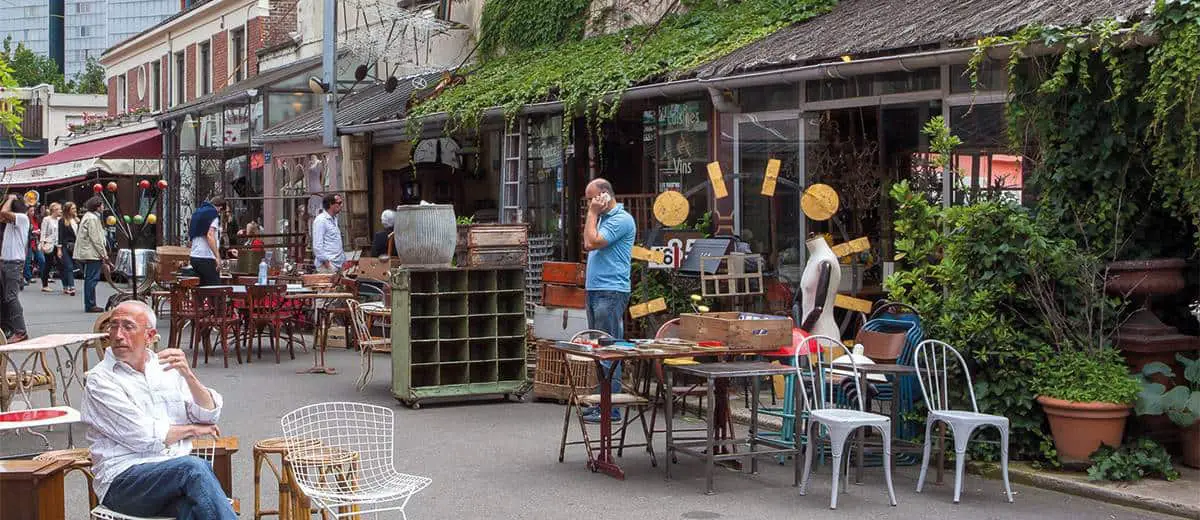

On a Saturday morning, the Rue des Rosiers fills up early. Dealers are still arranging stock when the first visitors arrive — a mix of decorators with measuring tape in their coat pockets, tourists without a plan, and regulars who know exactly which stall opens last but has the best prices. This is the Puces de Saint-Ouen, the largest concentration of antique dealers anywhere in the world, and it operates on its own unhurried logic.
Spread across the northern edge of Paris, just beyond the périphérique in the commune of Saint-Ouen, the Puces is not one market but thirteen. Each has its own entrance, its own character and, broadly, its own speciality — from the formal galleries of Marché Serpette to the joyful density of Marché Vernaison, which has been trading since 1920. The site contains more than 2,000 dealers in total.
This guide covers every sub-market, what each one specialises in, how to get there, and what to prioritise if your time is limited. Practical visitor information is in the block below — check it before you go, since hours and access can change.
Already familiar with the Puces? The Best Flea Markets in Paris guide covers the full picture across the city, including Vanves and the other major sites.
Puces de Saint-Ouen — Visitor Information
📍 Address: Rue des Rosiers, Saint-Ouen, 93400 (just north of the Paris périphérique)
📅 When: Saturday, Sunday and Monday. Most sub-markets open around 09:00–10:00 and close around 17:00–18:00. Hours vary by market — check individual market pages before visiting. The Puces is closed Tuesday to Friday.
🚇 Transport: Métro Line 4 to Porte de Clignancourt; exit and head north on Avenue de la Porte de Clignancourt. The main entrance is a 5–10 minute walk from the station.
💡 Tips: Arrive Saturday morning if you want the best selection. Mondays are quieter, with some stalls closed. Wear comfortable shoes — the site is large and the ground uneven in places. Map of the Puces de Paris Saint Ouen
Opening hours, market access and trader schedules can change without notice. Verify current details at pucesdeparissaintouen.com before your visit.
The thirteen markets of the Puces de Saint-Ouen
What each market does best
Walking the Puces without a loose sense of what each market specialises in is a reasonable strategy — serendipity is part of the experience. But it helps to know where to spend serious time if you’re looking for something specific.
Marché Vernaison is the oldest and arguably the most atmospheric. The covered alleys are narrow and slightly labyrinthine, with dealers selling everything from vintage jewellery and old postcards to painted furniture and African textiles. It rewards slow walking. If you have a single morning, start here.
Marché Serpette is where the decorators come. The style leans toward 20th-century French design — clean lines, good upholstery, the occasional signed piece. The dealers are knowledgeable and prices reflect it. This is not a bargain-hunting floor; it’s closer to a gallery environment with movable stock.
Marché Paul Bert covers similar mid-century territory but with a wider spread — Art Deco alongside industrial pieces, garden furniture, architectural salvage and decorative objects from across Europe. The outdoor section in particular has a relaxed rhythm. Prices vary considerably from stall to stall, and negotiation is expected rather than exceptional.
Marché Dauphine is the one serious book and print collectors should not skip. Two covered floors hold dealers in vintage posters, photography, maps, comics, vinyl and antique books. It’s quieter than the street-facing markets and easy to lose an hour in without noticing.
Marché Biron is the most formal. High-end furniture, chandeliers, sculpture — the kind of stock that arrives in a van with proper provenance. The dealers here are typically trade-focused, though individual buyers are welcome. Worth walking through even if you’re not buying.
Marché Malik breaks the antiques pattern entirely. It began, according to the Puces’s own history, as a market for secondhand clothing, and that identity has never quite left. Today it leans toward vintage fashion, streetwear and accessories — a different crowd, a different energy, and genuinely useful if you’re shopping for wearables rather than objects.
The remaining markets — Marché Jules Vallès, Marché Antica, Marché L’Usine, Marché Cambo, Marché Entrepôt, Marché Malassis, Marché le Passage and Marché des Rosiers — range from general bric-à-brac and furniture clearance to more specialist trade floors. The composition of sub-markets at Saint-Ouen can change over time. Some are more trade-oriented mid-week; on Saturdays and Sundays they’re open to all.
A practical note: the markets closest to the Porte de Clignancourt metro exit — the stalls along Avenue Michelet — are largely tourist-facing and sell new goods, imitation designer items and fast fashion. This is not the Puces proper. Keep walking north on Rue des Rosiers and you’ll reach the real thing within a few minutes.
How to visit — timing, navigation and negotiation
Saturday is the busiest day by a significant margin. Serious dealers are all present, the atmosphere is at its most alive, and the stock on the best stalls hasn’t been picked through yet — but you’ll be sharing the Rue des Rosiers with a lot of people by mid-morning. Sunday is slightly quieter and still worth the trip. Monday is the local’s day: fewer tourists, some stalls closed, but the dealers who do open tend to be more relaxed and occasionally more willing to talk price.
Arrive early. The Puces officially opens around 09:00 at most markets, and the hour between opening and 10:30 is genuinely different — cooler, less crowded, and the dealers are still setting up, which occasionally means a piece you might have missed later is sitting in plain view on a trolley. By early afternoon on a Saturday, the central alleys of Vernaison and the outdoor section of Paul Bert are busy enough to make careful browsing difficult.
Navigation is easier than the site’s scale suggests. The thirteen markets cluster along and just off the Rue des Rosiers. A free map of the Puces de Paris Saint Ouen is available at the entrance and from some dealers — it’s worth picking one up on arrival. The covered markets (Serpette, Dauphine, Biron, Malassis) have their own indoor directories. Don’t rely on GPS for individual stalls; the alleys inside Vernaison in particular don’t map cleanly.
On the question of negotiation: it is standard practice here, not a social risk. Dealers at the Puces expect it, and most have built a margin into their first price. A calm, direct offer — typically 10–20% below the asking price — is a reasonable opening. Haggling aggressively on a clearly priced piece in a formal gallery like Biron or Serpette will not land well. Reading the context matters. On a general stall or in Jules Vallès, the conversation is usually easier.
Cash remains widely used across the Puces. Some dealers now take card payments, but cash is still commonly preferred for smaller purchases and negotiations. Bring euros in smaller denominations; dealers are not always willing to break large notes early in the morning.
Bring measurements if you’re shopping for furniture. The piece that looks right in the alley of Paul Bert sometimes becomes a problem at a Parisian doorway or a stairwell. Dealers are used to the question and won’t take it as a slight — but they’ve also seen buyers skip measuring and regret it later.
Shipping and export can be arranged through several specialist carriers who work regularly with Puces dealers. You can verify current recommended shipping services with official Puces sources or dealers directly — however this is not something to arrange on the day for anything valuable.
How the Puces de Saint-Ouen came to be
The Puces didn’t begin as a market for antiques. It began as a market for everything nobody else wanted.
In the second half of the nineteenth century, the ragpickers — chiffonniers — who had long worked the streets of Paris were pushed gradually outward as Haussmann’s renovations reshaped the city. They settled beyond the old city gates, including around the Porte de Clignancourt, and began trading the objects they collected among themselves and then to anyone who would buy.
What started as improvised trade on open ground slowly formalised. By the early twentieth century, dealers were paying to reserve pitches. Marché Vernaison — still one of the most atmospheric of the thirteen markets — was among the first to be properly established, with trading recorded from 1920. The other covered markets followed across the following decades, each reflecting the tastes and collecting culture of its era.
The name marché aux puces — flea market — is itself a period term, referring not to the goods but to the condition in which some of them arrived: second-hand furniture and clothing that may have carried fleas. The phrase stuck, moved into everyday French, and eventually into most European languages. The Puces de Saint-Ouen didn’t invent the flea market as a concept, but it gave the form its most enduring address.
Through the mid-twentieth century, the site’s reputation shifted. Decorators and designers began arriving seriously — among them, reportedly, Coco Chanel and later a generation of American and European buyers who used the Puces as a sourcing circuit for furniture, lighting and objects that were genuinely hard to find elsewhere. The formal gallery markets — Serpette, Biron — reflect that period’s appetite for authenticated pieces and higher-end trade.
Today the site is one of the oldest continuously operating markets of its kind in the world. It has absorbed fashion cycles, economic slumps, the internet’s effect on antique pricing, and a sustained rise in global tourism — and it has remained, through all of it, a working market rather than a heritage attraction. Dealers still open Monday morning on the quieter end of the Rue des Rosiers and price things the way they want to price them. That has not changed.
What to look for — and where to find it
The Puces de Saint-Ouen covers enough ground that arriving without a loose sense of what you’re after is a reasonable way to spend three hours and come home with nothing. Not because the stock is thin — it isn’t — but because the sheer volume of it rewards a little preparation.
If mid-century French furniture is the goal, the covered gallery markets are the most concentrated source. Marché Serpette and Marché Paul Bert both carry strong stocks of post-war design — tubular chairs, lacquered sideboards, designer lighting from the 1950s through the 1970s. Pieces are authenticated, often restored, and priced accordingly. This is also where you’ll find the dealers most accustomed to international buyers: English is spoken, shipping can usually be arranged, and most accept card payment.
For decorative objects rather than furniture — ceramics, glassware, silverware, curiosities — Marché Biron tends to have the most formally presented stock, arranged in proper gallery-style cases rather than open shelving. It suits browsers who want to look carefully rather than dig. Marché Dauphine has broader range: textiles, vintage maps, scientific instruments, books, posters and ephemera sit alongside furniture and art, making it probably the most unpredictable of the enclosed markets in the best sense.
Marché Vernaison is the place for smaller items and the kind of hunting that actually feels like hunting. The alleys run in several directions and not all of them are immediately obvious from the entrance. Stalls here sell vintage jewellery, old photographs, decorative hardware, small paintings and the category that professionals call smalls — portable objects that fit in a bag and are easy to carry home. It’s the least formal atmosphere of the thirteen markets and, for many visitors, the most enjoyable one to spend time in.
Textile buyers should note Marché Malik specifically — it has historically been associated with vintage clothing, and while the mix at street-level has shifted toward new stock and commercial fashion in parts, the upper sections and surrounding alleys still yield vintage finds. The current stock composition at Malik varies and shifts over time — however the vintage clothing offer remains a meaningful part of the market.
The outdoor sections — particularly around the Marché Paul Bert external stalls and the Marché Jules Vallès area — tend to carry lower price points and less curated stock. For buyers who are comfortable assessing condition themselves, this is where the better deals still exist. Arrive early on Saturday; by Sunday afternoon, the best of the open-air stalls has usually moved on.
A practical note on price: the Puces is not a cheap market. It is an antiques market, and a well-established one with an international clientele. Negotiation is normal — most dealers expect it — but aggressive bargaining on clearly labelled gallery pieces rarely ends well. The outdoor stalls are more flexible. And if a price seems genuinely too high, the same object, or one very like it, is often available two alleys over.
Getting there — and planning your day around it
The simplest route from central Paris is Métro Line 4 to Porte de Clignancourt, the last stop on that branch. From the exit, head north along Avenue de la Porte de Clignancourt — the market is about a five-to-ten minute walk, and the direction is obvious once the street starts to fill.
The walk from the station takes you through a busy strip of street stalls selling new clothing and household goods. This is not the Puces — it’s the informal market that has grown up around the entrance over decades. Keep walking north, past the périphérique, and the character of the street changes. Rue des Rosiers is the spine of the site, and most of the thirteen market entrances open off it or are within a short walk of it.
By car, Saint-Ouen is accessible from the périphérique at Porte de Clignancourt. Street parking in the immediate area is limited and contested on busy mornings — arrive early or expect to search.
Saturday morning is the best single session if you have only one day. The market opens around 09:00 at most sub-markets, and the first two hours tend to have fuller stalls and quieter aisles — serious dealers, restorers and decorators arrive first, but there is still plenty of stock before the weekend crowds build. By early afternoon on Saturdays, the main alleys in Vernaison and Paul Bert can feel congested.
Sunday is slightly more relaxed in atmosphere, though the outdoor stalls have already turned over some of their best stock from the day before. Monday is quieter still and works well for focused gallery browsing in the enclosed markets — Biron, Serpette and Dauphine are often less pressured midweek than at the weekend peak. Not all sub-markets operate on all three days: check the individual market pages for confirmed hours before planning a specific visit around a particular section.
Allow at least three hours for a first visit; four to five is more realistic if you plan to cover more than two or three sub-markets seriously. The enclosed galleries have cafés and informal lunch spots — Paul Bert has a well-regarded restaurant inside the market itself, and several places along Rue des Rosiers are worth stopping at between markets.
One practical point worth settling before you go: most of the gallery dealers in the enclosed markets accept card payment, but the outdoor stalls and some of the smaller operators in Vernaison and Jules Vallès work in cash only. Bring enough for both.
What to buy — and what to know before you negotiate
The Puces rewards people who arrive knowing roughly what they are looking for — not because browsing is unwelcome, but because the scale can be disorienting without some orientation. Thirteen markets, more than two thousand dealers, several kilometres of covered and open-air alleys: without a loose plan, it is easy to spend two hours in one corner and miss an entire section that would have suited you better.
For furniture, the serious stock is concentrated in the enclosed gallery markets. Marché Biron has long been associated with high-quality period pieces — dining tables, armoires, mirrors — sold by dealers who know their inventory well and price accordingly. Marché Serpette and Marché Paul Bert both carry strong twentieth-century material, particularly Art Deco and mid-century design. Paul Bert, specifically, has a reputation for a broader range — from industrial pieces and vintage lighting to more refined decorative objects — and the outdoor sections tend to offer lower entry prices than the enclosed galleries.
For smaller objects — vintage clothing, records, posters, books, costume jewellery, bric-à-brac — Marché Vernaison is the right starting point. It is the oldest and most densely packed of the thirteen, and the narrow alleys between its hundred-plus stalls have a genuinely exploratory quality. Marché Jules Vallès is similar in character, with a higher proportion of lower-cost vintage goods and a more relaxed browsing atmosphere.
Marché Malik has historically specialised in second-hand clothing and streetwear, giving it a notably different feel from the antique-led markets nearby.
On negotiating: it is expected, but not a sport. The dealers here are professionals, not reluctant sellers, and a reasonable opening offer lands better than an aggressive one. Asking whether there is flexibility on price — est-ce que vous pouvez faire un geste? — is polite and usually met with a straight answer. Buying more than one piece from a single dealer almost always creates room for a small reduction. Haggling on a gallery dealer’s asking price by fifty percent rarely goes well.
One practical consideration for international buyers: France has export regulations covering certain categories of cultural property above defined age and value thresholds. If you are buying something significant — a painting, an important piece of furniture, anything that might qualify as a national treasure — ask the dealer about documentation before the purchase, not after.
For most visitors, though, the question is simpler: is this the right piece, at a price that feels fair, from a dealer who can tell you something about it? The best purchases at the Puces tend to come from dealers who can answer that last part — provenance, period, origin — without hesitation.
Eating, drinking and making the most of a full day
The Puces is not a morning-and-done destination. Most serious visitors spend four to five hours here, and the layout rewards a rhythm of browsing, stopping, doubling back. Building lunch or a coffee break into your plan isn’t an afterthought — it’s part of how the market works.
The Rue des Rosiers itself has several café terraces that fill up by midday on a Saturday. These are useful for a quick pause and a coffee, and for watching the foot traffic — a lot of what the Puces is, socially, becomes legible from a terrace chair.
For a longer lunch, the options inside and immediately around the market have improved considerably in recent years. Ma Cocotte, a restaurant inside the Marché Paul Bert designed by Philippe Starck, has attracted visitors who might not otherwise have stayed for a meal. Le Paul Bert, nearby, is more straightforwardly a neighbourhood bistro and tends to be popular with dealers as well as visitors — which is usually a reliable indicator.
A few things are worth knowing before you commit to a full day. Cash is still widely used by smaller dealers and outdoor-stall vendors, though many enclosed gallery dealers now accept card. It’s worth having both. There is no official cloakroom or luggage storage at the Puces itself — if you’re arriving directly with luggage from elsewhere in Paris, plan accordingly. However, several operators have opened storage points near major Paris transport hubs in recent years.
Sundays draw the biggest crowds, and the atmosphere is noticeably more festive — street musicians, more foot traffic from Paris, a slightly higher proportion of tourists relative to trade buyers. Saturday mornings, especially early, tend to attract more dealers and decorators. Monday is quieter and some stalls don’t open at all; it suits return visitors who know what they came back for.
If you’re travelling with someone who has limited enthusiasm for antiques, the surrounding streets of Saint-Ouen have their own texture — the town is not merely a threshold you cross to reach the market. The weekly rhythm of a working-class northern Paris suburb persists alongside the dealers and the visitors, and it’s one of the things that keeps the Puces feeling like a real place rather than a curated experience.
The galleries and the stalls — two very different experiences
First-time visitors often arrive expecting one kind of place and find two. The enclosed gallery markets — Serpette, Dauphine, Biron, Paul Bert‘s interior sections — feel calm, well-lit and curated. Dealers here tend to work regular hours, price their stock clearly and are accustomed to dealing with both trade professionals and individual collectors. The experience is closer to visiting a series of specialist antique shops than to rummaging through a flea market in any conventional sense.

The outdoor sections are something else. Around the edges of the main site, and particularly in the areas closest to the périphérique, the atmosphere shifts. Stock is more mixed, prices less fixed, and the process of finding something genuinely good requires patience rather than a map. This is where the flea market logic — the hunt, the uncertainty, the occasional extraordinary find at an ordinary price — still operates most directly.
Marché Jules Vallès, near the main entrance, sits roughly at the midpoint between the two registers. It tends to stock a broader range of objects than the specialist galleries: household items, small furniture, prints, tools, mid-century odds and ends. It’s a useful first stop for visitors who want to get oriented before committing to the more focused galleries further in.
The distinction matters practically. If you’re sourcing for a specific project — a decorator looking for a pair of matching wall sconces, or a collector tracking down a particular maker — the galleries are where to spend most of your time. The dealers there know their stock in depth and can often tell you more about provenance than you might expect. If you’re open to whatever turns up, or you’re visiting for the first time and want to feel the full range of what the Puces actually is, build time for both ends of the spectrum.
One practical point: the covered markets and the outdoor areas don’t always follow the same hours. Some outdoor vendors pack up earlier in the afternoon, and on Mondays the attrition is more pronounced — stalls that were full on Saturday may not open at all. If a particular outdoor section is your reason for visiting, Saturday morning is the safer choice.
What the Puces is not — and why that matters
The area between the Porte de Clignancourt Métro exit and the Rue des Rosiers is not the Puces. It’s worth saying plainly, because it catches a lot of first-time visitors off guard. The stretch of stalls along Avenue de la Porte de Clignancourt and the surrounding streets sells new and near-new goods — clothing, sportswear, bags, accessories — aimed primarily at the local neighbourhood rather than at antique hunters. None of that is the flea market proper.
Walk through it, keep heading north, and the character of the streets changes. Once you reach the Rue des Rosiers, you’re in the right place.
This distinction matters for another reason too. The Puces de Saint-Ouen has a reputation — earned over a century of trading — as one of the great places in the world to find serious antiques. That reputation is real, but the site has always contained multitudes. Alongside the specialist galleries where a single item can carry a five-figure price tag, there are dealers selling affordable mid-century furniture, stalls with boxes of old postcards for a few euros each, and vendors whose stock shifts from week to week in ways that have nothing to do with art market trends. The Puces is not a luxury shopping destination with a flea market aesthetic. It is a genuine mixed market where extraordinary things coexist with the ordinary, and where the range is genuinely part of the point.
What the Puces is also not, to a degree that surprises some visitors, is cheap by default. The galleries are professional operations and price accordingly. Even the more informal sections reflect the fact that dealers here are experienced — they know what they have, and they know that some percentage of visitors arriving at the Puces are trade buyers with serious budgets. A beautiful object at a genuinely low price does still surface, but it surfaces less often than the romantic image of the flea market suggests. The hunt is real; the guarantee is not.
None of this is a criticism. It’s more useful to arrive with an accurate picture of the place than to spend the first hour recalibrating expectations. The Puces rewards visitors who come prepared — with a rough sense of which sub-markets match their interests, a willingness to talk to dealers, and enough time to move slowly. That’s a different kind of visit from a Saturday morning browse through a neighbourhood brocante, and it tends to produce better results when treated as such.
Before you go — a few things that will make the visit easier
Wear shoes you’re comfortable standing and walking in for several hours. That sounds obvious until you’ve spent forty minutes crouching over a box of ceramics on a cobbled passageway in Vernaison and still have six more markets to cross.
Bring cash. Most dealers in the informal sections of the Puces prefer it, and some of the smaller stalls don’t take cards at all. The gallery operators in Serpette or L’Art Deco tend to be better equipped for card payments, but it’s not guaranteed. Having cash in hand also helps in any negotiation — a concrete offer lands differently than a theoretical one.
A tape measure is genuinely useful if you’re looking at furniture. So is a torch on your phone — some of the Vernaison alleys are dim, and markings, signatures and condition details are worth inspecting properly before you commit.
Arrive with a loose plan rather than a rigid one. If you have a specific interest — Art Deco lighting, 1950s French posters, studio ceramics — identify two or three sub-markets most likely to carry it and start there. Then let the morning take over. Some of the best finds at the Puces come from the dealer you weren’t expecting, in the market you almost skipped.
Saturdays draw the largest crowds, particularly from late morning. If you’re there to buy seriously rather than to browse, Sunday morning is often quieter, and some dealers say Monday — when the site is open but the tourist numbers drop — is when the more focused conversations happen. Early arrival on any day is worth it: by midday in peak season, the main alleys of Paul Bert and Serpette can feel genuinely crowded.
On the question of negotiation: it’s normal, expected and not considered rude. A polite opening offer of ten to fifteen percent below the asking price is a reasonable starting point in most informal sections. In the gallery markets, dealers are less likely to move significantly on price unless you’re buying multiple pieces. Reading the room matters more than following a rule.
Finally, don’t assume that everything interesting is on display. Some dealers keep stock in the back, particularly for regular clients. If you’re looking for something specific, it’s worth asking. A brief conversation about what you’re after can open up a visit considerably — and dealers who specialise tend to know exactly who nearby carries what they don’t.
Puces de Saint-Ouen — frequently asked questions
Which métro stop is closest to the Puces de Saint-Ouen?
Métro Line 4, Porte de Clignancourt. Exit the station and walk north on Avenue de la Porte de Clignancourt — the main entrance to the Puces is roughly five to ten minutes on foot.
When is the Puces de Saint-Ouen open?
Saturday, Sunday and Monday. Most sub-markets open between 09:00 and 10:00 and close between 17:00 and 18:00, though hours vary by market. The site is closed Tuesday through Friday. Hours for specific sub-markets can differ and may change.
What is the best day to visit?
Saturday is the busiest — expect the largest crowds, particularly from late morning. Sunday is generally quieter. Monday draws fewer tourists altogether, which can make for more unhurried browsing and easier conversations with dealers, though not all stalls open. If you’re visiting primarily to buy, Sunday morning or Monday tends to work better than a busy Saturday afternoon.
How many markets make up the Puces de Saint-Ouen?
Thirteen sub-markets in total, each with its own entrance, character and rough speciality. They range from the formal gallery spaces of Marché Serpette and L’Art Deco to the densely packed alleys of Marché Vernaison, which has been trading since 1920.
Do I need cash, or do dealers accept cards?
Cash is still preferred in many parts of the Puces, particularly in the smaller stalls and the more informal sections. Gallery-style operators in Serpette and similar markets are generally better equipped for card payments, but it isn’t universal. Bringing cash avoids problems — and a concrete offer in hand tends to carry more weight in any negotiation.
Is it acceptable to negotiate on price?
Yes — and dealers expect it. In the informal stall sections, a polite opening offer of ten to fifteen percent below the asking price is a reasonable place to start. In the gallery markets, there’s less flexibility unless you’re buying several pieces. The key is to keep it brief and courteous; hard bargaining over small sums tends to go down poorly.
Is the Puces de Saint-Ouen worth visiting if I’m not a serious collector?
Comfortably, yes. Plenty of visitors come to look rather than to buy — the scale and variety of what’s on display is its own attraction, and the atmosphere on a weekend morning is unlike anywhere else in Paris. If you’re interested in design, fashion history, French domestic objects or simply in watching how an extraordinary market operates, that’s reason enough.
Are there places to eat at the Puces?
Yes. The Rue des Rosiers has several café-restaurants that have become part of the Puces experience in their own right — some with long histories at the market. For a proper sit-down lunch, it’s worth arriving before the midday rush on Saturdays.
Book your stay in Paris
The Puces de Saint-Ouen opens on Saturdays, Sundays and Mondays — which makes a weekend stay the obvious choice. A base in the 18th arrondissement puts you closest to Porte de Clignancourt, though anywhere on Métro Line 4 works well. If you’re planning a full day at the market, arriving on Friday evening and leaving Monday gives you time to come back a second morning without rushing.
Use the map below to find accommodation near the Puces.
If this guide has been useful, the Best Flea Markets in Paris covers the full picture across the city — including Vanves on a Sunday morning, the Marché d’Aligre, and a handful of smaller sites worth knowing about. For the wider French circuit, the 20 Best Flea Markets in France is a good next step.