

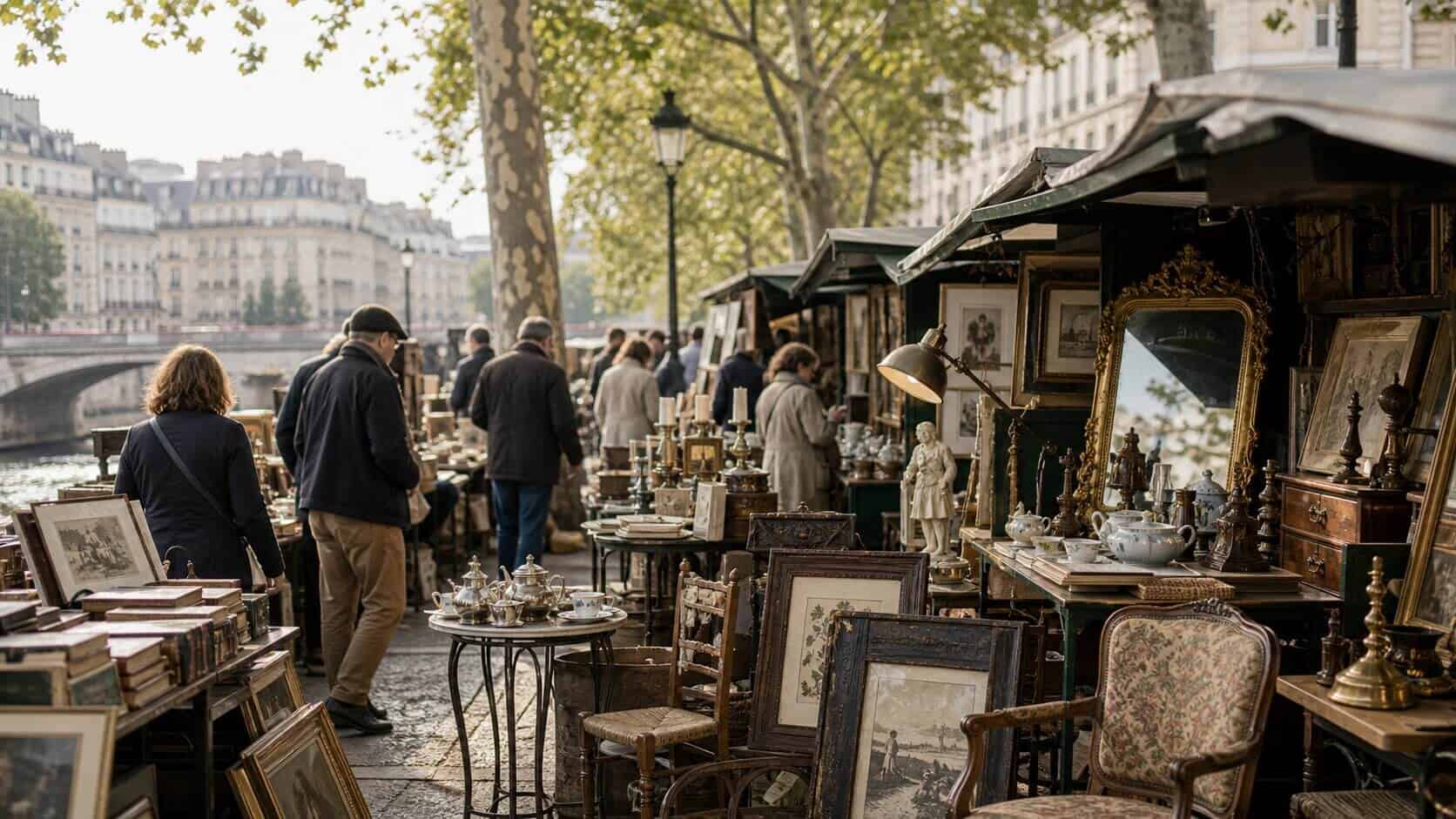

On Saturday mornings at the Puces de Vanves, the stalls are already packed by half past seven. Dealers from Brittany and the Loire set out Art Déco mirrors and interwar silverware before most of Paris has poured its first coffee. That particular urgency — the sense that the best things go early — runs through every Paris flea market on this list.
Known locally as puces or brocantes, Parisian flea markets trace their roots to the city’s edges — the gates and ring roads where second-hand traders set up beyond the city walls. Four of the five markets below still sit on or near the Boulevard Périphérique. The fifth, the Bouquinistes, lines the Seine in the centre of the city and has been doing so since the 16th century.
Here is a practical rundown of all five: what each market does well, who it’s for, and what you need to know before you go.
Puces de Saint-Ouen (Clignancourt) — Porte de Clignancourt
The Puces de Saint-Ouen is the largest and oldest flea market in Paris — and by some margin the most disorienting on a first visit. It spreads across more than 70,000 square metres in 12 distinct sub-markets, straddling the 18th arrondissement and the suburb of Saint-Ouen. The scale is closer to a neighbourhood than a market. Wander without a plan and you’ll spend an hour in the tourist-souvenir fringe before finding the serious dealers inside.
The shortcut is Rue des Rosiers, which runs through the heart of the complex and is where most of the major antiques galleries and specialist dealers are concentrated. The range is genuinely extraordinary: Baroque furniture, Art Nouveau objects, antique mirrors, tapestries, religious sculptures, weaponry spanning several centuries, vintage clothing, old photographs, vinyl records, second-hand books. Saint-Ouen is also the one Paris flea market where credit cards are widely accepted, which matters if you’re serious about buying. Most of the better dealers here are professionals — prices reflect that, but so does the quality and provenance of the stock.
📍 How to get there: Métro Porte de Clignancourt (line 4)
📅 Days: Friday, Saturday, Sunday, Monday
🕐 Hours: Friday 08:00–12:00 | Saturday 09:00–18:00 | Sunday 10:00–18:00 | Monday 11:00–17:00
🌐 Website: marcheauxpuces-saintouen.com
Puces de la Porte de Vanves — Porte de Vanves
Vanves is the antidote to Saint-Ouen’s scale. It runs along two short streets — Avenue Georges Lafenestre and Avenue Marc Sangnier — in the 14th arrondissement, close to the southern Périphérique, and the whole thing is walkable in under an hour. That compactness is part of the appeal. You’re not navigating a dozen sub-markets or trying to decipher a map; you’re moving steadily past a long succession of outdoor stalls, most of them laid out on trestle tables or directly on the pavement.
The stock skews toward smaller, portable objects — precisely the kind of things you can actually carry home. Vintage jewellery, enamelware, old postcards, silverplate cutlery, interwar ceramics, leather-bound books, pressed-glass decanters, military badges, posters, lace. Serious collectors come early — dealers from the provinces arrive before dawn — and the best pieces rarely survive past mid-morning. If you’re browsing for atmosphere rather than hunting specific items, later is fine; the market tends to thin out by early afternoon. Vanves attracts a local clientele alongside tourists, which keeps the energy less self-conscious than some of the more polished indoor galleries at Saint-Ouen.
Cash is essential here — most vendors don’t take cards, and there’s no ATM inside the market itself, so come prepared. For more Paris vintage and antiques options in the southern arrondissements, the Fleamapket directory lists additional brocantes and one-off vide-greniers in the area.
📍 How to get there: Métro Porte de Vanves (line 13)
📅 Days: Saturday and Sunday
🕐 Hours: 07:00–13:00
🌐 Website: pucesdevanves.fr
Puces de Montreuil — Porte de Montreuil
Montreuil is the roughest-edged of Paris’s major flea markets, and deliberately so. Where Saint-Ouen has polished galleries and Vanves runs on charm, Montreuil operates on volume and unpredictability. It sprawls across an open-air site near the eastern Périphérique in the 20th arrondissement, drawing a mix of professional dealers, casual sellers clearing out flats, and traders who defy easy categorisation. The stock reflects that variety: tools, industrial hardware, second-hand clothing in loose piles, old electronics, African and North African goods, kitchenware, furniture fragments, and — if you work through the stalls methodically — genuinely interesting vintage pieces buried among the noise.
That buried-treasure quality is both the draw and the cost of entry. Montreuil rewards patience and a tolerance for disorder in a way the other Paris puces don’t quite ask of you. Seasoned collectors treat it as the high-risk, high-reward option: the prices are generally lower than at Saint-Ouen, and the sellers are less likely to have researched everything they’re offering. Showing up with an eye for mid-century design or vintage workwear, and the willingness to sort through unpromising-looking boxes, is the right approach. Cash is standard practice throughout.
The market is also one of the few in Paris said to extend into Monday, making it a viable option for travellers leaving the city early in the week. For a broader map of flea markets and vide-greniers across the eastern arrondissements and the inner suburbs, the Fleamapket directory is a useful starting point.
📍 How to get there: Métro Porte de Montreuil (line 9 or tramway T3B)
📅 Days: Saturday, Sunday, Monday
🕐 Hours: 07:00–19:30
🌐 Website: paris.fr
Brocante de la Place d’Aligre — Faubourg Saint-Antoine
The Place d’Aligre sits in the 12th arrondissement, tucked into the Faubourg Saint-Antoine neighbourhood that has been associated with craftspeople and working-class commerce since the Ancien Régime. The brocante here operates in and around the covered Marché Beauvau, spilling out across the square alongside a busy food market. The combination is part of the appeal: you can browse a trestle table of old cutlery, mismatched crockery, and inter-war trinkets while the cheese and vegetable sellers do their Saturday trade a few metres away. It feels like a neighbourhood errand rather than a tourist destination, which is precisely what distinguishes Aligre from the purpose-built sprawl of Saint-Ouen.
The scale is intimate by Paris standards — a relatively small number of stalls selling the kind of affordable domestic objects that don’t tend to survive the curation process at Vanves: chipped but usable tableware, worn linen, oddments of costume jewellery, paperback novels in French, small decorative pieces of uncertain age. Prices are generally modest, and the atmosphere is unhurried enough that a conversation with a vendor about what something is, or where it came from, is entirely normal. Collectors hunting high-value antiques will find the pickings thinner than elsewhere on this list, but for anyone interested in everyday material culture — the objects of ordinary Parisian life — Aligre has a texture the bigger markets rarely match.
Its location in the heart of the city, rather than on the Périphérique, makes it easy to fold into a morning that starts or ends at the Bastille, a short walk west along the Canal Saint-Martin side of the 12th.
📍 How to get there: Métro Ledru-Rollin (line 8)
📅 Days: Tuesday to Sunday
🕐 Hours: 08:00–14:00
🌐 Website: pucesaligre.unblog.fr
Les Bouquinistes — Along the Seine
The Bouquinistes are not a flea market in the conventional sense — there are no folding tables, no car boots, no dealers dragging furniture across cobblestones at dawn. Instead, some two hundred and forty green metal boxes line the parapets of the Seine between the Pont Marie and the Quai de la Tournelle on the Left Bank, and from the Pont du Louvre to the Quai des Tuileries on the Right. Each box belongs to a licensed seller, and when opened, its hinged lid props up to display the contents: old paperbacks, vintage magazines, antique postcards, second-hand maps, antiquarian prints, and occasionally a stray piece of ephemera — a menu card, a theatre programme, a postcard sent from a long-demolished hotel.
The Bouquinistes have operated along the Seine in some form since the sixteenth century, which makes them older than any of the peripheral puces, and their UNESCO recognition as part of the Paris riverside landscape reflects that continuity.
For collectors, the most rewarding boxes tend to be those stocked by sellers with a clear specialisation — one vendor might concentrate on French cinema stills from the 1950s and 1960s, another on pre-war illustrated magazines, another on lithographic botanical prints. The generalist boxes, which lean heavily toward tourist-facing reproductions of Toulouse-Lautrec and Eiffel Tower prints, are less interesting to serious browsers. Walking the full length of both banks takes patience, but it is the right approach: the range of what individual sellers choose to carry is genuinely varied, and the half-hour you spend at a promising box talking through a set of 1930s aviation postcards is exactly the kind of encounter the Bouquinistes are built for. Prices are typically modest for printed ephemera, though desirable antiquarian items are priced accordingly.
Unlike the weekend-only puces, the Bouquinistes operate across most of the week, with individual sellers setting their own schedules — some open daily, others only on weekends, and boxes stay shuttered in heavy rain. The Seine embankment location means they pair naturally with an afternoon in the Latin Quarter or a walk across to the Île de la Cité. For travellers assembling a broader Paris market itinerary, the Fleamapket directory at fleamapket.com lists current outdoor markets and brocantes across the city.
📍 Where: Right bank: Pont Marie to Quai du Louvre | Left bank: Quai de la Tournelle to Quai Voltaire
📅 Days: Monday–Saturday and Sunday (weather permitting)
🕐 Hours: Monday–Saturday 09:30–19:00 | Sunday 13:00–18:00
🌐 Website: cql.fr/bouquinistes
Planning Your Visit
Timing is everything across Paris’s flea markets. The best items move early — serious collectors are browsing Vanves by 7am, and Saint-Ouen’s better dealers see steady traffic from opening. Arriving after 11am at any of the weekend puces means competing with larger crowds and finding the most desirable pieces already gone. For Aligre and the Bouquinistes, a mid-morning start is more forgiving, but earlier is still better. Monday openings at Saint-Ouen and Montreuil offer a quieter experience if your schedule allows.

Cash remains the practical default at most stalls, though Saint-Ouen’s permanent gallery dealers increasingly accept cards. Bring a mix. On wet weekends, Montreuil and Aligre see fewer stalls; indoor markets at Saint-Ouen operate regardless of weather.
How to Haggle at a Paris Flea Market
Price tags are rare at Parisian flea markets. Vendors often set prices on the spot, and those prices are frequently adjusted based on how a customer looks and where they seem to be from. Overdressed visitors who don’t speak a word of French routinely pay 25–30% more than they need to. The gap between tourist price and local price is real — and it’s entirely negotiable.
The basic approach: decide your maximum price before you ask the vendor, then open below it with a smile. Silence works in your favour — let the pause sit. Showing mild disinterest in the item often prompts the vendor to move first. Most will accept a discount of up to 30% without much resistance. One important rule, however: if you name a price and the vendor accepts it, you are expected to buy. Walking away after an agreed price is considered bad form.
Learning a few words of French helps more than most visitors expect. It signals respect and immediately changes the dynamic. We recommend starting with these 10 French flea market slang you’ll actually hear at the flea market. For a deeper guide, see our full article on shopping smart at French flea markets.
Where to Stay
Paris’s flea markets are spread across several arrondissements and inner suburbs, so your best base depends on which markets matter most. For Saint-Ouen and Montreuil, staying in the 18th or 19th arrondissement puts you on the northern and eastern edges of the city with quick Métro access. Montmartre-area hotels suit Saint-Ouen visits particularly well. For Vanves, the 14th or 15th arrondissement is the natural base — both are well-connected and less expensive than central Paris. If you want walking access to Aligre and the Bouquinistes, the 11th, 12th, or 5th arrondissements place you close to the Seine and within easy reach of the Latin Quarter. For a single trip covering multiple markets, a central base near République or Châtelet gives reasonable Métro access to all five, at the cost of a little extra travel time to the outer puces.
Frequently Asked Questions
What is the best flea market in Paris?
It depends on what you’re looking for. For scale and variety, Saint-Ouen (Clignancourt) is the obvious answer — it’s the largest antique market in Europe. For quality at reasonable prices and an authentic atmosphere, many regulars prefer Vanves. For a bargain-hunting experience with fewer tourists, Montreuil is the better choice.
When is the best time to visit Paris flea markets?
Early morning, before 10am. The best items sell fast, and the crowds arrive mid-morning. At Vanves in particular, serious collectors are browsing by 7am. Additionally, weekday visits to Saint-Ouen (open Friday and Monday) offer a quieter, more relaxed experience than the weekend rush.
Do Paris flea markets open year-round?
Saint-Ouen and Vanves operate throughout the year, including most public holidays, though individual stalls may close during August when many Parisians take their annual leave. Montreuil and Aligre also run year-round but see reduced vendor numbers in poor weather. The Bouquinistes are weather-dependent: individual sellers set their own schedules, and many keep boxes closed during heavy rain or on cold winter days.
Is haggling expected at Paris flea markets?
Negotiation is normal and generally expected, particularly at open-air markets like Vanves, Montreuil, and Aligre. The key etiquette rule: if a seller accepts your offer, you commit to buying. Polite persistence works better than aggressive bargaining. At Saint-Ouen’s permanent gallery dealers, prices tend to be firmer, though a respectful counter-offer is rarely unwelcome on higher-value pieces.
Can I find genuine antiques, or is it mostly tourist goods?
Genuine antiques and quality vintage pieces are available at all five markets, but the proportion varies. Saint-Ouen’s gallery dealers and Vanves’s specialist stalls offer the highest concentration of authenticated pieces. Montreuil requires more digging but occasionally yields real finds at low prices. Aligre and the Bouquinistes are strongest for printed ephemera, decorative objects, and interesting everyday pieces rather than fine antiques. Knowing what you’re looking for — and arriving early — makes the difference at every venue.
Is it safe to visit Paris flea markets?
Generally, yes. However, pickpocketing is a known issue at busy markets — especially Saint-Ouen and Montreuil. Keep bags zipped and in front of you, avoid keeping valuables in back pockets, and stay aware of your surroundings in crowded aisles. The markets themselves are legitimate and well-established; the risk is no different from any busy public space in a major city.