



At the Puces de Saint-Ouen on a busy Saturday morning, you might overhear a vendor mutter that he’s been lavé — washed. He doesn’t mean by the rain. He sold something for less than it cost him, and the word for that particular misfortune has been part of French flea market slang for decades.
French markets — whether a sprawling brocante in Provence or a neighbourhood vide-grenier in Lyon — run on their own vocabulary. Vendors, collectors and regulars use a shorthand that outsiders rarely catch. Understanding even a handful of these expressions changes the experience: you follow conversations, read situations faster, and negotiate with a little more confidence.
Here are ten expressions worth knowing before you go.
1. Le prix marchand — the trade price
Le prix marchand is the dealer price: the lower rate a vendor offers to another professional in the trade rather than to a private buyer. If you’re browsing and a stallholder asks whether you’re a marchand, the answer shapes the price they’ll quote. Some vendors hold firm on this distinction; others are flexible. Either way, knowing the term signals you’ve done your homework.
2. La cote — the market value
La cote refers to an object’s recognised market value — what it typically sells for, based on recent auction results, dealer pricing or collector consensus. A vendor might say an item has a strong cote to justify the price, or that the cote has dropped to explain why they’re selling at a discount. It’s the single word that anchors most price conversations at serious brocantes.
3. Un chineur — a dedicated bargain hunter
The verb chiner — to hunt for bargains — is old French market vocabulary, and a chineur is someone who does it seriously. Not a tourist browsing casually, but a person who gets there early, works the stalls methodically and knows what they’re looking for. The word carries a certain respect. Being called a bon chineur by a vendor is a compliment.
The Marché aux Puces de Saint-Ouen in Paris is sometimes called Les Puces in everyday speech — a shortened, familiar form of marché aux puces (flea market) that you’ll hear regularly in conversation.
4. Un brocanteur lavé — a dealer who sold at a loss
A brocanteur lavé — literally a “washed” dealer — has nothing to do with personal hygiene. It means a vendor who sold an item without turning a profit: the market did the washing, and he came out clean-handed and empty-pocketed. You might hear it as quiet self-deprecation after a slow Sunday, or as a warning about pricing something too low.
5. Dans son jus — untouched, unrestored
Dans son jus translates literally as “in its own juice” — and in a French flea market, it’s one of the most loaded compliments a piece of furniture can receive. It means the object hasn’t been cleaned up, repainted, stripped or altered in any way. The patina is original. The wear is genuine. Whatever the piece looked like when it left the farmhouse attic or the bourgeois dining room, that’s exactly how it looks now.
For serious collectors, dans son jus is a signal to stop and look harder. A commode with original hardware and untouched lacquer will almost always command more than a similar piece that’s been “refreshed.” Vendors who know what they have will say it upfront — and price accordingly.
It’s also a useful phrase to use yourself. If you spot a piece and ask “c’est dans son jus?” — is it untouched? — you’ll get a quick read on whether the vendor knows their stock and whether the patina in front of you is earned or invented.
6. Le coup de fusil — a sharp price
Le coup de fusil — the gunshot — means a price that hits you before you see it coming. In everyday French it describes being overcharged at a restaurant; at a brocante or flea market, it’s the same idea applied to an asking price that seems designed to wound rather than negotiate.
You’ll hear it muttered between buyers after a vendor quotes something well above the going rate: “C’est un vrai coup de fusil.” It’s not necessarily an accusation — French market culture tolerates bold opening prices — but it does signal that the gap between asking and buying is going to take some work to close.
Recognising a coup de fusil when you hear one — or sense one — matters. A very high first price isn’t always a sign that a vendor won’t deal; sometimes it’s an invitation to counteroffer. Other times it’s a firm conviction about what something is worth. Context, body language and a glance at the cote will usually tell you which.
7. La trouvaille — the lucky find
Une trouvaille is the word every chineur is really hunting for. Literally a “discovery” or “find”, it carries a weight that the English word doesn’t quite capture — something between luck, instinct and reward for showing up early.
A trouvaille isn’t just any purchase. It’s the piece you spotted before anyone else did, priced by a vendor who didn’t quite know what they had, or who simply needed it gone. At Saint-Ouen or the Marché aux Puces de Montreuil, regulars will talk about a trouvaille weeks later — the Louis XV chair bought for the price of a bistro lunch, the signed print tucked behind a stack of anonymous landscapes.
The word also functions as social currency. Vendors and buyers swap trouvaille stories the way anglers swap fishing stories. Half the pleasure is the telling.
8. Le bradeur — the seller who just wants it gone
Un bradeur is a vendor more interested in clearing stock than in maximising profit. The verb brader means to sell off cheaply — to offload — and a bradeur at a vide-grenier or brocante is precisely that: someone who has priced to move, not to negotiate upward.
Spotting a bradeur early in a morning is useful. Their stall is usually a mix of everything — no curatorial logic, no careful pricing — and the gaps between what’s on the table and what it’s actually worth can be significant. Dealers know this. They tend to arrive before the public gates open precisely to find bradeurs before anyone else does.
The word isn’t pejorative. A bradeur may simply be clearing a house, ending a season or finishing their last market. Whatever the reason, the result is often the best prices on the site.
9. La chine — the hunt itself
La chine is the act of searching — the slow, methodical trawl through a market looking for something worth finding. The verb chiner gives you chineur (see above), but the noun deserves its own entry because it describes something the English word “hunting” doesn’t quite capture.
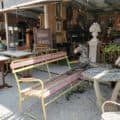
Hunting implies a target. La chine is more patient than that. You’re not necessarily looking for anything specific; you’re looking in the way that experienced market-goers look — alert, methodical, open to surprise. A seasoned chineur will tell you that the best finds come precisely when you weren’t expecting them.
You’ll hear the verb used casually: je suis venu chiner — I came to browse, to search, to see what’s there. It’s the closest French has to a single word for the whole culture of flea market going.
10. Le brocanteur — the professional in the trade
Not everyone selling at a French flea market is a brocanteur. The word refers specifically to a professional dealer in second-hand goods — someone for whom this is a livelihood, not a weekend clear-out. A vide-grenier is open to anyone; a brocante is, in principle, reserved for brocanteurs.
The distinction matters more than it might seem. A brocanteur typically knows their stock. They’ve sourced it, priced it deliberately and can usually tell you something about it. That knowledge cuts both ways: there’s less chance of a wild underpriced find, but there’s also someone worth talking to if you want to understand what you’re looking at.
At the larger permanent markets — Saint-Ouen, the Marché aux Puces de Lyon-Brocabrac, the Marché Paul Bert — the majority of stalls are run by brocanteurs who have traded the same pitch for years. They’re the ones who’ll use most of the vocabulary on this list without thinking twice.
Knowing the word, and the distinction it draws, is its own kind of preparation. Turn up at a brocante expecting vide-grenier prices and you’ll leave frustrated. Turn up understanding the trade culture, and you’ll have a much better morning.
Take the vocabulary with you
None of these expressions require a language degree. Most of them you’ll pick up fast once you’re standing at a stall in the Marché Vernaison or scanning a table at a Sunday brocante in the Dordogne — because you’ll hear them used naturally, in context, by people who mean them.
That’s the best way to learn market slang anywhere. Listen before you speak. Watch how vendors react to each other, how a chineur handles the opening of a negotiation, how a bradeur signals — without quite saying it — that the price is already at the floor.
A few of these words will give you an immediate edge. Dans son jus tells you how to read a piece that hasn’t been touched. Le prix marchand tells you what question is really being asked when a seller sizes you up. La trouvaille gives you the word for the thing you came hoping to find.
The rest of the vocabulary — the rhythm of a proper negotiation, the unspoken etiquette around handling stock, the right moment to walk away — comes with time. But arriving with even this short list puts you a step ahead of most visitors. And in a culture that genuinely respects people who take the trade seriously, that counts for something.