

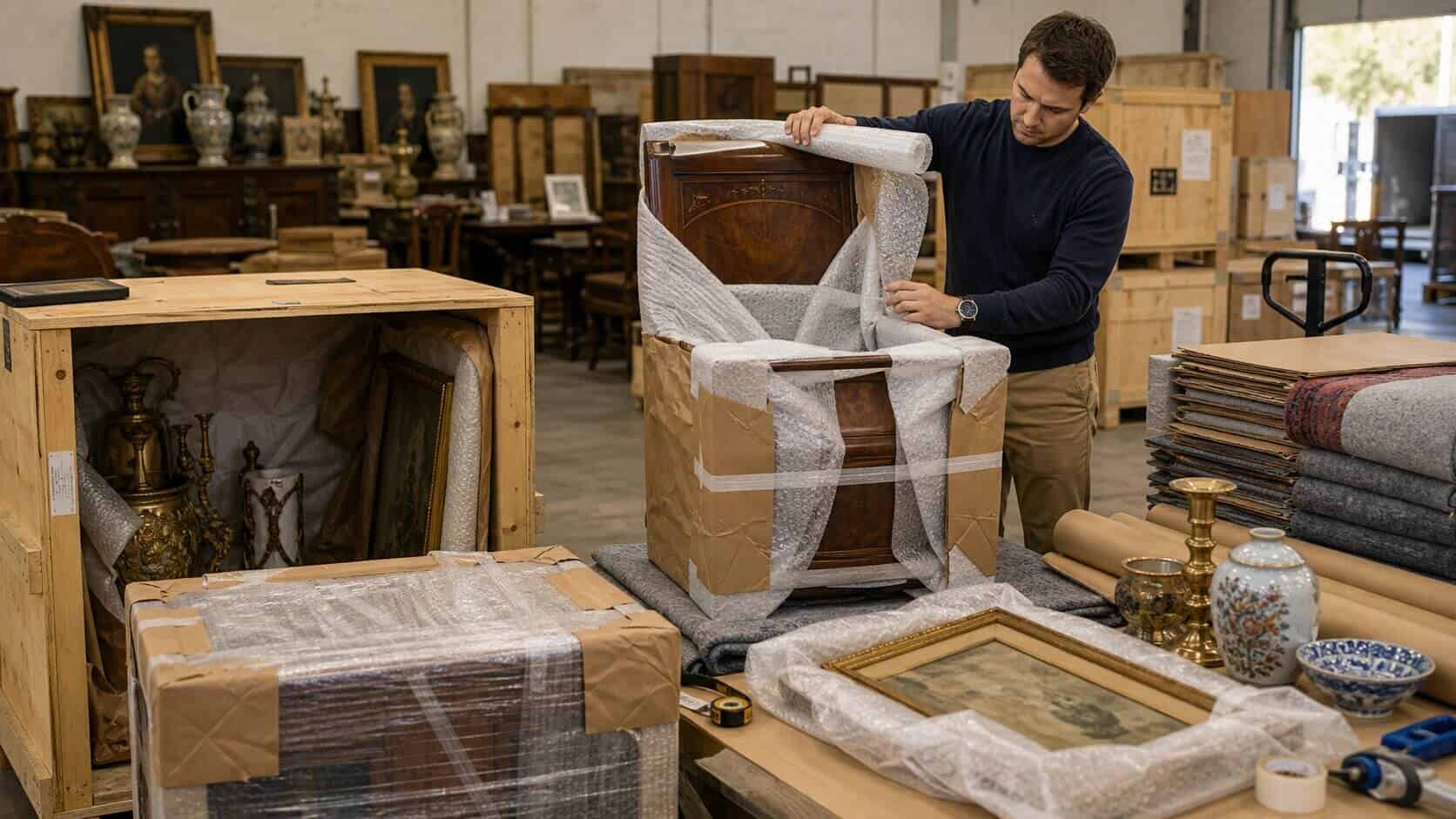

Twenty crates and pieces of furniture, collected across Belgium, loaded onto a single truck — and delivered to Vienna four days later for $400. That’s what shipping antiques from abroad looks like when it actually works. The Provençal armoire you spotted at a brocante, the 19th-century trunk at a Paris flea market, the set of art deco chairs that won’t fit in any overhead locker: none of them need to stay behind.
Getting antiques home from abroad is a practical problem with a range of practical solutions. The right one depends on size, budget and how patient you’re willing to be. This guide covers every main option — from national postal services to ocean freight consolidation — along with realistic cost expectations and the things worth checking before you commit to a purchase.
How to Ship Antiques from Abroad: Your Options at a Glance
The method that makes sense depends first on what you’ve actually bought. A pair of silver candlesticks and a rolled textile print are a very different logistical proposition from a carved armoire or a stack of heavy framed mirrors. The good news: most sizes and budgets have a workable route.
| Shipping Method | Best For | Speed | Cost Range | Fragile Items? | Consolidation? |
|---|---|---|---|---|---|
| National Postal Service | Parcels <30kg, non-fragile | 2–3 weeks | €50–200 | Not ideal | No |
| Seller Arrangement | Simple local logistics | Variable | €€ (reduced) | Varies | Sometimes |
| Freight Forwarder | Medium-sized furniture | 3–4 weeks | €300–1,200 | Yes (if specialised) | Yes |
| Specialist Shipper | Fragile, high-value pieces | 2–4 weeks | €500–2,000+ | Yes | Yes |
| Consolidated Container | Multiple pieces, flexible timing | 6–12 weeks | €€ (lowest per-item) | Yes | Yes |
| Air Freight | Urgent, high-value shipments | 1–2 weeks | €€€€ (premium) | Yes | No |
| Ocean Freight | Large volumes, flexible timing | 6–12 weeks | €€ (lowest bulk cost) | Yes | Yes |
Start Small: Parcels Under 30kg
When National Postal Services Make Sense
For smaller items that fit in a standard parcel box and weigh under roughly 30kg, national postal services are worth checking first before anything else. Ignore them at your peril — they’re frequently underpriced relative to courier quotes. In France, La Poste’s Colissimo service offers international tracked shipping that can be surprisingly competitive for boxes in this range. A pair of ceramic candlesticks, a bundle of vintage prints, a small textile piece: these move efficiently through the postal system and arrive safely.
The advantage is simplicity. No forwarder, no quotes, no paperwork beyond what the post office handles. The downside is that timing is postal-service timing — typically 7 to 21 days depending on destination — and there’s no consolidation available. If you’ve bought only one item, postal service is perfect. If you’re buying across multiple stops, it’s inefficient.
How to Calculate Postal Costs Before You Buy
Before you agree on a price with a vendor, ask for the dimensions of the piece unpacked, then add 10–15 centimetres on each side to estimate the packed parcel size. Go to La Poste, the Belgian post office or your carrier’s website and get a quote for that size and weight to your home address. This takes five minutes and tells you whether the piece makes financial sense. A €40 ceramic dish that costs €80 to ship isn’t a bargain — it’s a loss dressed up as a find.
Medium-Sized Pieces: Freight Forwarders and Specialist Shippers
Ask the Seller First
Many flea market vendors who deal in bulky or heavy antiques have shipped internationally before. Some larger flea markets and antique fairs have an on-site shipping desk or a preferred local handler. This costs nothing to ask and occasionally solves the problem immediately. A vendor with a regular European buyer base may have already identified a reliable shipper and be willing to use them again. Their experience is worth knowing about before you start calling freight companies.
Finding a Customs Broker or Freight Forwarder
For anything too large or heavy for postal service, a freight forwarder in your home country is the next logical step. Tell them what you’re buying, its approximate dimensions, weight and destination. Established brokers work with local partners even if they don’t have an office in the country you’re buying from. The Antiques Diva & Co, for instance, works with specialist art and antiques shippers across Europe and Asia and can connect private buyers with vetted local handlers. A good forwarder will also advise on customs documentation before you buy — critical information if import duties could materially change the deal’s economics.
Specialist Shipper vs. General Freight Company
This distinction matters more than you might think. Specialist art and antique shippers such as Hedley’s Humpers and Chudley International understand crating requirements, know how to handle marble tops and gilt frames, and carry appropriate insurance. General freight companies may quote lower rates but often lack experience with fragile or high-value pieces. For anything with delicate finishes, complex structure or genuine value, the specialist route is worth the premium. For a solid wooden chest or a straightforward piece of garden furniture, a general forwarder may be sufficient — get quotes from both and compare.
Shipping Costs by Size and Weight: What to Budget
Standard Pallet-Sized Shipments (250–270kg)
For a standard pallet-sized crate of around 250–270kg, air freight costs at least €900–1,200, plus storage, packing and any applicable duties. Delivery typically takes 2–3 weeks. Ocean freight for the same size shipment runs roughly €550–650, again plus additional charges, but takes 6–8 weeks. The gap widens considerably when you factor in consolidation and customs handling — which is why consolidation is worth exploring for anything over a single piece.
Full Container Loads (10,000kg+)
A full 20-foot container holds up to 16,000kg of merchandise and costs approximately €5,500–6,500. Delivery runs from 3 to 12 weeks depending on origin, destination and commercial freight volumes at the time of shipment. Smaller amounts in a shared container are possible but involve more paperwork. For buyers consolidating multiple pieces across a longer trip, shared containers are the real value play.
The Economics of Consolidation: Save Money by Waiting
Why Consolidation Changes the Equation
Consolidation (also known as groupage) is the single most effective way to reduce the cost of shipping antiques internationally, and it’s underused by private buyers who don’t know it’s an option. The principle is straightforward: instead of shipping one piece in a half-empty container, you combine your items with those of other buyers or dealers heading to the same destination, and split the freight cost proportionally. The result can be dramatically cheaper per piece than any individual shipment.
The Belgium-to-Vienna example that opens this guide is what consolidation looks like in practice. Moving companies quoted an average of $1,500. Using a consolidation platform, couriers came in at $600 or less. We chose a top-rated carrier who completed the job for $400 and delivered everything in perfect condition four days after collection. That’s consolidation at work.
Three Routes to Consolidation
The first route is to find an antique importer based near your home who runs regular container shipments from the country you’re buying in. Ask whether they accept third-party pieces in their containers, what the lead time is, and who handles local collection and storage while you wait for the shipment to fill. Many established importers are open to this arrangement — it fills their container and generates a side income.
The second route is through a specialist freight forwarder who runs their own consolidation service, grouping antiques and art from multiple clients into shared container loads. Some of the larger specialist shippers operate exactly this kind of programme.
The third route is through consolidation platforms like Shiply, which covers almost 100 countries and connects users with a network of over 80,000 delivery companies. Complete a form with your shipment details, pick-up and delivery addresses and dates, and receive quotes from couriers within about an hour. All couriers on the platform carry feedback ratings, and most have insurance covering loss or damage up to $100,000. UShip and specialty shipper networks like shipsms.co.uk offer similar services with slightly different geographic coverage.
The Time Trade-Off
Consolidated shipments move on the container’s schedule, not yours. Waiting for a container to fill can add weeks or months to the journey. If you need something quickly, consolidation isn’t the right option. But if you’re buying across a longer trip, or you’re willing to hold pieces at a local depot while you continue shopping, the economics can be compelling. Buying across multiple markets in a single trip and consolidating everything into one shipment is a strategy that experienced antique dealers use as a matter of course — there’s no reason private buyers can’t do the same.
Speed vs. Cost: Air Freight vs. Ocean Freight
Air Freight: When Speed Justifies Cost
Air freight is fast — typically 1–2 weeks from collection to delivery — and it’s the better choice for fragile, high-value pieces where speed reduces the window for handling damage and where the cost of freight is small relative to the value of the object. A single significant piece of furniture or a crate of ceramics with strong resale value might justify the premium. The downside: antiques are frequently bulky relative to their mass, and volumetric charges can make air freight prohibitively expensive even if the piece itself isn’t especially heavy. A large gilt mirror or an armoire can attract charges that make air impractical.
Comparison: Air vs. Ocean Freight
| Factor | Air Freight | Ocean Freight |
|---|---|---|
| Reliability | More reliable, shorter handling time | Less reliable, higher risk of damage |
| Cost | €900–1,200+ (250kg pallet) | €550–650 (same volume) |
| Charges Calculated By | Weight | Volume |
| Speed | 2–3 weeks (sometimes 1–2 weeks) | 6–12 weeks (consolidation 8–12) |
| Accessibility | International airports — often more central | Requires transport to loading warehouse near port |
| Tracking | Provided | Provided |
| Best For | Small, high-value, urgent pieces | Large volumes, furniture, flexible timing |
Ocean Freight: The Economics of Patience
Ocean freight changes the economics considerably for larger or heavier shipments. The cost-per-cubic-metre is substantially lower than air, and for buyers moving several pieces — or willing to wait for a consolidated load — it’s almost always the more rational choice. A container from Europe to the east coast of the United States might take 2–4 weeks; shipments to Australia introduce additional port handling and can extend further. For buyers on a tight timeline, that gap matters. For anyone buying on a longer trip or consolidating pieces from multiple stops, it rarely does.
In short: choose air freight if speed matters. Choose ocean freight if budget is the priority. For fragile or high-value antiques on a short timeline, air is worth the premium. For large or heavy items where a few extra weeks of wait is acceptable, ocean consolidation is almost always the better value.
A Practical Note: Customs Brokers and Ocean Freight
Ocean freight almost always requires a customs broker at the destination port, whereas air freight shipments sometimes clear more simply through courier channels. If you haven’t worked with a customs broker before, an ocean shipment is a good reason to engage one early. They can advise on import classification, duty rates and documentation requirements before your container arrives, not after. This foresight saves time and money.
Critical Checks Before You Commit to a Purchase
Customs and Import Duties
Many countries offer reduced or zero import duty on genuine antiques — in the United States, items over 100 years old are generally duty-free under HTS 9706; the EU applies reduced VAT rates on qualifying pieces. But definitions vary across borders, enforcement is inconsistent, and the rules depend on your destination, the object’s country of origin and how it’s classified. Research the specific rules for your home country before you buy, not after the piece is already in transit. A customs broker is worth consulting for any purchase where the import duty could materially change whether the deal makes financial sense.
Documentation: Your First Line of Defence
Ask the seller for a receipt that describes the piece accurately — materials, approximate age, country of origin — and reflects the actual sale price. Some buyers are tempted to under-declare value to reduce duty exposure; this creates legal risk and can complicate insurance claims if something goes wrong in transit. For pieces that might fall under cultural property export restrictions — which apply in countries including Italy, France and Greece — confirm that the seller can provide any required export documentation before money changes hands.
Insurance: Standard Liability Isn’t Enough
Standard carrier liability is typically based on weight, not value, and will not come close to covering a significant antique if it’s damaged in transit. Specialist fine art and antiques insurance is available and, for anything of real value, essential. Some specialist shippers include it in their service; others offer it as an add-on. Either way, confirm the coverage level in writing before the piece leaves the seller’s hands. For high-value items, a standalone transit insurance policy — arranged independently through a specialist insurer — is often the cleaner solution. Price the premium before you finalise the purchase and factor it into your total cost.
Packing: The Difference Between Safe and Damaged
Antiques require proper packing — custom crating for fragile or awkwardly shaped pieces, moisture protection for timber, padding for anything with projecting ornament. If you’re arranging shipping yourself rather than through a specialist, find a packer with experience in antiques or fine art. A piece that survives a transatlantic voyage badly packed is a piece that arrives damaged, and carrier liability for improper packing is minimal.
One practical check: ask the seller how they would pack the piece for shipping. Their answer is informative twice over — it tells you about their experience with international buyers, and it gives you a baseline for comparing what your chosen shipper proposes to do differently.
Sizing Up a Piece Before You Buy
Size Matters More Than Weight
Size and weight are the two levers that drive almost every freight quote you’ll receive. Shippers bill on cube weight — every cubic inch costs money in air or ocean shipments. A bulky but light item can cost more to ship than a smaller, heavier one. A large but light piece — a wicker armoire, say, or a gilt-framed mirror — can generate a higher freight charge than something smaller and denser, because it occupies disproportionate space in a vehicle or container.
When you’re sizing up a potential purchase, measure it before you negotiate the price. Ask the seller for the packed dimensions, or apply a rough crating allowance yourself — typically adding 10 to 15 centimetres on each side. That number is what freight companies will quote against, and it can shift a shipment from one pricing tier to another. Knowing it before you negotiate gives you a realistic sense of the total landed cost.
Condition: A Cold Eye on Risk
Shipping stresses furniture in ways that a market stall never will — vibration, temperature changes, handling at multiple transfer points. A piece that already has a loose joint, a fragile veneer or a cracked marble surface is more likely to arrive damaged. Examine structural joints, drawer runners and any applied decorative elements before buying. For gilt or lacquered surfaces, run a finger along edges and corners where impact is most likely. If you’re buying ceramics or glass, ask the seller directly how they would pack the piece — their answer tells you something about their experience and your shipping risk.
Provenance and Age: More Than Just Collecting
In many destination countries, genuine antiques — broadly defined as items over a hundred years old — attract reduced import duties or are exempt entirely. In the United States, objects meeting the age threshold are generally duty-free under the relevant harmonised tariff schedule heading; the EU applies reduced VAT rates to qualifying antiques. The definitions aren’t always consistent across borders, and rules change. If you’re considering a significant purchase, research the specific import classification for your destination before you buy, not after. A customs broker can advise on whether a specific piece is likely to qualify and what documentation the seller can provide to support that claim. An invoice noting the approximate date and country of origin is a minimum; a more detailed provenance note helps considerably.
The Psychology of Buying Across Multiple Markets
Timing Within a Trip Affects Your Decisions
If you’re early in a buying circuit across several markets, you have options — you can hold back and compare, or find a forwarder’s depot to receive pieces as you go. If it’s the last day and you’ve already committed to a container share or a forwarder’s collection window, the pressure is different. Buying speculatively on day one of a ten-day trip and buying decisively on day nine require different discipline.
The most common expensive mistake in this context is buying something on an emotional impulse early in a trip, shipping it home, and then finding a better version at half the price two days later. There’s no clean solution to that, but building in a short holding period before confirming any shipment gives you a useful pause. Consolidation naturally enforces this — you can’t ship until the container is full, so you have time to reconsider.
Bundle Purchases to Reduce Per-Item Costs
The single most effective way to reduce per-piece shipping costs is consolidation. Shipping five pieces in one container consignment costs far less per item than shipping each one separately, and the savings can be substantial enough to change what’s worth buying. This also affects how you negotiate. Sellers at established antique fairs often deal with international buyers regularly. If you’re interested in more than one piece from the same vendor, say so. A seller who sees a larger sale is frequently more flexible on price than one negotiating a single small transaction.
Common Expensive Mistakes — and How to Avoid Them
Letting the Seller Arrange Shipping
A common and expensive mistake is letting the seller arrange shipping on your behalf without checking what else is available. Sellers aren’t shippers; they use whoever is convenient rather than whoever is cost-effective. For anything beyond a single small parcel, spend an hour getting two or three independent quotes. National postal services handle surprisingly large boxes at reasonable rates — check this first for anything under roughly 30kg. For heavier or bulkier pieces, contact a specialist art and antique forwarder, ask about consolidated container options, and compare the difference. The gap between the seller’s suggested shipper and a consolidator with a regular route to your destination can be significant — often saving €200–400.

Forgetting Insurance Until Too Late
Standard carrier liability is calculated by weight. For a serious antique, the gap between that and replacement cost can be enormous. Ask your shipper explicitly what their maximum liability is, and whether you can purchase additional cover. For high-value pieces, a standalone transit insurance policy is the cleaner solution. Price it before you finalise the purchase. Specialist shipper claims usually resolve faster, which is another reason to choose experience over cost alone.
Not Checking Import Duty Position
Import duty can make or break the economics of a purchase. A piece that costs €500 with a €300 import bill attached is a different proposition from one that’s duty-free. Research your destination’s rules before you buy, not after. A customs broker costs far less than an unexpected duty bill. Many countries offer zero or reduced duty on genuine antiques, but “qualifying” matters — documentation and age verification are essential.
Key Things to Remember Before You Commit
The most expensive mistakes in international antique shipping happen before anything is packed. A few key principles can prevent significant problems later:
- Shipping can cost more than the item itself. Always get a shipping quote before finalising a purchase, especially for large pieces. Factor in storage, packing and duties alongside the transport cost.
- Consolidate your shipments. Rather than shipping items individually, wait and combine everything into a single shipment. It is simpler, involves less paperwork and is substantially cheaper — often 40–60% less than individual shipments.
- Size matters more than weight. Shippers bill on cube weight — every cubic inch costs money. A bulky but light item can cost more to ship than a smaller, heavier one.
- Check customs rules in your home country. Import duties and taxes vary by country and by the age of the item. Research this before you buy, not after — a surprise import duty can significantly change the economics of a purchase.
- Get your items appraised before shipping. Standard shipping insurance may not cover the full value of a high-value antique. Consult a personal property appraiser and consider purchasing additional specialist antique shipping insurance.
- The longer you can wait, the cheaper it gets. Ocean freight, particularly via consolidated groupage, rewards patience. If you can wait 8–12 weeks, your costs will be significantly lower than air freight — sometimes 40–60% less for the same volume.
- International baggage rules are strict. Do not assume you can pack small items in an extra checked bag. Check airline rules for checked baggage and fragile items before departing — the costs and restrictions may surprise you.
Know When to Negotiate and When to Walk Away
Factor Total Landed Cost Before You Agree a Price
The price tag on a piece is only the starting point. Before you commit, run a quick mental calculation: shipping method, approximate freight cost, packing, insurance, and any import duties at your destination. If the total landed cost still makes the piece good value compared to what you’d pay at home, you’re in a strong position. If it’s marginal, that’s useful information too — either for negotiating harder on price, or for deciding to leave it behind.
Know When the Piece Is Worth Paying Full Price
Not everything warrants aggressive negotiation. At informal flea markets, haggling is expected and sellers price accordingly. At established antique dealers and specialist fairs, prices are often set closer to market value, and aggressive bargaining can damage a relationship worth keeping — especially if you’re likely to return. A vendor who has already come down once and is clearly at their limit is telling you something; pushing further rarely ends well.
There are also categories of object where condition, rarity or provenance genuinely justify the asking price. A piece with solid documentation, clear origin and good provenance is worth more than a comparable piece without it — not just because it may clear customs more smoothly, but because it will be easier to insure, more straightforward to resell, and more satisfying to own. If the price reflects that, it usually reflects it accurately.
Walking Away Is a Legitimate Outcome
The logistics of international shipping mean that some purchases simply don’t make sense — and recognising that early is genuinely useful. A large, fragile piece that requires specialist crating, won’t consolidate with anything else you’re buying, and has uncertain import classification is a different proposition from a solid wooden chest that packs well and ships easily. If you’re unsure about any part of the chain — the seller’s documentation, the shipper’s experience with fragile antiques, the import duty position at your destination — that uncertainty is worth taking seriously. A piece that stays behind isn’t a failure; it’s a decision made with complete information.
Frequently Asked Questions
What is the cheapest way to ship antiques from abroad?
For small items, the cheapest option is usually the national postal service of the country where you are buying — France’s Colissimo, for example, offers competitive international rates for packages up to 30kg. For larger items, consolidated ocean freight (groupage) is almost always the most economical method — particularly if you can share a container with an importer or use a platform like Shiply or UShip to find carriers with spare capacity. Ocean freight is slower than air but can cost 40–60% less for the same volume of goods. The Belgium-to-Vienna example (€400 via Shiply consolidation) illustrates this perfectly.
Do antiques really qualify for zero duty?
Many countries offer zero or reduced duty on genuine antiques (100+ years old), but “qualifying” matters. The US applies zero duty under HTS 9706 if properly documented. The EU reduces VAT on qualifying pieces. A customs broker in your destination country should verify your specific purchase before you commit. Documentation matters: a dated invoice with approximate manufacture date and provenance helps. Without proper documentation, even a genuine antique may not qualify for the duty exemption.
What is consolidated shipping for antiques?
Consolidated shipping (or groupage) combines multiple shipments heading to the same country or region into a single container or truckload. Instead of paying for a full container yourself, you share the space — and the cost — with other shippers. It is significantly cheaper than booking a dedicated shipment and is widely used in the antique trade. Platforms like Shiply, UShip and specialty shipper networks connect individual shippers with carriers who have spare capacity, often at 50–75% below standard rates.
Air or ocean freight — which makes sense?
For small, high-value pieces where speed matters, air makes sense — but expect to pay €900–1,200+ for a 250kg pallet, with delivery in 2–3 weeks. For furniture or when consolidating, ocean almost always wins financially — €550–650 for the same volume, but 6–12 weeks. Get quotes for both before deciding. The real question isn’t air vs ocean, it’s whether you need the item quickly or whether you can wait and save significantly.
What if something arrives damaged?
File a claim with the shipper within the timeframe specified in their terms (usually 14–30 days). Specialist shipper claims usually resolve faster than claims with general carriers. For valuable pieces, a standalone transit insurance policy makes the process smoother. Carriers typically don’t cover damage on declared values below actual replacement cost, which is why the insurance conversation happens before shipping — not after something arrives damaged.
Is haggling expected in international buying?
At informal flea markets, yes — sellers price accordingly and expect negotiation. At formal antique fairs and established dealers, prices are closer to market value. Aggressive bargaining can damage relationships worth keeping, especially if you plan to return. Read the room. A vendor who’s already come down once and seems at their limit is telling you something. Respect that signal.
What’s the biggest mistake buyers make?
Letting the seller arrange shipping without comparing other options. Sellers use whoever’s convenient, not whoever’s cost-effective. For anything beyond a small parcel, getting 2–3 independent quotes (including national postal service) takes an hour and often saves €200–400. Do this before confirming with the seller, not after. Your 60 minutes of research can pay for itself ten times over.
The Bottom Line: Getting It Right Once Makes Everything Easier
The practical upside of getting the process right once is that it becomes straightforward thereafter. Buyers who establish a relationship with a reliable forwarder, understand their destination’s import rules and know which shippers to trust for fragile pieces find that shipping antiques from abroad stops feeling complicated and starts feeling like a genuine advantage — access to inventory, price points and objects that simply aren’t available at home. The antiques market abroad is deep enough that another opportunity will always come. Shipping a piece home improperly, or buying one whose total cost you miscalculated, is a harder problem to recover from than simply waiting for the next find.
The buyers who do this well aren’t necessarily more experienced collectors — they’re simply people who asked the freight question early, found a forwarder they trust, learned their destination’s import position once, and understood the consolidation options. After that, the process runs itself.