

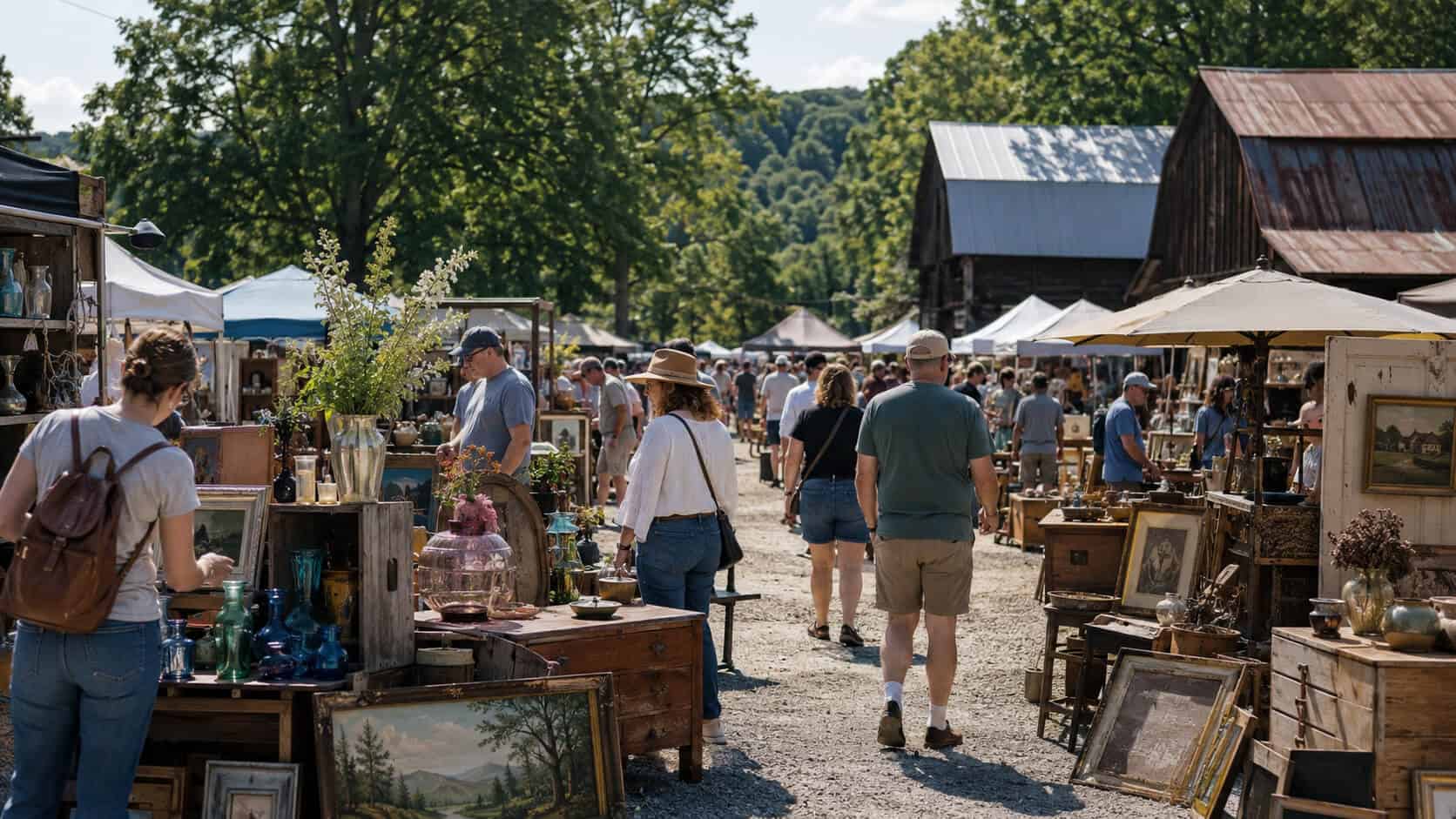

On a Saturday morning at the Raleigh Flea Market on Blue Ridge Road, the car park fills before 9am. Dealers unload folding tables, regulars cut straight through to the permanent antique buildings at the back, and somewhere near the entrance a vendor is already deep in conversation about the provenance of a mid-century sideboard. This is flea markets in North Carolina at their most characteristic: practical, local, and occasionally surprising.
The state has real range. True flea markets with hundreds of vendors sit alongside specialist antique barns and curated vintage shops — and this guide covers both. Cities like Winston-Salem have built genuine reputations as antique destinations in their own right, drawing collectors from well beyond state lines. Some entries here are classic open-air markets; others are antique retail stores worth a dedicated detour. Where format differs, that’s noted in the entry.
Raleigh Flea Market
The Raleigh Flea Market is one of the largest in the Southeast, and its scale is genuinely hard to appreciate until you’re walking it. On a busy weekend the market draws well over 600 vendors, a substantial portion of whom are antique and collectibles dealers — which means the browsing here is more considered than a typical car-boot sprawl. Furniture, vintage clothing, records, tools, glassware, and outright curiosities all share space, often on the same row. The permanent indoor antique buildings toward the rear of the site are worth prioritising if time is short; the quality there tends to be more consistent than the open-air stalls.
For a deeper look at what the market offers and how to approach it, see the dedicated Raleigh Flea Market guide.
📍 Address: 4285 Trinity Rd, Raleigh, NC 27607 (NC State Fairgrounds)
📅 Days: Saturday–Sunday year-round; closed in October for NC State Fair
🕐 Hours: 9:00 am–5:00 pm (outdoor); 9:00 am–4:00 pm (indoor)
💰 Admission: Free | Parking: Free
🌐 Website: theraleighmarket.com
Flea Body’s
Flea Body’s occupies a different niche from the large-scale weekend markets on this list. It has the feel of a curated shop rather than a sprawling vendor floor — the kind of place where the selection has been edited, and it shows. Shoppers who prefer browsing without the sensory overload of a 600-stall market tend to respond well to the atmosphere here.
The stock leans toward vintage goods and second-hand finds with genuine character — the sort of inventory that rewards a slow look rather than a quick scan. If you’re making a day of antiquing in the area, Flea Body’s works well as a focused stop alongside one of the larger markets nearby rather than a standalone destination, though dedicated vintage hunters may find it worth the trip on its own terms.
📍 Address: 3405-1 Market St, Wilmington, NC 28403
📅 Days: Monday–Sunday
🕐 Hours: Mon–Sat 10:00 am–5:00 pm; Sun 12:00 pm–5:00 pm
💰 Admission: Free
🌐 Website: fleabodyshop.com
Sutton and Son’s Antiques
A family-run operation with the kind of institutional knowledge that only comes from years of handling estate pieces, regional furniture, and the slow accumulation of genuine finds — that’s the promise the name makes, and the shop delivers on it. Sutton and Son’s sits in a different register from the big weekend markets: this is a destination for collectors who already have a fairly clear idea of what they’re looking for, whether that’s Southern country furniture, vintage textiles, or decorative objects with a traceable history.
The stock here tends to reflect a curatorial eye rather than volume turnover. That distinction matters if you’ve already worked through the larger multi-vendor markets and are looking for something with a bit more provenance behind it. Worth building into a day that combines one of North Carolina’s bigger flea markets with a more focused antique stop.
📍 Address: 3156 Dellwood Rd, Waynesville, NC 28786
📅 Days: Monday–Sunday
🕐 Hours: Mon–Sat 10:00 am–5:00 pm; Sun 1:00 pm–5:00 pm
💰 Admission: Free
🌐 Website: suttonandsonsantiques.com
4. Antique Tobacco Barn — Asheville’s Warehouse-Scale Find
Converted from an actual tobacco warehouse, this Asheville institution has a scale and atmosphere unlike anything else on this list. The sheer volume of inventory is part of the appeal — multiple floors of furniture, architectural salvage, vintage lighting, glassware, and American country pieces spread across a space large enough that a single visit rarely covers it all. It draws both serious collectors and curious tourists, which is a combination that usually dilutes quality but somehow works here because the stock is genuinely broad enough to satisfy both audiences.
Asheville itself adds context. The city has a well-established vintage and arts culture, and the Tobacco Barn benefits from that ecosystem — vendors and pickers in the region know where to bring their better finds. If you’re visiting western North Carolina and have any interest in American furniture, decorative antiques, or the kind of architectural oddities that rarely turn up at open-air markets, this is the stop that justifies the drive.
📍 Address: 75 Swannanoa River Rd, Asheville, NC 28805
📅 Days: Monday–Sunday
🕐 Hours: 10:00 am–6:00 pm daily (hours extended from 5 pm to 6 pm as of June 2025 — verify before publishing)
💰 Admission: Free | Parking: Free on-site and across the street
🌐 Website: atbarn.com
5. Oddfellows Antiques (Permanently closed)
Something a little different starts to become clear the moment you walk in. Oddfellows leans into the eccentric and the unexpected — the kind of shop where a Victorian curiosity sits next to a piece of mid-century industrial hardware and neither looks out of place. It occupies a different niche from the warehouse-scale operations on this list, with a personality that tends to appeal to collectors who enjoy a bit of editorial instinct in what’s on the floor rather than sheer volume alone.
What distinguishes Oddfellows is the sense that the inventory has been assembled with some deliberate taste rather than simply accumulated. That’s a meaningful difference once you’ve spent a few hours at a large multi-vendor market. Shoppers drawn to oddities, decorative pieces with an unusual history, or vintage goods that don’t fit a tidy category tend to find the browsing rewarding here. It works well as a complementary stop on a longer antiquing day in the area.
📍 Address: 124 Swannanoa River Rd, Asheville, NC 28805
⚠️ permanently closed
💰 Admission: Free
🌐 Website: oddfellowsasheville.com
6. Twice as Nice Flea Market and More
Expectations are set honestly here: a broader range of goods than the specialist antique stops on this list, the kind of market where a general browser and a focused collector can both leave reasonably satisfied. The mix tends toward the eclectic — repurposed furniture, vintage housewares, collectibles, and the sort of miscellany that makes open-air market shopping genuinely unpredictable in the best way.
Where it earns its place on a North Carolina flea market itinerary is in that breadth. After a morning at a more curated antique store, there’s something refreshing about a market where the inventory hasn’t been pre-edited too heavily. Practical finds sit alongside decorative ones, and the pricing typically reflects a more accessible end of the market. It’s a solid option for shoppers who want variety without committing to the scale of a 600-vendor operation.
📍 Address: 3060 Wilmington Hwy, Jacksonville, NC 28540
📅 Days: Monday–Sunday
🕐 Hours: 10:00 am–6:00 pm daily
💰 Admission: Free | Parking: Free lot
📖 More info: Facebook — TwiceAsNiceFleaMarketAndMore
7. Jamestown Flea Market
Jamestown sits in the piedmont region between Greensboro and High Point — a corridor with deep roots in American furniture manufacturing — and the local flea market reflects that geography. Shoppers who know the area tend to arrive with an eye for furniture and home goods, and the market delivers that kind of inventory with some regularity. It’s the sort of find-it-yourself experience that rewards a patient walk-through rather than a targeted search.
What gives the Jamestown Flea Market a practical edge is its accessibility for shoppers working a broader piedmont itinerary. Positioned between larger cities, it functions well as an unscheduled stop rather than a sole destination — the kind of market where you’re not committing a full day, but where a couple of hours can turn up something genuinely useful or unexpected. The mix leans toward everyday collectibles, repurposed household items, and the occasional furniture piece worth a closer look.
📍 Address: 709 Jamestown Rd, Morganton, NC 28655
📅 Days: Friday, Saturday, Sunday year-round
🕐 Hours: Fri 7:00 am–2:00 pm; Sat–Sun 7:00 am–4:00 pm
💰 Admission: Free | Parking: Free lot
📖 More info: Facebook — Jamestown Flea Market
8. Farmer’s Market Flea Market
The Farmer’s Market Flea Market occupies a distinct niche in the North Carolina flea market landscape by combining the rhythms of a working farmers market with the browsing appeal of a general flea market. That dual identity shapes the character of the place: agricultural and household goods share space with vintage finds and secondhand merchandise, giving the visit a grounded, community-oriented feel that differs from the more specialist antique destinations on this list.
For collectors, that mixed format can be genuinely productive. Items that might not surface in a curated antique store — old farm tools, vintage kitchen goods, regional ephemera — tend to appear in markets with this kind of agricultural heritage. The unpredictability is part of the draw. It rounds out a North Carolina flea market itinerary well as a contrast to the larger, vendor-heavy operations like the Raleigh Flea Market, and it offers a pace and atmosphere that feels distinctly local rather than destination-driven.
📍 Address: 366 Livestock Market Rd, Lexington, NC 27295
📅 Days: Tuesday, Friday, Saturday
🕐 Hours: 7:00 am–12:30 pm
💰 Admission: Free
🌐 Website: farmersmarket-fleamarketnc.com
North Carolina rewards the patient browser. Whether you’re hunting pressed glass in an Asheville warehouse or turning over furniture in a Winston-Salem shop, the variety across this state is genuine — specialist and general, indoor and open-air, curated and happily chaotic. The eight venues above represent a strong cross-section of what the state offers, but they’re also a starting point. Markets open, close, and shift character over time, so treat this list as an invitation to explore rather than a definitive registry.
Planning Your North Carolina Flea Market Trip
A few practical habits will serve you well across most of these stops. Larger weekend markets like the Raleigh Flea Market draw serious crowds by mid-morning, so arriving early gives you first access to the best vendor selection and a calmer browsing experience before the aisles fill. At outdoor and mixed-format markets, weekday visits — where they’re available — often mean fewer competitors for the same stock.
On payment: outdoor market vendors frequently prefer or require cash, while established antique shops and malls are more likely to accept card payments. Bringing both keeps your options open and occasionally makes you a more attractive buyer when negotiating. Speaking of which — polite negotiation is standard practice at most flea markets and general antique stalls, though it’s less expected at boutique antique shops where pricing tends to be firmer.
If you’re building a multi-stop itinerary, Asheville and Winston-Salem both anchor a productive day’s circuit: Asheville for the Antique Tobacco Barn and the broader River Arts District antique scene, Winston-Salem for Oddfellows, Sutton and Son’s, and the surrounding antique corridor. Raleigh stands well on its own as a day trip given the scale of its flea market. For the more relaxed, off-the-beaten-track stops — Jamestown, the Farmer’s Market Flea Market — build in flexibility rather than scheduling them as headline destinations.
Book Your Stay
Asheville and Raleigh both offer a wide range of accommodation options to suit different budgets and trip lengths. Asheville in particular is worth an overnight stay given the density of antique, vintage, and independent retail in and around the city — the Antique Tobacco Barn alone can absorb several hours, and there’s plenty more within a short drive. Raleigh suits a weekend base if you’re combining the flea market with the broader Research Triangle area. For Wilmington and the coastal markets, staying in the city centre puts you within easy reach of Flea Body’s and the surrounding independent shops.
Frequently Asked Questions: Flea Markets in North Carolina
What is the biggest flea market in North Carolina?
The Raleigh Flea Market is widely regarded as one of the largest in the state, with a significant number of vendors attending on weekends — including a substantial proportion of antique and collectibles dealers. It operates across two permanent indoor buildings as well as outdoor stalls, giving it a scale that’s difficult to match in a single visit.
Are there antique shops as well as flea markets in North Carolina?
Yes — and this guide covers both. Flea markets like the Raleigh Flea Market and Jamestown Flea Market are traditional open-format markets where vendors rent stall space and stock varies week to week. Antique shops and stores like Sutton and Son’s, Oddfellows, and the Antique Tobacco Barn operate more like permanent retail environments with curated, stable inventory. Both formats are worth your time; knowing which you’re visiting helps set expectations for pricing, negotiation, and what you’re likely to find.
Do I need cash at North Carolina flea markets?
Cash is strongly advisable, particularly at outdoor and general flea markets where individual vendors may not have card readers. Antique shops and malls are more consistently card-friendly, but it’s never guaranteed. Bringing a reasonable amount of cash alongside a card gives you flexibility and can strengthen your position when negotiating on larger items.
When is the best time to visit a North Carolina flea market?
For outdoor and weekend markets, early morning is the standard advice for good reason: first-comers get first access to fresh stock before the crowds arrive. Indoor antique shops are generally less time-pressured, and weekday visits can mean more relaxed browsing and more willing conversation with dealers. In summer, getting to large outdoor markets before midday also helps you avoid the heat during peak browsing hours.
How do I find more flea markets in North Carolina?
The Fleamapket directory is a useful tool for locating flea markets across North Carolina and beyond — searchable by location, it’s a practical first stop when planning a trip or looking for markets beyond this list.