

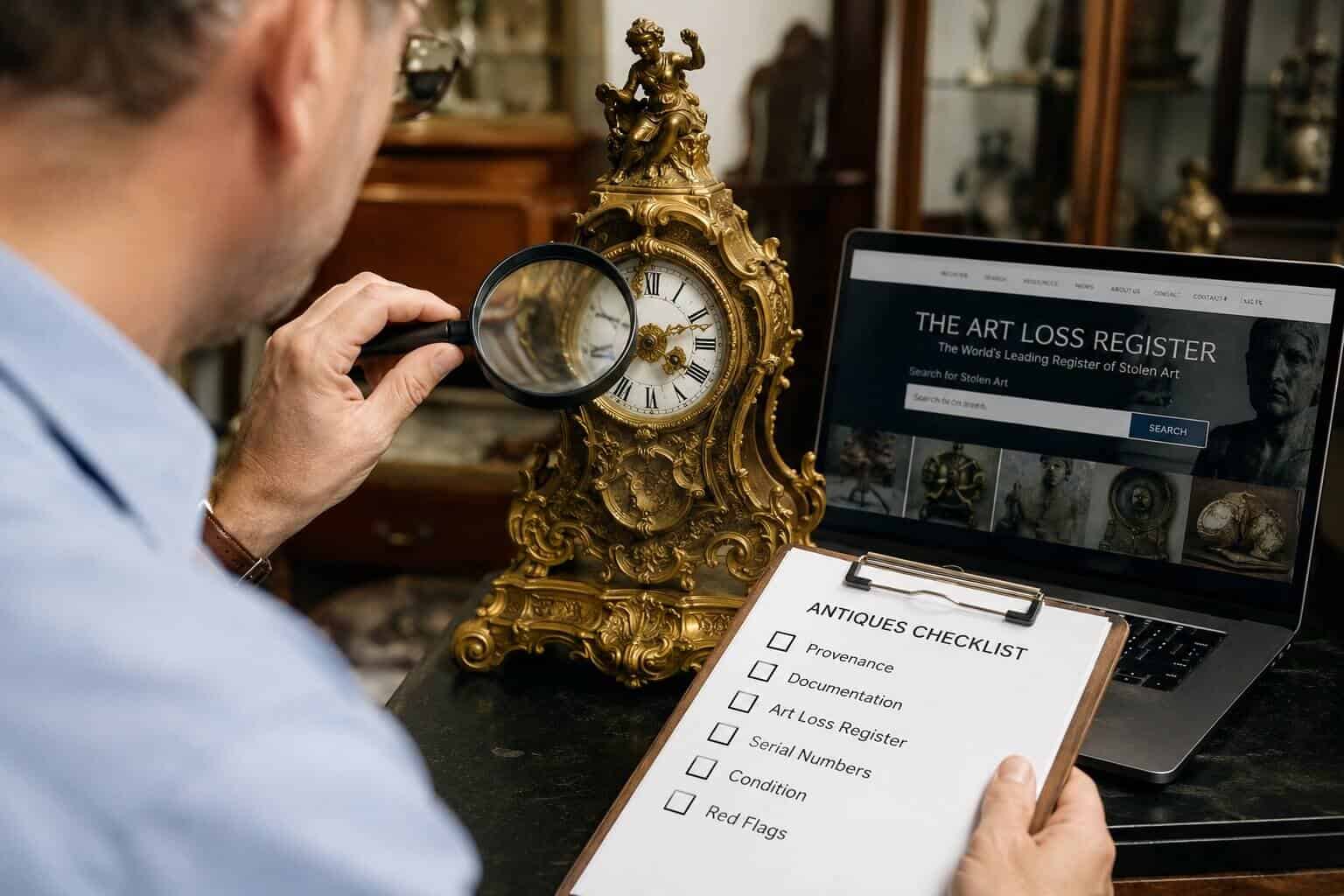

Picture a pair of silver candelabra at an estate sale. No receipt, no family story, just a folded price tag and a vague shrug from the person running the table. Most pieces like that are exactly what they appear to be — cleared from a house, priced to move. But some aren’t. Stolen antiques do circulate through legitimate channels: flea markets, estate sales, online auctions, even reputable dealers who bought in good faith further up the chain.
The uncomfortable truth is that a good-faith purchase doesn’t automatically protect you. In many jurisdictions, if a stolen object is traced back to you, it can be reclaimed by the original owner — regardless of what you paid. Knowing how to check if an antique is stolen before handing over money is worth the effort, and it’s less complicated than most buyers assume.
Why Provenance Matters — and Who’s at Risk
Provenance is simply the documented history of an object — where it came from, who owned it, and how it changed hands. For buyers, it’s both a quality signal and a legal safeguard.
The legal risk varies by country. Under English law, the general rule is that a thief cannot pass good title — meaning buying a stolen item in good faith doesn’t give you clean ownership, and the original owner can reclaim it. Similar principles apply across much of Europe and in most US states, though the specifics differ. Some civil-law countries offer stronger protections to good-faith purchasers who can demonstrate they took reasonable steps to verify provenance. Wherever you are, those “reasonable steps” are increasingly expected to include a database check.
The risk isn’t limited to naive buyers at car boot sales. High-value thefts move through auction houses. Looted antiquities surface at reputable galleries. A piece can be stolen once, sold three times, and arrive at your door with a convincing paper trail that stops just short of the original theft. Professional dealers and resellers have extra reason to check: buying a stolen piece for stock creates liability and reputational damage that no margin justifies.
The Art Loss Register — Your First Stop
The Art Loss Register is the primary private database of stolen art, antiques and collectibles. It holds records submitted by insurers, private collectors, law enforcement agencies and cultural institutions — the register describes itself as one of the largest such databases in the world, though the precise figure should be verified before quoting it here.
You can submit an object for a search directly through their website at artloss.com. Searches are not free — there is a fee per item, with different tiers for private buyers, dealers and insurers. If the object doesn’t appear in the database, you receive a certificate confirming the search was conducted. That certificate has real value: it demonstrates due diligence if a dispute ever arises later.
For high-value purchases — anything above a few hundred pounds or dollars — a search is worth treating as a standard part of the transaction, not an optional extra. Many reputable dealers will already have done one; if they haven’t, you can commission it yourself before completing the sale.
Two limitations are worth knowing. First, the database only contains what has been reported to it. An object stolen from a private home and never formally registered as missing won’t appear — a clean result is reassuring, not a guarantee. Second, the register covers art and antiques broadly but doesn’t include every category of collectible equally well. Furniture, ceramics and jewellery are all represented, but coverage depth varies.
Other Databases Worth Knowing
The Art Loss Register is the best-known starting point, but it isn’t the only resource. Depending on where an object originates — or where it may have been stolen — other databases can fill gaps.
Interpol Works of Art
Interpol maintains a database of cultural property reported stolen by member countries. You can search it at interpol.int under the Works of Art section. It skews toward items of recognised cultural or national significance — think archaeological pieces, religious objects, items seized during conflict — rather than general antiques. Worth checking for anything with a documented country of origin, particularly from regions with known looting histories.
FBI National Stolen Art File (NSAF)
The FBI’s Art Crime Team maintains the National Stolen Art File, which aggregates reports from US law enforcement agencies. Searches are available to the public through the FBI website. If you’re buying in the United States, or the piece has passed through American hands, it’s a reasonable addition to your checks.
Carabinieri TPC (Italy)
Italy’s Carabinieri unit for the protection of cultural heritage — the TPC — runs one of the most comprehensive national databases of stolen cultural property in the world, shaped by decades of dealing with looted archaeological material. Their database is searchable online and is particularly relevant for Italian furniture, sculpture, paintings and antiquities.
No single database holds everything. A clean result across all of them is genuinely useful evidence of due diligence — but treat it as strong reassurance rather than a legal clean bill of health. An object stolen and never reported to any registry can pass every check.
Provenance Questions to Ask the Seller
A database search tells you what’s been flagged. A conversation with the seller can tell you a great deal more. Most reputable dealers expect these questions and answer them readily. Hesitation, irritation or vague deflection is itself informative.
Ask these directly, and pay attention to how the answers land:
- Where did this piece come from? You’re looking for a specific, traceable answer — an estate, a previous collector, an auction house — not a shrug and “I’ve had it a while.”
- How long have you owned it, and who did you buy it from? A chain of ownership, even a short one, is meaningful. A dealer who bought at a named auction two years ago can usually tell you that.
- Is there any documentation — receipts, auction catalogues, insurance records, old photographs? Paper trails aren’t mandatory for lower-value pieces, but they matter above a certain threshold. An item photographed in a 1970s country-house sale catalogue is a different proposition from one with no history at all.
- Has this piece been outside the country? Import history matters for anything that might originate from a region with export restrictions on cultural property.
- Has the Art Loss Register been searched? A confident yes, ideally backed by a certificate, is exactly the right answer from a professional dealer.
None of this is confrontational — frame it as standard practice, because for anyone serious about collecting, it is. A seller who treats basic provenance questions as an insult is worth walking away from regardless of how appealing the piece looks.
Red Flags at Flea Markets and Estate Sales
Databases and dealer conversations are useful when you have the time and the seller’s cooperation. At a busy flea market or a crowded estate sale, the dynamic is different — decisions move faster, and there’s often no paperwork in sight. Learning to read the situation is just as important as knowing where to search.
None of the following signals proves a piece is stolen. But several together should slow you down considerably.
- No history whatsoever. A seller who can’t say anything about where a piece came from — not an estate, not a house clearance, not a market they bought it from — is offering you an object with no chain of custody at all. That’s not automatically suspicious, but it’s a reason to be cautious, especially for higher-value items.
- Identification marks that look tampered with. Hallmarks, maker’s marks and serial numbers on silver, clocks and decorative metalwork can be removed or altered. If an area looks polished out, scratched over or deliberately obscured, treat it as a serious warning.
- A price that seems deliberately low. Experienced dealers price to sell, not to give things away. A piece offered well below its obvious market value isn’t a lucky find until you understand why it’s priced that way.
- Reluctance to provide a receipt. Any legitimate seller at a market should be willing to give you a written record of the transaction — their name, a description of the piece, the price, the date. Resistance to this is a red flag in any context.
- Urgency or pressure to decide now. “Someone else is interested” is a retail tactic. Heavy pressure at a market stall — especially on an expensive piece — can also be an attempt to short-circuit your better judgement.
- Items that seem out of place for the seller. A single high-quality piece of Georgian silver on a stall otherwise selling mid-century kitchenware isn’t impossible, but it’s unusual enough to prompt questions. Context matters.
- Religious or ceremonial objects without clear context. Icons, reliquaries, Torah scrolls, temple bronzes and similar pieces are disproportionately represented in cultural property theft cases. If a seller can’t account for the origin of a piece in this category, caution is well warranted.
At estate sales specifically, the presence of a professional estate company running the sale gives you a degree of protection — they have reputational and sometimes legal exposure too. Private sales from homes with no professional involvement offer fewer guarantees. Neither is inherently unsafe, but they’re different environments.
If you’re at all uncertain about a piece and can’t run a proper check on the spot, the simplest move is to ask the seller to hold it while you do. Most won’t object if the sale is genuine. If they won’t wait 24 hours, that tells you something.
What Happens If You Buy Something Stolen by Mistake
This is the question most buyers don’t think to ask until it’s too late. The short answer is uncomfortable: in most legal systems, buying a stolen object in good faith does not automatically mean you get to keep it.
The underlying principle is old — nemo dat quod non habet, Latin for “no one can give what they do not have.” A thief cannot transfer good title to a buyer, no matter how innocent that buyer is. If the original owner can prove ownership and the piece surfaces, they may have a legal claim to it — even years later, even if you paid market rate.
How this plays out in practice depends heavily on jurisdiction. UK law and most US state laws lean toward protecting original owners over good-faith purchasers. Some European jurisdictions offer stronger protections for buyers who can demonstrate they acted without knowledge and paid a fair price. None of this is uniform, and none of it is a reason to skip due diligence.

The practical consequences for a buyer can include:
- Losing the object without compensation, if the seller has disappeared or has no assets
- Police involvement, even if you’re quickly cleared of any wrongdoing
- Reputational difficulty if you’re a dealer or reseller
- A civil dispute if you try to recover your money from the seller
If you discover after a purchase that a piece may be stolen — through a database hit, a news report or a contact from authorities — the recommended course is to stop any planned resale immediately, contact local police and, if relevant, reach out to the Art Loss Register directly. Voluntary disclosure generally reflects well; concealment does not.
For collectors buying regularly at estate sales or flea markets, keeping your own paper trail is worthwhile protection: receipts, photos of the piece, the seller’s name and stall number if available. It won’t prevent a dispute, but it documents that you acted in good faith — and that matters if a question ever arises.
Frequently Asked Questions
Is there a free way to check if an antique is stolen?
The Interpol Works of Art database is free to search online. The FBI Art Crime Team publishes a stolen art list that is also publicly accessible. The Art Loss Register charges a fee for a formal certificate search, though you can submit an enquiry to find out whether a basic check is feasible for your item. For lower-value pieces, free options are a reasonable starting point — for anything significant, a paid ALR search is worth the cost.
The stakes of getting this wrong are higher than most buyers assume — our guide to ten famous antiques that vanished through the legitimate trade shows how objects can circulate for decades before anyone asks the right questions.
Can I be prosecuted for buying a stolen antique if I didn’t know?
In most jurisdictions, genuine good faith is a defence against criminal prosecution. The risk rises sharply if you ignored obvious red flags — an unusually low price, no paperwork, a seller reluctant to provide details — because prosecutors may argue you had reason to suspect. Civil liability is a separate matter: even without criminal charges, you could lose the object if the original owner pursues a claim. Jurisdiction matters here, so if you’re in any doubt after a purchase, take legal advice promptly.
Do auction houses check for stolen antiques?
Most established auction houses — Christie’s, Sotheby’s, Bonhams and their peers — run standard database checks as part of their consignment process, including against the Art Loss Register. That doesn’t guarantee every lot is clean, and smaller regional auction houses vary considerably in how thorough their checks are. A passed auction-house check is reassuring, but it’s not a substitute for your own enquiry on higher-value lots.
What counts as proof of provenance for an antique?
There’s no single standard. Useful provenance evidence includes receipts or invoices from previous sales, auction catalogue entries, correspondence naming the object, photographs showing it in a known collection, and published references such as exhibition catalogues or scholarly articles. A continuous ownership chain back several decades is the ideal — but for many antiques, partial documentation is the reality. A gap in the record isn’t automatically suspicious; an unwillingness to discuss the record at all is.
Are flea market antiques more likely to be stolen?
Not as a rule. Most pieces at flea markets and brocantes are exactly what they appear to be — cleared from house contents, passed between families, bought at local sales. Stolen goods do occasionally surface in informal markets because oversight is lighter, but the same is true of small antique shops and unvetted online listings. The issue is less about venue and more about whether the seller can account for the piece. Apply the same questions wherever you’re buying.
None of this needs to be complicated. A quick Art Loss Register search, two or three direct questions to the seller, and a basic read of the room will cover the vast majority of purchases. Most antiques are exactly what they look like — objects that have simply moved through time and hands. The checks described here take minutes and cost very little. Against the alternative — losing a piece you paid good money for, or becoming entangled in a recovery claim — that’s time well spent.
When in doubt, slow down. A good piece will still be there after you’ve done your homework. A piece that can’t wait usually can’t wait for a reason.
Before you buy, it also helps to understand what the secondary market for stolen and dispersed antiques actually looks like. Our guide to ten famous antiques that went missing — and what they were worth covers cases from wartime theft to quiet estate dispersal, and explains why provenance gaps are more common than most buyers expect.