

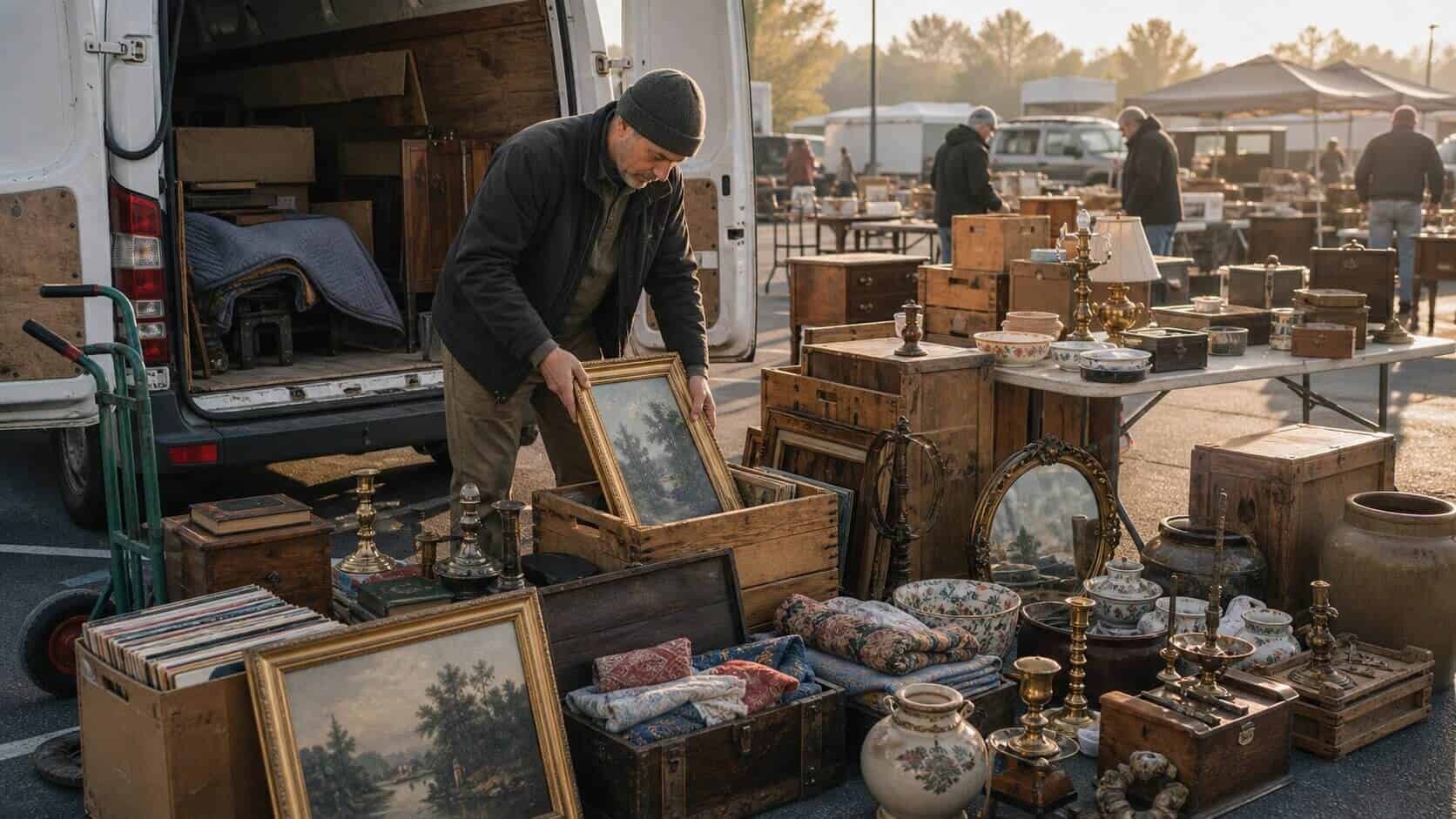

Walk into any successful flea market — Nashville, Lille, a dusty county fairground — and you’ll quickly spot the vendors with the best-stocked stalls. They didn’t get there by accident. Knowing where to source flea market merchandise is one of the most searched questions in the resale world, and for good reason. Your sourcing decisions shape everything: the price you can ask, the story you can tell, the margin you can make.
Most successful vendors like you use several sourcing channels at once, rotating between them depending on the season, what’s moving, and what the next market crowd is likely to want. The options below cover the main sourcing routes — with notes on what each one actually offers a reseller, not just a casual buyer.
Before you commit: define cost, risk and feasibility
Before chasing any particular sourcing channel, it helps to set a clear baseline: how much can you spend to acquire stock, how quickly do you need to recoup it, and how much uncertainty can you absorb if items don’t sell at the price you expected? Buying vintage or antiques for resale is a fundamentally different exercise from buying for yourself. A piece that excites you personally is not automatically a piece the market will price well. Getting honest about cost, risk and feasibility before you commit saves a lot of painful inventory later.
Acquisition cost versus realistic resale price. The margin has to work before you buy, not after. A common mistake among new vendors is anchoring to what an item sold for somewhere else — a sold listing on a resale site, a price tag at another stall — without accounting for the full cost of sourcing it themselves: travel, entry fees, time, packing and any restoration. At estate sales, for instance, prices can be genuinely reasonable and condition can be excellent, particularly on items that have sat undisturbed in a home for decades. But even there, popular categories such as mid-century furniture or art glass attract competitive buyers, and bargain assumptions don’t always hold.
Risk varies dramatically by channel. Buying from a known dealer or established antique fair carries a degree of accountability — provenance questions can be asked, and the seller is often reachable after the transaction. Buying remotely through online auctions or live-sale groups carries more uncertainty: condition is harder to assess from photographs, and return options are frequently limited. That risk isn’t a reason to avoid those channels, but it does affect how much you should be willing to pay relative to expected resale value. The wider the information gap, the lower your acquisition ceiling needs to be.
Feasibility means matching the channel to your actual setup. A vendor working a small regional market on weekends has different logistics from someone running a full booth at a major monthly event. Some sourcing routes — wholesale liquidation lots, for example — can generate volume quickly but require storage space and upfront capital. Others, like sourcing from individual flea markets or vide-greniers, are slower and more labour-intensive but carry lower financial risk per item. Know your storage capacity, your transport limits and your sell-through rate before committing to a channel that demands scale you don’t yet have.
One practical rule that experienced resellers tend to apply: aim to buy at a price that leaves room to negotiate at point of sale. Flea market shoppers expect to haggle, and if your acquisition cost leaves no room to move on price, you’ll either lose sales or take losses. Building that buffer in at the sourcing stage, not the selling stage, is what separates sustainable resellers from ones who burn through their buying budget and wonder why the margin never materialised.
Choose the right method: compare options, timing and trade-offs
Not every sourcing channel suits every vendor, and the best resellers tend to match their method to the moment — the season, the market they’re targeting, the category they’re buying in. Each route has a natural rhythm and a distinct set of trade-offs. Understanding those before you show up with cash in hand makes the difference between a productive sourcing run and a frustrating one.
Flea markets, brocantes and vide-greniers
Other markets are the most accessible entry point for new resellers and remain a reliable staple for experienced ones. The top-tier events draw professional dealers who know their prices, but smaller regional markets and vide-greniers — where private individuals clear out homes — are where genuine bargains still surface. Timing matters here: arrive early for first pick, but arrive late if you’re willing to negotiate hard, since sellers moving unsold stock in the last hour are often motivated. The trade-off is inconsistency: great finds one week, nothing useful the next. Build a rotation of events rather than relying on one.
Estate sales and house clearances
Estate sales offer some of the best conditions for resellers: items that have sat undisturbed in a single home, often with provenance intact and prices set to clear rather than maximise. Dedicated listing sites compile sales by location, which saves driving speculatively. The catch is competition — popular categories attract organised buyers who arrive prepared and move fast. If you’re buying for resale rather than personal collection, prioritise categories where you have genuine knowledge of the resale market, not just a vague sense that something looks old and interesting.
Antique fairs and market extravaganzas
Large antique fairs and multi-day market events concentrate professional dealers and serious stock in one place, which is efficient for sourcing across multiple categories in a single trip. Prices tend to reflect that professionalism — dealers know their inventory — but there’s still room to negotiate, particularly toward the end of a multi-day event. These are better suited to resellers with a clear category focus and enough buying budget to make the entry cost and travel worthwhile. Going without a clear brief invites unfocused spending.
Thrift stores and charity shops
Thrift stores reward consistency more than occasional visits. Stock turns over continuously, and the best finds go quickly to regular browsers who visit on restocking days. Pricing is set by staff rather than sellers with deep category knowledge, which creates genuine opportunities — but the same gap means mislabelled or unrecognised items can disappear before you spot them. If you’re sourcing from thrift stores at volume, frequency beats luck. The trade-off versus estate sales is that there’s no provenance and no story to tell a buyer.
Online auctions and live-sale groups
Online channels — auction platforms and social media live-sale groups — extend your sourcing reach beyond what’s geographically accessible. That’s the obvious advantage. The disadvantages are equally obvious: you’re buying from photographs, condition descriptions vary in reliability, and return options are often limited or non-existent. For resellers, remote buying raises your information risk, which should lower your maximum acquisition price accordingly. These channels work best for resellers who know a specific category well enough to spot misidentified or undervalued lots from images alone — jewellery, ceramics, a particular type of vintage clothing. General browsing without that knowledge tends to produce expensive mistakes.
Wholesale and liquidation lots
Wholesale liquidation offers volume and speed at the cost of curation. You may acquire fifty items to sell ten good ones, which requires storage space, sorting time and a reliable way to move the remainder. For vendors targeting a general-merchandise stall rather than a curated vintage booth, this can make sense. For anyone building a reputation around quality or category expertise, mixed lots can dilute the offer. It’s a channel that scales, but only if your setup can absorb the logistics.
Execution checklist: questions, paperwork, safeguards and mistakes to avoid
Knowing where to source is only half the equation. The other half is what you do — and don’t do — once you’re standing in front of a potential purchase. Resellers who lose money rarely do so because they chose the wrong sourcing channel; they usually lose it because they skipped a step at the moment of buying. Work through the following before money changes hands.
Questions to ask before you buy
Whether you’re at an estate sale, an antique fair or bidding remotely, get answers to the same core questions every time. What is the item’s provenance — where has it been, who owned it, and for how long? Is the condition exactly as presented, or are there repairs, replacements or restorations? For online purchases, ask for additional photographs in natural light before committing. At live sales, ask why the lot is being sold now; the answer occasionally surfaces useful context. If a seller can’t or won’t answer basic questions, treat that as information in itself.

Paperwork and receipts
Always get a receipt, even at informal markets. A dated receipt naming the seller and describing the item protects you if a buyer later questions authenticity or origin. For higher-value pieces — jewellery, signed artwork, named furniture makers — ask whether any supporting documentation exists: old auction records, appraisals, photographs of the item in situ. Documentation adds resale value and reduces the burden of proof on you. Keep physical receipts scanned and backed up; paper deteriorates, and a lost receipt at a customs check or an insurance claim is a genuine problem. If you’re reselling across borders, research import and export restrictions for specific categories — certain antiques, wildlife-derived materials and cultural objects carry legal obligations that vary by country.
Safeguards against common mistakes
Set a maximum price before you enter a negotiation, not during it. Auction momentum, end-of-day pressure and the sunk cost of travel all push buyers above their sensible ceiling. Write the number down if it helps. For online lots, factor shipping, insurance and any import duties into your ceiling before you bid — not after you’ve won. For wholesale and liquidation, inspect a sample of the lot rather than assuming the visible top layer represents everything underneath. Mixed lots sold “as is” rarely improve on closer inspection.
Avoid buying outside your category knowledge under time pressure. The best sourcing channels — estate sales, live auctions, antique fairs — all create urgency by design. Urgency is useful to sellers; it works against buyers. If you’re uncertain whether something is genuine, rare or resalable, the correct decision is almost always to pass and research rather than buy and hope. A missed opportunity costs nothing. A misidentified purchase costs storage space, time and the original outlay.
Finally, track what you pay and what you sell for, item by item. It sounds obvious, but many part-time vendors operate on feel rather than data. A simple log of acquisition cost, source channel and eventual sale price will tell you, over a season, which sourcing method actually works for your category — and which one you’ve been romanticising.
What Makes a Good Sourcing Decision
The vendors with the most consistently well-priced stalls share one habit: they treat every sourcing trip as a business decision, not a treasure hunt. That means knowing your category well enough to price on the spot, tracking what actually sells rather than what excites you in the moment, and building relationships — with estate sale organisers, thrift store managers, auction house staff — that give you an edge over casual buyers. The sourcing channel matters less than the discipline you bring to it.
Frequently Asked Questions
Is it legal to buy items at estate sales and resell them at a flea market?
In most jurisdictions, yes — purchasing second-hand goods and reselling them is entirely legal. The main practical consideration is honest representation: describe condition accurately and don’t overclaim provenance you can’t verify. Tax treatment of resale income varies by country and by the volume of sales, so if you’re running a regular stall, it’s worth checking the rules that apply locally before you scale up.
What’s the difference between buying at a live auction versus an online auction?
At a live auction you can inspect items in person during the preview, read the room during bidding, and take stock home the same day. Online auctions offer convenience and much wider geographic reach, but you’re relying entirely on photographs and condition reports — and shipping costs can significantly affect your margin. Both types typically charge a buyer’s premium on top of the hammer price, so factor that in before the lot closes, not after.
How do vendors decide which sourcing channel to focus on?
Most vendors develop a specialty over time — a category they know well enough to spot underpriced pieces quickly. The practical test is straightforward: what would this item realistically sell for at your stall, and does the sourcing price leave enough margin after transport, cleaning or repair costs? Buy what you understand. Knowing the difference between a reproduction and an original, or recognising a maker’s mark, directly determines whether a sourcing trip makes money.