

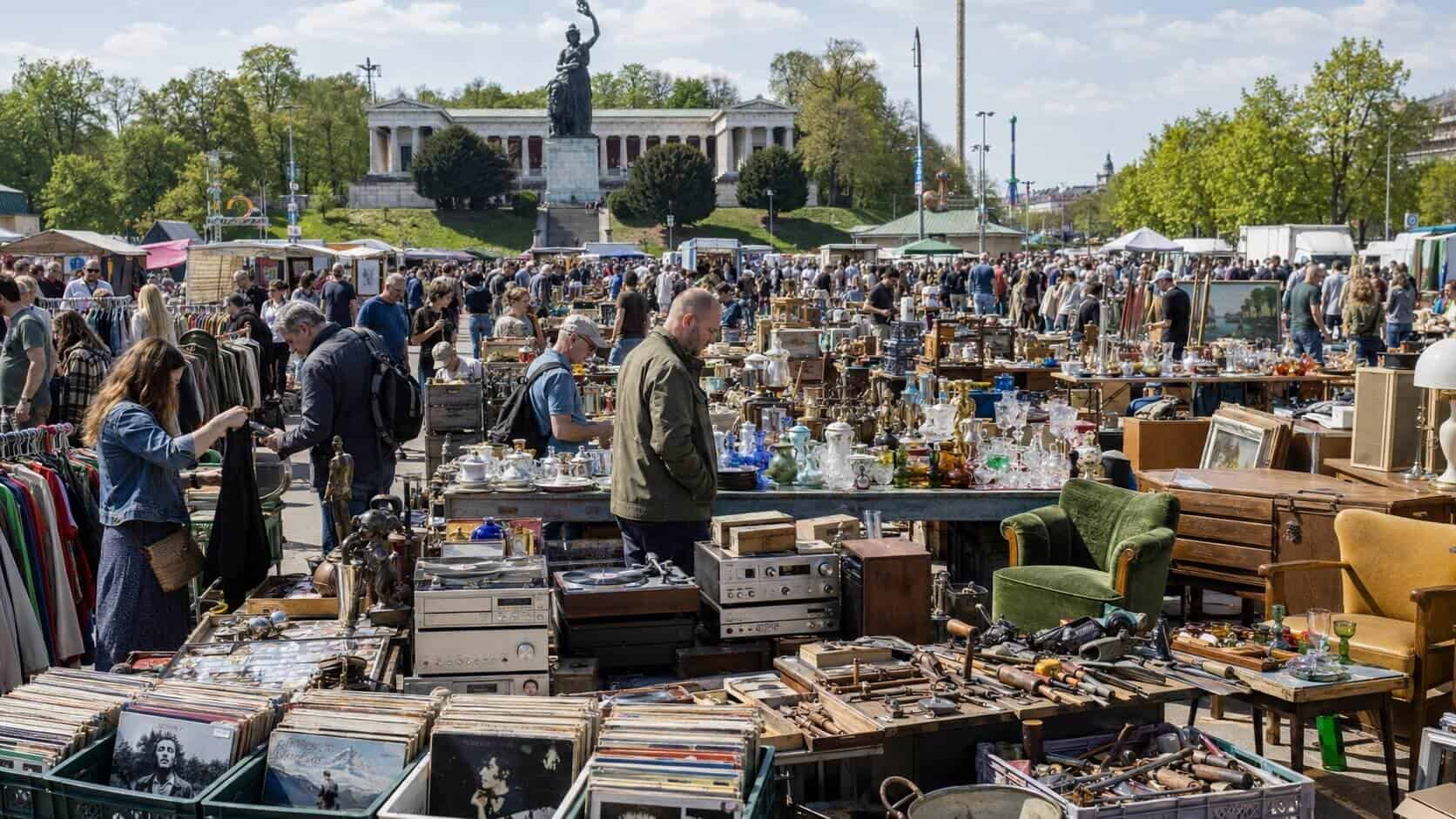

At six o’clock on a Saturday morning in April, the Theresienwiese flea market Munich — the Riesenflohmarkt auf der Theresienwiese — is already moving. Locals arrive pulling folding trolleys. Collectors arrive with a list. The stalls stretch in long rows across the same vast open ground that hosts Oktoberfest a few months later, only here the atmosphere is quieter, more purposeful, and considerably cheaper.
The Riesenflohmarkt is one of the largest single-day flea markets in Europe. It runs once a year, on the first Saturday of Munich’s Frühjahrsfest (Spring Festival) in April, and draws visitors from across Germany and well beyond. The scale is hard to overstate: around 2,000 stalls, somewhere in the region of 80,000 visitors on a good day, and a stall mix that covers mid-century furniture, Bavarian militaria, vintage clothing, ceramics, vinyl and general household goods priced to move.
If you’re planning to visit one of Europe’s great spring flea markets, this is the one worth building a Munich weekend around.
Scale, Stock and What the Riesenflohmarkt Does Differently
Most flea markets occupy a square or a car park. The Theresienwiese is neither. It’s a proper event ground — wide, flat and open — and the Riesenflohmarkt uses every metre. Stalls run in long parallel rows that take time to walk end to end. There are no shortcuts; if you want to see it all, plan on several hours and comfortable shoes.
The stall mix leans more varied than specialist. You’ll find boxes of used kitchen ware next to a table of 1970s design furniture next to someone selling Bundeswehr surplus. The antique and mid-century furniture section is particularly strong relative to the market’s overall size — pieces that would command serious prices at a dealer turn up here at negotiated rates, especially early in the morning before the crowds thicken and the better finds disappear.
Categories typically represented include:
- Vintage and second-hand clothing
- Vinyl records and audio equipment
- Mid-century and antique furniture
- Bavarian and European militaria
- Ceramics, glassware and kitchenware
- Used electronics and tools
- Books, maps and printed ephemera
- Jewellery and decorative objects
Prices are generally negotiable. Sellers are there to sell, not to transport unsold stock home. Cash is strongly recommended — card payment acceptance varies considerably by vendor, and it’s wise not to rely on it.
The market opens at 06:00 and closes at 16:00. The earliest hour is genuinely the best hour: light is improving, the site isn’t yet crowded, and the serious sellers — the ones with the better stock — are ready and willing to deal. By 10:00 the atmosphere shifts; it becomes more of a day out than a hunting ground.
If you want a longer immersive account of what a full day at the Riesenflohmarkt actually feels like, our eyewitness report from a previous edition covers the experience in detail — the rhythm of the stalls, the atmosphere, what sold and what didn’t. The practical logistics have changed; the character of the market has not.
On the haggling question: the Riesenflohmarkt rewards confident, polite negotiation. Sellers expect offers. A direct, respectful approach works far better than hesitation or elaborate justification. For a primer on how to approach flea market negotiations, our guide to flea market haggling covers the basics well.
How to Get There — and When to Arrive
The Theresienwiese is one of Munich’s most accessible event grounds. The U4 and U5 U-Bahn lines both stop at Theresienwiese station, which puts you directly at the site entrance. From the Hauptbahnhof it’s two stops. Walk out of the station and the market is in front of you.
On market day, the U-Bahn is by far the better option. The Theresienwiese has no meaningful car parking, and the surrounding streets fill quickly. Anyone driving in from outside Munich should park centrally and use public transport for the last stretch.
On the question of timing: the market opens at 06:00, and that first hour is the one that matters most. The stalls with the more considered stock — the furniture, the militaria, the better-condition ceramics and vinyl — are set up and ready from the opening bell. Sellers who have driven in from elsewhere want to move pieces before hauling them home. Early arrivals negotiate from a position of genuine advantage.
By mid-morning the atmosphere is more relaxed and more crowded. That’s not a problem if you’re there for the experience rather than the hunt. But if you’re a serious buyer, 06:00 is not an aspiration — it’s a plan.
Bring cash. Plenty of it. A few stalls may accept card payment, but the majority won’t, and there’s no guarantee of an ATM nearby once you’re inside the market rows.
Wear layers. April in Munich can be cold at 06:00 even on a clear spring morning, and the Theresienwiese is exposed — there’s no shelter from wind on the open ground. By midday it can feel warm and pleasant. Dress accordingly.
The History Behind the Market — and the Ground It Stands On
The Theresienwiese has been Munich’s great public gathering ground for two centuries. Named after Princess Therese of Saxe-Hildburghausen, whose marriage to Crown Prince Ludwig in 1810 gave the city its first Oktoberfest, the field has always been a place where Munich comes together in large numbers for a collective event. The Riesenflohmarkt — the “giant flea market” — continues that tradition in a quieter register.
The market is organised by the Bayerisches Rotes Kreuz (BRK München), the Bavarian Red Cross, which is one of the reasons it has maintained a consistent character over the years. Proceeds support BRK charitable work. That structure — a major charity running a single enormous annual market — gives the Riesenflohmarkt a different feel from purely commercial events. Sellers apply for stalls through the BRK; it is not a casual drop-in arrangement.
The market runs as part of the Frühjahrsfest, Munich’s spring festival, which occupies the Theresienwiese each April before the summer season begins. The Riesenflohmarkt takes place on the first Saturday of the Frühjahrsfest — the one day per year the flea market fills the ground. That single-day format contributes directly to the sense of occasion. There’s no next weekend. Either you’re there or you miss it for another year.
For collectors visiting Munich in spring, the timing aligns well with other spring flea market events across Europe — it’s worth building an itinerary around the region if the trip is primarily about markets.
📍 Address: Theresienwiese (Matthias-Pschorr-Straße 1), 80336 Munich
📅 When: Once a year — first Saturday of the Spring Festival (April)
🕐 Hours: 06:00–16:00
💰 Admission: Free
🚇 Transport: U4/U5 to Theresienwiese
⚠️ Verify exact date before travelling.
Where to Stay in Munich
The Riesenflohmarkt starts at 06:00, which means an early alarm — and that’s a much easier prospect if you’re already in Munich the night before. The Theresienwiese is well connected to the city centre, and most central Munich hotels are within two U-Bahn stops of the market site. The Hauptbahnhof area has the broadest range of options across budgets, from business hotels to smaller independent places; Schwabing and Maxvorstadt are worth considering if you prefer a quieter neighbourhood with good transit links. Booking early is advisable if your visit coincides with the Frühjahrsfest weekend — Munich fills up quickly during its festival calendar.
Frequently Asked Questions
When does the Theresienwiese flea market take place?
The Riesenflohmarkt runs once a year, on the first Saturday of Munich’s Frühjahrsfest in April. It is a single-day event — there is no second date and no rescheduled fallback. The exact date shifts slightly from year to year depending on when the Frühjahrsfest opens.
How do I get to the Theresienwiese by public transport?
The U4 and U5 U-Bahn lines both stop at Theresienwiese station, two stops from München Hauptbahnhof. Walk out of the station and the market site is directly in front of you. On market day, public transport is the practical choice — the surrounding streets fill quickly and on-site parking is not available.
Is the Riesenflohmarkt good for serious collectors, or mainly casual browsers?
Both, but at different hours. Serious buyers — particularly those after mid-century furniture, vintage ceramics, vinyl or militaria — should arrive at opening time (06:00) when the better-condition stock is still on display and sellers are most willing to negotiate. By mid-morning the market shifts tone: more visitors, less urgency, fewer of the stronger pieces. If you’re there primarily for the atmosphere and the general browse, mid-morning onwards is perfectly enjoyable. Either way, bring cash — card acceptance among individual sellers is unreliable.
Who organises the market, and can I apply for a stall?
The market is organised by BRK München — the Bayerisches Rotes Kreuz, Bavaria’s Red Cross. Proceeds support BRK charitable work, which gives the event a different structure from purely commercial flea markets. Stalls are allocated through an application process run by the BRK rather than on a walk-up basis. ⚠️ If you’re interested in trading, contact BRK München directly to confirm the current application process, deadlines and any stall fees — details change from year to year.