

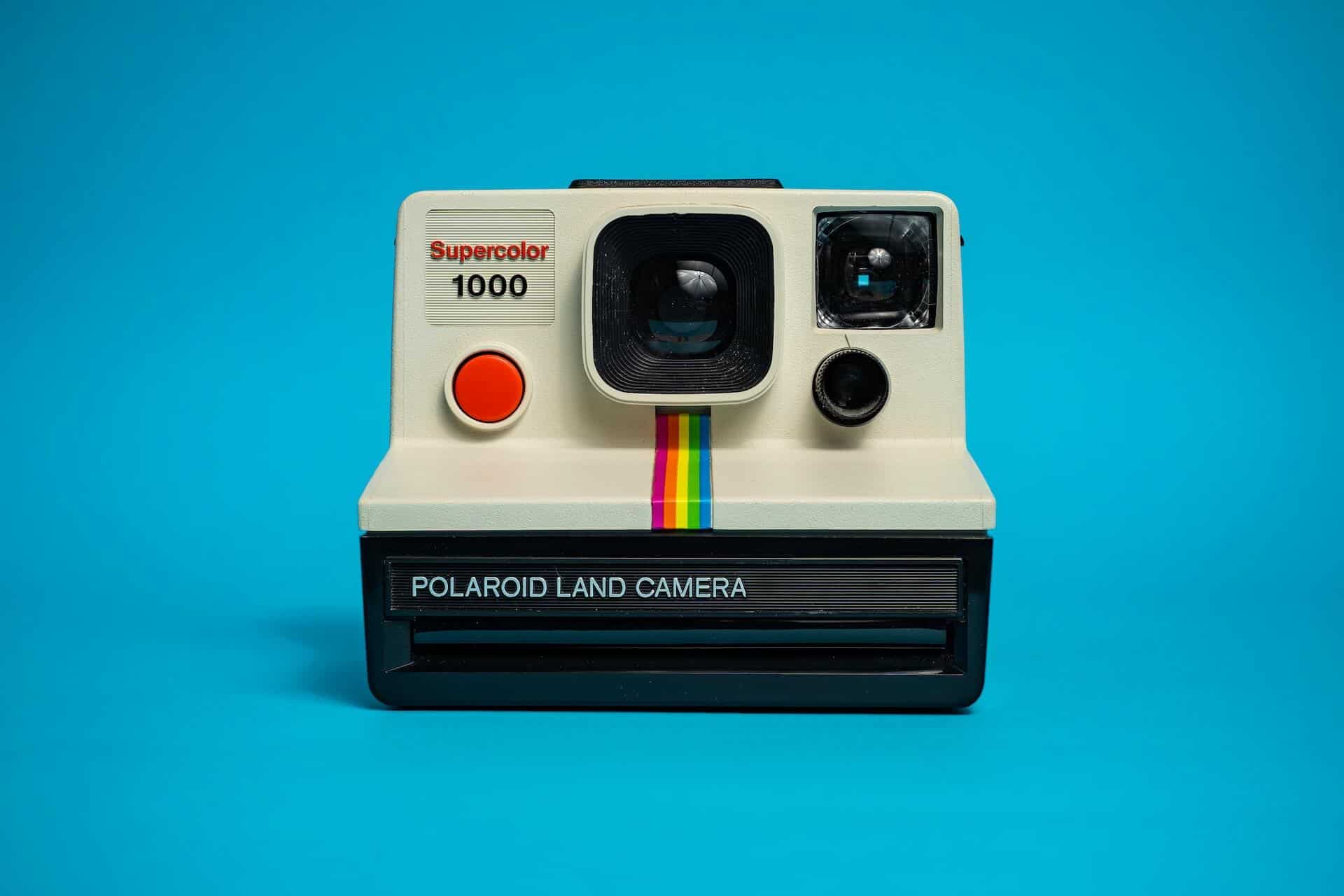

Pull a Polaroid 1000 out of a cardboard box at a flea market and something odd happens — people stop. The cream plastic body, the bold rainbow stripe across the front, the satisfying heft of it in both hands. It doesn’t look like a piece of technology so much as a souvenir from a decade that had more confidence in primary colours than any era before or since. Launched in 1977, the 1000 was Polaroid’s bid to strip instant photography down to its simplest possible form: point, press, wait, peel. No folding mechanism, no manual focus ring, no exposure arithmetic. Just a fixed-body box camera that let anyone — regardless of experience — walk away with a print in under two minutes.
That non-folding design sets it apart from the more celebrated Polaroid SX-70, which collapses flat and carries a certain industrial elegance, and from the later Polaroid 600, which refined the formula with a higher-speed film system. The 1000 is the blunter instrument — deliberately so. And that bluntness, paradoxically, is what makes it interesting to collectors. It survived in large numbers because it was cheap, robust and widely sold across Europe and North America, which means second-hand examples still turn up in everything from charity shops to serious vintage fairs in surprisingly usable condition. The question isn’t usually whether you can find one. It’s whether the one in front of you is worth buying.
This review works through the camera system piece by piece — the body design and materials, the fixed-focus lens, the flash bar arrangement, the film and battery loading — with a collector’s eye on condition, variants, and what the 1000 is genuinely good at in 2026. One small but telling detail to start with: the shutter button comes in two colours, red or green, and the debate between enthusiasts over which variant is preferable has outlasted several much more significant photographic arguments.
Design Elements and Unique Functions
The Polaroid 1000’s design is not subtle, and it was never meant to be. The front face of the camera is dominated by the rainbow stripe — a band of red, orange, yellow, green and blue that runs horizontally across the body and wraps the brand’s identity into the object itself. It was a deliberate piece of product design in an era when consumer electronics were beginning to understand that looks sold units. The stripe is so recognisable that it has since become shorthand for the entire Polaroid aesthetic, reproduced on merchandise, clothing and retrospective branding long after the original cameras stopped rolling off the line.
Beneath the styling, the body is a single-piece moulded plastic shell — creamy white, slightly warm in tone rather than bright white, with a texture that picks up handling marks and light scratches over time. The outer shell holds up remarkably well as a material, though yellowing is the most common cosmetic issue on older examples. The cream tones can shift toward a more jaundiced ivory depending on how much ultraviolet exposure the camera has seen over its lifetime. This doesn’t affect function, but it does affect display value.
When buying at market, run your thumb across the front and sides. Surface scuffs are cosmetic and essentially unavoidable on a camera this age, but look more carefully at the corners, which bear the brunt of any drops, and at the film door hinge at the back, which can develop a slight warp if the camera has been stored in a damp environment. A warped film door means light leaks, and light leaks on instant film are not the charming, lo-fi effect they can be with 35mm — they tend to simply ruin the image.
The rainbow stripe is also worth checking closely. On authentic original examples, it should sit flush with the body surface and show clean colour separation. Fading or lifting at the edges is a sign of age but does not disqualify an otherwise functional piece. What it can indicate is that the camera spent time in damp or humid conditions, which is worth bearing in mind when you then check the film door seal and internal condition.
The shutter button sits on the top of the camera and comes in either red or green depending on the production variant. Functionally the two are equivalent, and the distinction is cosmetic rather than mechanical. Among collectors, however, the colour provokes genuine allegiance — the red-button version is often described as the more classic-looking of the two, while the green button is sometimes associated with specific regional or later production runs. Whether that matters to you depends on whether you’re buying to shoot or buying to display, but it’s worth knowing the difference exists before you pay a premium for one over the other based on a seller’s confident but possibly improvised claim about rarity.
The lens is fixed-focus, set for subjects roughly 1.2 to 1.5 metres away and beyond. Get closer than that and the image softens noticeably — the fixed optics simply can’t compensate for the distance. Some photographers treat this as a limitation to work around; others lean into it deliberately, using the gentle blur on foreground subjects to give portraits and still-life shots a slightly impressionistic quality that suits the warm palette of SX-70-format instant film particularly well. The practical upshot at a market stall is straightforward: if the lens element looks clean through the viewfinder and the aperture blades move freely, the optical system is likely in serviceable shape. Haze or fungal bloom inside the lens is harder to remedy without specialist tools and is worth factoring into the price accordingly.
One functional detail that often surprises first-time buyers is the lack of any manual exposure control. The 1000 meters the scene automatically through a small photocell on the front of the body and adjusts accordingly — within limits. It handles average daylight and indoor flash situations competently, but it struggles in mixed or very contrasty light. The exposure compensation slider, a small wheel or switch depending on the specific variant, shifts the meter reading lighter or darker and is the only user input the camera offers beyond composing and pressing the button. Check that this control moves freely and returns to the mid-position; a seized or sticky compensation wheel is one of the more common issues on older examples and affects results more than most visible faults.
Size and Weight: Compact and Lightweight
For a camera that looks, at first glance, like a small brick, the Polaroid 1000 is surprisingly manageable in the hand. The body is chunky by modern standards — this is emphatically not a camera you slip into a jacket pocket — but the weight is light enough that carrying it around a flea market or swap meet for a few hours never becomes a chore. The hard plastic shell accounts for most of the bulk; the actual mechanism inside is relatively minimal, which keeps the overall mass down.
The non-folding, fixed-body design is worth understanding in context. Where the Polaroid SX-70 collapses flat for storage — a genuinely elegant piece of industrial design — the 1000 stays the same shape whether it’s in use or sitting on a shelf. That means it takes up more bag space, but it also means there are no folding joints to crack, no bellows to deteriorate, and no collapsing mechanism to seize up after decades in a drawer. At a market stall, this structural simplicity is one of the first things that works in a second-hand example’s favour: there’s comparatively little to go wrong in purely mechanical terms.
The proportions also make the camera easy to hold with both hands without feeling awkward. The shutter button sits naturally under the index finger of the right hand, and the film ejection slot at the front is positioned so that the developing print emerges without requiring you to reposition your grip. For buyers who intend to actually shoot with the camera rather than display it, this ergonomic directness is one of the more underrated qualities of the design — it was built for people who had never used a camera before and needed to be able to operate it immediately, without instruction.
When handling an example at a market, the weight itself can serve as a rough diagnostic. A Polaroid 1000 that feels unusually light may have had its battery compartment stripped or a component removed; one that rattles when gently shaken deserves a closer look for loose internal parts. Neither is necessarily disqualifying, but both are worth noting before agreeing on a price. The film door should close with a firm, clean click — any looseness there is a more significant concern, because a poorly sealing door admits light that will damage instant film at the point of exposure rather than during development.
Technical Features: User-Friendly Yet Versatile
Strip away the nostalgia and the Polaroid 1000 is, at its core, a camera designed to succeed where others had made consumers feel inadequate. Polaroid’s engineers built it around a philosophy of automatic everything — automatic exposure, automatic flash detection, automatic film advance. The technical architecture was deliberately undemanding, but that simplicity conceals some genuinely clever engineering decisions that still hold up when you actually load film and shoot.
The lens is fixed-focus, set at a distance optimised for general social photography — a group at a party, a face across a table, a subject standing in a garden. This is not a camera built for macro work or for compressing distant landscapes. The practical minimum is roughly 1.2 to 1.5 metres; closer than that and the fixed optics cannot produce a sharp result. Experienced shooters working with the 1000 know this boundary well and use it deliberately — subjects placed nearer than the focus plane dissolve into a soft blur that can be atmospheric with the right lighting and film stock, but is simply a missed shot if you were expecting definition. For flea market use, where you might want to document a find up close, it is worth keeping that distance in mind.
Exposure is handled by a built-in electronic system that reads available light through a sensor on the camera front and sets the aperture and shutter speed accordingly. There is no manual override in the conventional sense — the 1000 does not offer dials, rings or mode switches. What you do have is a lighten/darken control, sometimes described as an exposure compensation slider, which allows you to nudge the automatic reading in either direction. In practice this becomes one of the most useful tools you have, particularly when shooting subjects against bright windows or in mixed indoor-outdoor light where the automatic system might expose for the wrong part of the frame. Collectors who buy to shoot rather than display should test this slider as part of any pre-purchase evaluation — a stuck or unresponsive compensation control is a meaningful defect, not a cosmetic one.
The shutter mechanism is electronically controlled and integrates with the flash detection circuit, so the camera can determine whether the ambient light is sufficient or whether flash is required. This was a genuine advance for a consumer camera at this price point in the late 1970s. It meant that users with no photographic knowledge could produce reasonably exposed images across a range of conditions without making any decisions themselves. For the collector buying today, the flip side is that a fault in the electronic control board affects multiple functions simultaneously — an important reason to test the camera with a film pack before committing to a purchase, or to factor the cost of a CLA (clean, lubricate, adjust) service into your budget if you’re buying from a stall where testing isn’t possible.
The Polaroid 1000 was originally designed around SX-70 integral film, and the battery that powers the camera is built into each film pack rather than stored separately in the body. This integration means that a dead or depleted film pack renders the camera inoperable regardless of the body’s condition — a quirk that surprises first-time buyers but is actually an elegant solution to battery maintenance for a device that might sit unused between shoots. The practical implication for second-hand buyers is that a Polaroid 1000 sitting on a flea market table with a film pack still loaded may have a dead battery regardless of how the body looks. Always confirm the body alone is your purchase; the film is a consumable.
None of these technical choices are accidental. The Polaroid 1000 was engineered to remove every decision point that might cause hesitation or error — and that same logic makes it genuinely accessible to contemporary users who pick one up with no prior experience of analogue photography. The learning curve is shallow, the results arrive in minutes, and the fixed parameters that might frustrate a technical photographer become liberating for someone more interested in the image than the process. It remains one of the easier vintage cameras to recommend without heavy caveats, which is part of why it continues to move steadily through second-hand markets rather than gathering dust in collector storage.
Viewfinder and Eyepiece: Ensuring Comfort and Precision
The viewfinder on the Polaroid 1000 is a simple optical design — a small rectangular window positioned in the upper-left corner of the front face, paired with the eyepiece on the rear. It won’t impress anyone accustomed to SLR cameras, but it was never meant to. For a device engineered around point-and-shoot simplicity, the viewfinder does its job with minimal friction: you raise the camera, you see roughly what you’re going to get, and you press the shutter.
The emphasis here is on “roughly.” The viewfinder on the 1000 is a bright-line style with no rangefinder coupling and no focus confirmation — because there is no focusing to confirm. The lens is fixed, and framing is the only compositional decision the camera asks of you. What the viewfinder gives you is a sense of the scene’s boundaries, which is enough for the kind of relaxed, social photography the camera was built for. For tighter or more deliberate compositions, experienced users learn to account for the slight parallax offset between the viewfinder position and the actual lens — a gap that becomes particularly noticeable at closer distances.
That minimum focusing distance is worth keeping in mind when you’re composing through the eyepiece. The viewfinder gives no visible warning when you’ve moved inside that threshold. You simply get a softer, slightly diffused image on the developed print. Some instant film shooters have come to embrace this quality, particularly in low light or when photographing subjects with strong colour, where the mild blur reads as atmospheric rather than accidental. But if you’re buying a Polaroid 1000 at a market stall to use seriously, it’s a characteristic to understand in advance rather than discover on the first pack of film.
The eyepiece itself is a small rubber-edged window designed to press reasonably comfortably against the brow. By contemporary standards it is modest, but in context — a late-1970s consumer camera sold to people who had never used a camera before — it represents a considered ergonomic choice. The rubber surround softens contact with the face and provides some light exclusion when shooting in bright conditions, reducing the washout that can make bright-line viewfinders difficult to read outdoors.
When evaluating a second-hand Polaroid 1000, the viewfinder and eyepiece are among the first things worth examining physically. The rubber eyepiece surround degrades with age and exposure to light — look for cracking, hardening or compression that has flattened the seal against the body. A deteriorated eyepiece is a cosmetic issue rather than a functional one, and replacement surrounds do surface occasionally in the vintage camera parts trade, but it’s a detail that signals how carefully a previous owner stored the camera. A 1000 that has been kept in a bag or case will typically show less eyepiece degradation than one left on a shelf in direct light for years.
The glass or plastic lens of the viewfinder itself should be checked for fogging, scratches and haze. Minor dust inside the viewfinder chamber is common in cameras of this age and doesn’t affect the photograph — it only affects what you see when composing. More significant internal fogging, caused by off-gassing from degraded foam or adhesive inside the body, can make the viewfinder genuinely difficult to use in lower light conditions. Hold the camera up to a bright window and look through both ends of the viewfinder to get a clear sense of its condition before you commit to a purchase.
None of this should put buyers off. The Polaroid 1000’s viewfinder limitations were shared by virtually every consumer camera of its era and price bracket, and they remain a manageable feature rather than a real obstacle. For flea market collectors who want a camera that actually shoots, it’s a straightforward system with few moving parts to fail — and that simplicity is a meaningful advantage over more mechanically complex vintage cameras that require careful servicing before they’ll produce a usable image.
The Flash Bar: Illuminating the Scene
One of the more distinctive accessories associated with the Polaroid 1000 is the flash bar — a removable strip of individual flash bulbs that slots into a socket on the top of the camera body. Unlike the built-in electronic flashes that became standard on later compact cameras, the flash bar is a deliberately low-tech solution: each bulb fires once and that’s it. When you’ve worked through the row, you flip the bar around to use the bulbs on the other side, then discard it entirely.
The Q-Light flash bar is the accessory most commonly associated with the 1000, and finding one in working condition at a flea market alongside the camera is a minor coup. Because the bulbs are single-use and have a finite shelf life, many bars found loose in market bins or bundled with old camera lots will be partially or fully spent. A quick visual check tells you most of what you need to know: fired bulbs have a visibly blackened or frosted interior, while unused ones remain clear. A bar with several intact bulbs is still genuinely useful — you don’t need a full complement to get real value from it.
For collectors buying a Polaroid 1000 to shoot rather than display, the flash bar question matters more than it might initially seem. The camera’s fixed-aperture lens is calibrated for outdoor daylight conditions. Indoors, or in the kind of low ambient light that characterises evening gatherings — precisely the social situations the 1000 was marketed towards — flash becomes less optional and more essential. Without it, underexposure is the predictable result. The lighten/darken slider on the front of the camera offers some correction, but it has limits, and no amount of slider adjustment compensates for a genuinely dark room.
That said, the flash bar gives the Polaroid 1000 a period-authentic quality that contributes meaningfully to its appeal as a shooting camera. The popping single-use bulbs, the slight warm cast they produce, the physical ritual of checking which bulbs remain — these are part of what makes using the camera feel different from anything digital. Collectors who shoot Instax or 600-era film in other cameras and then pick up a 1000 with a Q-Light bar often comment on how the process itself becomes part of the experience rather than a background function.
When assessing a flash bar at a market, handle it carefully. The contact pins that connect the bar to the camera’s hot shoe socket can corrode or bend, and a bar that looks intact may not make a reliable electrical connection. If you’re buying camera and flash bar as a bundle, try to test the fit before you pay — the bar should seat firmly without wobbling. Loose contact is a common source of misfires and is worth factoring into any negotiation on price.
Replacement flash bars do still surface — at camera fairs, in vintage electronics stalls, and occasionally in the back drawers of general bric-a-brac dealers who haven’t identified what they have. The packaging from the late 1970s and early 1980s is collectable in its own right, and a sealed bar in original box represents a small but genuine find for dedicated Polaroid collectors. For anyone buying purely to use the camera, though, it’s also worth knowing that modern alternatives exist in the form of electronic flash adapters designed to fit the same socket — a practical workaround that doesn’t compromise the shooting experience as much as it might sound.
Battery and Film Cartridge: Innovative and Convenient
One of the most genuinely clever engineering decisions Polaroid made with the 1000 is the way it handles power. The camera has no separate battery compartment, no AA cells to source or replace. Instead, the battery is built directly into the film cartridge itself. Every pack of SX-70 film — the type the Polaroid 1000 uses — contains a flat six-volt battery integrated into the cartridge base. Load a fresh pack of film and you load a fresh power source at the same time. It is a deceptively simple idea, and it solves a problem that plagues many vintage cameras: the question of whether an old battery is the reason nothing is happening.
For flea market buyers, this has a useful practical implication. If you pick up a Polaroid 1000 at a brocante or car boot sale and want to test it on the spot, you don’t need to carry spare batteries or worry about dead cells that have been sitting inside the body for decades. As long as you have a cartridge of compatible film — or can find someone at the stall with one — the camera either works or it doesn’t. There’s no battery corrosion to scrape out of the contacts, no leaking AA cells to contend with. The body stays clean in a way that many cameras of the same era simply don’t.
The flip side is equally worth knowing before you buy. A partially used film pack has a partially depleted battery. If someone is selling a Polaroid 1000 with a cartridge already loaded and describes it as “working,” it is worth asking how many shots remain and how long the pack has been in the camera. Polaroid film has a shelf life, and a battery that has sat in a loaded camera for a year or more may not have enough charge left to reliably fire the shutter motor and eject a print. This is one of the more common reasons a used Polaroid 1000 fails its first test: not a mechanical fault, just an exhausted cartridge.
Loading itself is straightforward enough that it requires no instruction manual. The cartridge drops into the camera body through the front-opening door, and the camera automatically ejects the protective dark slide that covers the top sheet of film. That single ejected dark slide is a reliable sign the camera has successfully initialised — if you load a cartridge and nothing ejects, something is wrong, and it is usually either a flat battery or a stuck ejection mechanism. Knowing this makes market testing significantly less guesswork.
The SX-70 film format the 1000 uses is still in active production, which matters considerably for anyone buying to shoot rather than display. Current manufacturers — most notably Polaroid Originals, now trading as Polaroid — produce compatible cartridges, though the film chemistry has evolved from the original formulation. Collectors who shoot regularly with the camera sometimes note that modern film responds differently to the lighten/darken exposure slider than the original SX-70 film did, which means a little experimentation is often needed when using a freshly bought 1000 for the first time. That is a small adjustment, not a dealbreaker, and the camera’s continued usability with current film stock is a genuine advantage over vintage cameras that require long-discontinued formats.
From a collector’s perspective, the integrated battery design also means the camera’s condition can be assessed more cleanly than many comparable vintage pieces. Without a battery compartment, there is one fewer place for corrosion to hide. When examining a Polaroid 1000 at a market, focus your attention on the lens element for fogging, the ejection rollers for dried chemical residue — a common issue when old film has passed through and the camera was never cleaned — and the lighten/darken slider for smooth movement. The rollers in particular are worth a close look: dried emulsion buildup can cause streaks across prints and is painstaking to clean out. A camera whose previous owner shot film regularly and cleaned the rollers periodically is worth more than one that sat loaded and unused for years.

The Polaroid 1000: More Than Just a Vintage Camera
What the Polaroid 1000 ultimately offers — across all its users, past and present — is a rare convergence of simplicity, cultural weight, and physical presence that most cameras from the same period simply cannot match. It was designed to be used by anyone, required no technical knowledge, and produced a photograph that was finished before you had time to second-guess the moment. That philosophy, radical when Polaroid pushed it in 1977, now reads as a kind of deliberate editorial restraint. You point, you press, you wait. The camera decides the rest.
For collectors and flea market buyers, that same philosophy extends to the experience of acquiring one. The Polaroid 1000 is not an obscure or difficult find. It surfaces regularly at car boot sales, brocantes, and thrift stores across Europe and North America — often in reasonable mechanical condition, occasionally still paired with an unused flash bar or an expired film cartridge tucked into a box. Its sheer production volume means supply has not dried up. What has changed is the awareness around it. A camera that once sold for next to nothing at a Sunday market now attracts buyers from several different directions: working photographers who want a shootable instant camera with character, design collectors drawn to the ’70s colour palette and the iconic stripe, and a younger generation for whom instant film carries a tactile appeal that digital photography cannot replicate.
That broadening demand has pushed prices upward at the more visible end of the market — online platforms and curated vintage shops — while market stalls and car boots remain the places where value still surfaces if you know what you are looking at. A camera in full working order with minimal yellowing and an intact rainbow stripe is worth considerably more than a cosmetically tired example with a stiff film door, even if the seller has not yet made that distinction. Learning to assess the cream plastic for UV yellowing, checking the stripe for cracking or peeling, and testing the film door hinge takes less than two minutes at a stall. That small amount of preparation regularly separates a good buy from an overpriced display piece.
It is also worth situating the 1000 within the broader Polaroid collecting conversation. The SX-70 commands higher prices on account of its folding mechanism, metal body, and SLR optics — it is the collector’s Polaroid, the one with technical cachet. The 600 series has its own following driven partly by nostalgia and partly by the ongoing availability of compatible film. The 1000 sits between these poles in an interesting way: more visually iconic than most 600-series cameras, more approachable in price than an SX-70, and more immediately readable as a period object than either. For a collector assembling a shelf that communicates a specific moment in design history, it earns its place on its own terms rather than as a consolation for something more expensive.
The camera’s continued visibility in film and television set dressing, editorial photography, and vintage-themed retail has kept cultural recognition high in a way that purely technical vintage cameras rarely sustain. People respond to it who have never loaded an instant film cartridge, which is unusual for a camera of its age. That recognition is part of what holds market value across buyer types and prevents it from fading into the category of the merely obsolete. It is, in the most useful sense, a crossover object: functional enough for the photographer, specific enough for the collector, legible enough for anyone else who happens to pick it up.
If you are considering adding a Polaroid 1000 to a collection or simply want a working instant camera with genuine period character, the advice is straightforward: handle before you buy when possible, prioritise plastic condition and stripe integrity over cosmetic perfection, and treat the red-versus-green shutter button debate as a preference rather than a valuation criterion unless you are buying specifically for display. The camera rewards a little knowledge and costs very little to get wrong. That, perhaps more than anything else, is what has kept it relevant across nearly five decades.
Finding a Polaroid 1000 in the Wild
The Polaroid 1000 turns up with surprising regularity at flea markets, brocantes and estate sales — partly because it was produced in large numbers, and partly because its size and recognisable design meant owners tended to keep it rather than throw it out. Car boot sales in the UK and vide-greniers across France are particularly reliable hunting grounds, where it often appears alongside other late-1970s household items. In North America, estate and thrift sales in suburban areas frequently surface them in original boxes, occasionally with unused flash bars still attached.
When buying in person, the inspection priorities are consistent: check the plastic body for deep cracks around the film door hinge and the front lens surround, since these are the stress points most prone to damage from mishandling. The rainbow stripe should be examined for peeling at the edges rather than judged on fading alone — some surface wear is expected and does not affect function. Test the shutter button for responsiveness if possible, and confirm the film door seal is intact. Cosmetic marks on the cream body are largely irrelevant to working condition and can work in your favour at negotiation.
Online, expect prices to vary considerably depending on whether the camera is listed as tested and working, untested, or sold purely for parts and display. Boxed examples with accessories command a premium, but a clean, unboxed working camera at a reasonable market price is generally the better practical buy. The red versus green shutter button distinction does surface in listings, sometimes with inflated pricing attached — treat it as a display preference rather than a genuine indicator of scarcity unless you have specific evidence to the contrary.
Frequently Asked Questions About the Polaroid 1000
Is the Polaroid 1000 still usable as a working camera?
It depends what you want from the experience. The 1000 is a fixed-focus, fully automatic camera with no manual overrides — it won’t give you creative control, and the results will always carry that characteristic soft, warm instant-film look rather than precision. For casual shooting, parties, or the specific aesthetic of late-1970s instant photography, it remains a genuinely functional tool. For anyone expecting modern sharpness or consistency, it will disappoint. The main practical limitation is the minimum focusing distance of approximately 1.5 metres — closer subjects will produce soft results. Go in with the right expectations and it’s a rewarding camera to use. Go in expecting a Polaroid SX-70 and you’ll find it limiting.
Is the Polaroid 1000 a good choice for a first vintage instant camera?
It is one of the better entry points. The lack of a folding mechanism means there are fewer fragile moving parts, the controls are minimal enough that there is almost nothing to misconfigure, and working examples appear regularly at accessible prices. The fixed focus and single exposure dial actually help beginners develop an eye for distance and light without the distraction of manual settings. The main ongoing cost is film, which is worth budgeting for before buying the camera.
Where is the best place to find a Polaroid 1000 at a fair price?
Flea markets, brocantes, car boot sales and estate sales remain the most reliable sources for below-retail pricing, particularly when sellers are not specialist camera dealers. Online platforms including eBay and Etsy carry consistent stock, though prices there tend to reflect wider market awareness of the camera’s collectability. Buying in person allows for a basic condition check before committing, which is worthwhile given that the most common issues — cracked plastic and failed film door seals — are easy to spot on inspection.
What should I look for when buying a Polaroid 1000 at a flea market?
Start with the light seals around the film door — the foam degrades over time and crumbling seals will ruin every shot by allowing light leaks. Check that the shutter fires cleanly and that the viewfinder is clear rather than fogged or scratched. Cosmetically, look at the white plastic body in good light: heavy yellowing and stress cracks near the film door hinge are the most common signs of age or rough handling. A camera with an intact rainbow stripe, a clean lens face, smooth controls and a film door that closes firmly is usually a better buy than a cosmetically perfect example with mechanical uncertainty.
What film does the Polaroid 1000 use?
The Polaroid 1000 uses SX-70 integral film packs. Modern reformulated film compatible with SX-70 cameras is produced by Polaroid Originals, now trading as Polaroid, and is available through specialist photography retailers and online. Results with contemporary film can differ from the original 1970s emulsion in colour rendering and development time, so it is worth researching current community experience before buying in bulk.
What is the difference between the red and green shutter button versions?
Both versions are functionally identical in operation. The distinction is cosmetic, and its precise production or market significance has not been conclusively documented in publicly available sources. Among collectors, the preference tends to come down to aesthetics: the red button is considered the more familiar variant, while the green button version has acquired a degree of curiosity value. Neither is reliably rarer than the other based on available market evidence.
How does the Polaroid 1000 compare to the Polaroid 600?
The Polaroid 600 is a later design, released in the early 1980s, and represents a technical step forward: it uses a higher-speed film with better low-light performance and a built-in electronic flash rather than a disposable flash bar. The 1000 predates that system and feels more mechanical and more constrained by comparison. In collector terms, the 600 series is broader and more varied — there are dozens of sub-models and special editions — while the 1000 is more typologically consistent. Which is better to own depends on your priority: the 1000 wins on period design and rainbow-stripe iconography; the 600 wins on practical usability and film availability.
How does the Polaroid 1000 compare in value to the Polaroid 600 or SX-70?
The Polaroid 1000 typically sits at a lower price point than the folding SX-70, which is considered the more technically sophisticated and collectable of the classic Polaroid models. It is broadly comparable in market price to working Polaroid 600 cameras, though the 1000’s stronger design identity and period associations give it a different kind of collector appeal. For buyers interested in a working camera rather than a display piece, the 1000 often represents good value relative to its condition on the secondhand market.
Can the Polaroid 1000 be used with a standard tripod?
The camera features a tripod socket on the base. Whether a standard modern tripod plate fits directly without an adapter depends on the specific tripod and plate combination — this is worth checking before assuming a direct fit. The camera’s light weight means a compact or travel tripod is more than sufficient for static shots.