

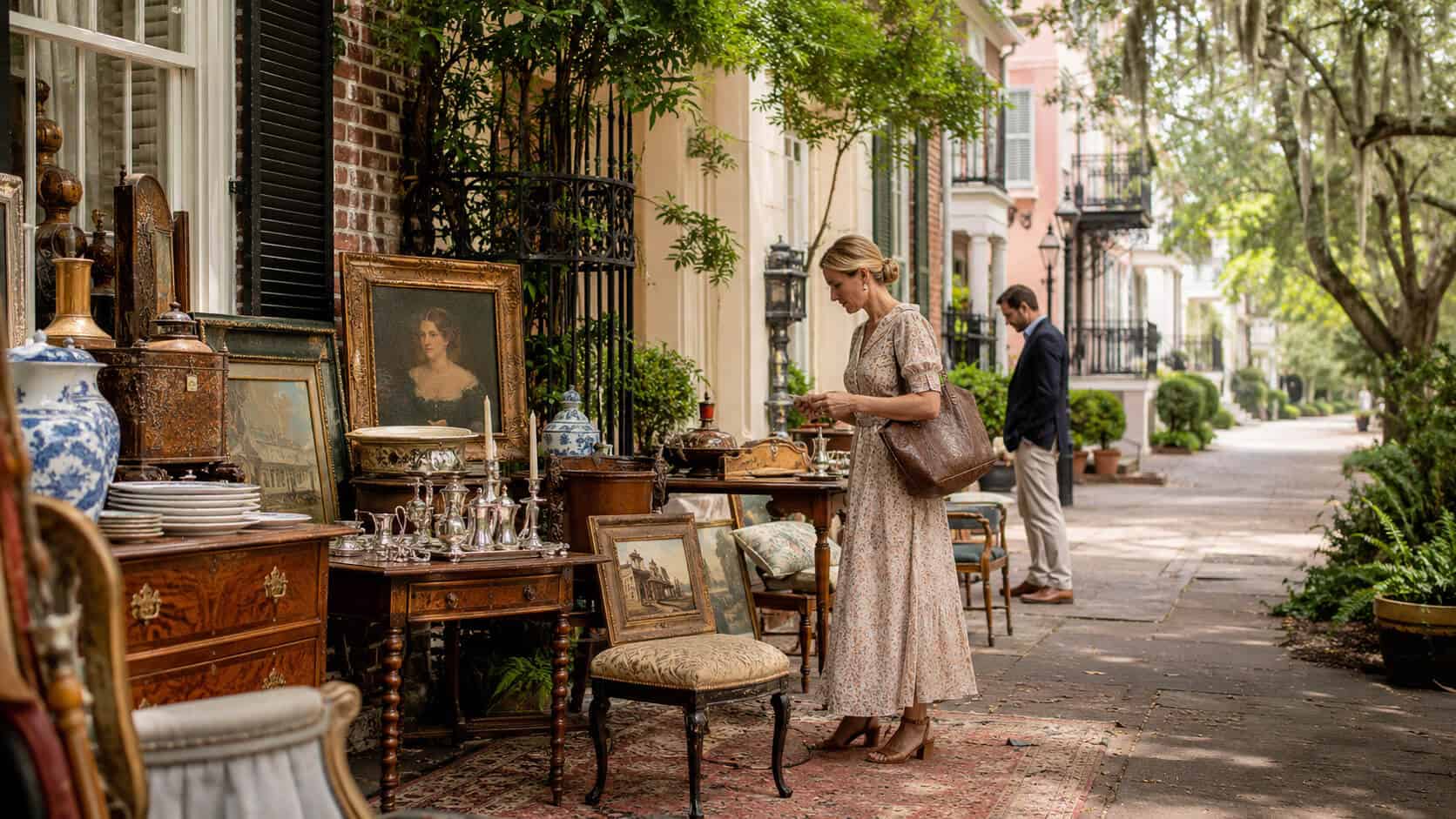

The best antiquing towns in the United States don’t announce themselves with billboards. They announce themselves with a window full of Depression glass catching the afternoon light, or a dealer unfolding a hand-painted campaign chest onto the sidewalk before you’ve had your coffee. From a sun-bleached desert city where mid-century modernism never really went out of style to a tiny Iowa town that draws serious pickers from four states over, the places on this list share one quality: enough density of good shops, in close enough proximity, to make a dedicated antiquing trip genuinely worthwhile. These aren’t towns with one promising store and a lot of hope. They’re towns where a long Saturday afternoon still won’t get you through everything.
Palm Springs, California
Palm Springs was designed to be looked at. The architects who arrived in the mid-twentieth century left behind a city of flat rooflines, breezeway walls, and kidney-shaped pools — and all of that original furniture, glassware, and decorative hardware had to go somewhere when estates changed hands. It mostly went into the city’s antique and vintage shops, making Palm Springs one of the best places in the country to hunt mid-century modern pieces in their natural habitat. The Palm Springs Antique District runs along and around Palm Canyon Drive, where a walkable stretch of dealers makes it easy to compare prices on an Eames-era lounge chair or a set of atomic-age barware without doubling back across town.
For shoppers who prefer the market format, the Palm Springs Vintage Market draws vendors and collectors to a regular outdoor setting and has become a reliable fixture for MCM fans, estate finds, and the kind of mid-century ceramics and lighting that the permanent shops sometimes price out of reach. The broader Coachella Valley rewards those willing to range a little further — neighbouring desert communities add their own shops to the mix, and the combination of year-round sunshine and a long tradition of design-conscious residents means the supply of quality pieces keeps regenerating.
Where: Palm Canyon Drive, Palm Springs, CA 92262
When: Opening hours vary from one store to the other. Most stores open Monday – Saturday from 10:00 to 17:00 – Palm Springs Vintage Market: 1st Sunday of the month (October to May): 08:00 – 14:00
Palm Beach, Florida
Palm Beach operates at a different register than most antiquing towns — this is a place where serious estate jewelry, European furniture, and American decorative arts move through proper galleries and well-appointed shops rather than barn-floor stalls. Worth Avenue and its surrounding side streets form the natural spine of the antiquing district, and the density of dealers in a compact, walkable area makes it one of the more rewarding towns in the South for shoppers with specific things in mind: a Georgian silver piece, a signed piece of mid-century art glass, a French provincial armoire with documented provenance.
What keeps Palm Beach on this list alongside more casual markets is the quality of what cycles through. Wealthy estates turn over regularly, and the inventory that flows into local shops reflects generations of deliberate collecting rather than accumulation. The town also benefits from proximity to the broader South Florida market — dealers here tend to be knowledgeable, and conversation about a piece’s history is usually available if you ask. It rewards the patient, specific buyer more than the casual browser.
Where: South Dixie Highway, West Palm Beach, FL 33405
When: Opening hours vary from one store to the other. Most stores open Monday – Saturday from 10:00 to 17:00
Charleston, South Carolina
Charleston’s antiquing strength comes from the same source as its architecture — centuries of accumulated domestic life in one of the oldest cities in the country. The Lower King Street antique district is the natural starting point, a concentrated stretch where dealers in formal American and European furniture sit alongside shops heavy on silver, porcelain, and plantation-era decorative objects. The historic character of the surrounding streets makes the browsing feel genuinely immersive rather than strip-mall transactional.
What sets Charleston apart from other Southern antiquing towns is the depth of locally sourced inventory. Low Country estates have been turning over for generations, and pieces with regional provenance — rice beds, Carolina-made silver, portrait miniatures — turn up here with a frequency you won’t find in markets further inland. Shoppers interested in early American furniture or decorative arts will find Charleston dealers unusually well-stocked and, generally, well-informed about what they’re selling.
The city also rewards a slower pace — pairing a morning on King Street with an afternoon in the French Quarter or along the Battery keeps the trip from feeling purely transactional. For more Southern antiquing destinations, see our guides to the broader Southeast flea market and antique scene.
Clinton, Tennessee
Clinton sits about fifteen miles north of Knoxville, and its compact downtown has quietly become one of East Tennessee’s better stops for serious antique hunters. The town’s main commercial strip holds a concentration of multi-dealer antique malls where the inventory skews toward Americana — Southern folk pottery, oak and walnut country furniture, Depression glass, and the kind of everyday cast-iron and tinware that rarely surfaces in coastal shops. The scale is manageable, which means you can cover the core dealers in a focused morning without the fatigue that comes with sprawling flea markets.
What gives Clinton an edge over other small Tennessee towns is its proximity to a region that has been generating collectable material for generations — Appalachian crafts, quilts, and primitive woodwork turn up here with genuine regularity. Dealers tend to be hands-on owners rather than absentee booth renters, which generally makes for better conversation and more accurate attribution. It pairs naturally with a day trip into the broader Knoxville antique scene if you want to extend the hunt.
Where: Market Street, Clinton, TN, 37716
When: Opening hours vary from one store to the other. Most stores open Monday – Saturday from 10:00 to 17:00
Hazel, Kentucky
Hazel is a small town on the Kentucky–Tennessee border that has built an outsized reputation among antique hunters across the region. Its main street holds a dense cluster of antique shops and multi-dealer malls that punch well above the town’s modest population — the kind of concentration that makes a detour genuinely worthwhile rather than merely hopeful. The inventory leans heavily toward country and primitive American pieces: stoneware crocks, painted furniture, Depression-era kitchenware, and the quilts and textiles that the surrounding rural counties have been producing and accumulating for generations.
What keeps serious collectors coming back is the pricing, which tends to reflect a slower regional market rather than the inflated expectations you’d encounter in larger destination towns. Dealers here generally know their stock well, and because Hazel draws from deep rural Kentucky and western Tennessee estate sales, unusual pieces surface with genuine regularity. The town is also close enough to Murray, Kentucky to combine both into a productive day trip if your appetite for the hunt runs long.
Where: Main Street, Hazel, KY 42049
When: Opening hours vary from one store to the other. Most stores open Tuesday – Saturday from 10:00 to 17:00
Buchanan, Virginia
Tucked into the Shenandoah Valley along the James River, Buchanan is a small Botetourt County town that rewards antique hunters willing to venture off the main Blue Ridge corridor. The historic downtown has a modest but well-curated set of dealers whose inventory reflects the surrounding region — Virginia walnut and cherry furniture, period stoneware, Civil War-era ephemera, and the kind of rustic farm implements that rarely travel far from where they were made. The scale is intimate, which suits collectors who prefer a genuine browse over the sensory overload of a warehouse mall.
What distinguishes Buchanan from other small Virginia towns is its position within a stretch of the Valley that has historically been slow to turn over its estates, meaning older, locally-sourced pieces still surface here with some regularity. The town itself has the bones of an earlier era — a surviving canal-era streetscape — which lends context to what you find inside the shops. It pairs naturally with a drive along Route 11 through the broader Valley antique corridor if you have a full day to dedicate to the region.
Where: Main Street, Buchanan, VA 24066
When: Opening hours vary from one store to the other. Most stores open Tuesday – Saturday from 10:00 to 17:00
Stillwater, Minnesota
Perched above the St. Croix River on the Wisconsin border, Stillwater has earned its place as one of the Midwest’s most reliable antiquing stops. The town’s main commercial streets hold a genuine concentration of dealers — multi-room shops occupying historic brick buildings that were originally outfitted for the lumber trade — and the inventory reflects both the region’s Scandinavian settler heritage and the broader Upper Midwest estate pipeline. Painted country furniture, art pottery, vintage sporting goods, and pieces of early Minnesota industrial life turn up here alongside more formal American antiques that traveled north with earlier settlers.
What separates Stillwater from a generic antique row is the quality of the building stock itself, which gives browsing a genuinely atmospheric quality rather than a strip-mall feel. Dealers tend to be well-informed, and because the town draws from Wisconsin and Minnesota estate sales in roughly equal measure, the range of material is wider than the town’s modest size might suggest. It also functions as a natural extension of a Twin Cities antiquing trip, close enough to Minneapolis–Saint Paul to combine without an overnight stay if your schedule is tight.
Where: Main Street, Stillwater, MN 55082
When: Opening hours vary from one store to the other. Most stores open Monday – Saturday from 10:00 to 17:00
Wiscasset, Maine
Wiscasset has long billed itself as “the prettiest village in Maine,” and for antique hunters, that claim comes with substance behind it. The small coastal town sits on the Sheepscot River in Lincoln County and has accumulated a notable density of dealers along its main streets — a concentration striking enough for a community of its size. The inventory here leans heavily toward New England period pieces: early painted furniture, ship captain’s portraits, nautical instruments, saltbox-era woodenware, and the kind of formal Federal pieces that came into Maine homes during the prosperous shipbuilding years.
What gives Wiscasset an edge over other picturesque New England stops is the depth of locally-sourced material. Dealers here are drawing from a long-settled coastal region whose estate inventories haven’t been fully picked over, and the proximity to mid-coast and Downeast Maine means pieces rarely seen elsewhere in the Northeast still circulate through these shops. The town also sits conveniently on Route 1, making it a natural anchor for a broader mid-coast Maine antiquing drive — Bath and Belfast are both within reasonable range for collectors building a longer itinerary.
Where: Bath Road, Wiscasset, ME 04578
When: Opening hours vary from one store to the other. Most stores open Tuesday – Saturday from 10:00 to 17:00
Adamstown, Pennsylvania
Lancaster County’s Adamstown has one of the strongest claims to the title of antique capital on the East Coast. The town sits along Route 272 and Route 30 in the Pennsylvania Dutch Country, and its density of antique venues — ranging from sprawling multi-dealer malls to tightly curated specialty shops — is extraordinary for a community of its size. Weekends are when Adamstown truly operates at full volume, with thousands of dealers reportedly active across the various complexes, and serious collectors have been making the pilgrimage here for decades.
The inventory reflects the deep Germanic and Pennsylvanian settler heritage of the surrounding region: decorated stoneware, painted blanket chests, pieced quilts, fraktur documents, and country furniture with strong regional character appear alongside American Victorian, Depression-era glass, and mid-century pieces drawn from the broader Mid-Atlantic estate pipeline. The sheer volume means patient hunting rewards nearly every visit — and because dealers are spread across multiple large venues in close proximity, it’s genuinely possible to cover significant ground without moving your car more than once or twice.
Adamstown also benefits from its position within easy driving distance of Philadelphia and the greater New York metropolitan area, which keeps both dealer turnover and collector foot traffic unusually high. For anyone serious about Pennsylvania country antiques specifically, this is a mandatory stop — and pairing it with nearby Lancaster city or a drive through the broader Route 30 antique corridor makes for a full and productive weekend itinerary.
Where: N. Reading Road, Adamstown, PA 19501
When: Thursday – Sunday: 10:00 – 18:00 | Monday: 10:00 – 17:00 | Antique Extravaganza: always begins the Thursday of the last full week of April, June, and September (4-days event)
Galena, Illinois
Tucked into the rolling hills of Jo Daviess County in the far northwest corner of Illinois, Galena is one of the Midwest’s most satisfying antiquing destinations — and one of its most underestimated. The town’s remarkably intact 19th-century Main Street, lined with Federal and Italianate commercial buildings, sets the scene naturally for antiques hunting. The density of dealers concentrated along and just off Main Street means most serious shopping can be done on foot, which is rare for a town this size.
The inventory here draws heavily from the lead-mining era that gave the town its name and its early prosperity, meaning you’ll find pieces with genuine regional provenance: Victorian parlor furniture, period advertising and trade ephemera, early American pressed glass, and decorative objects that circulated through the prosperous households of a once-booming river and rail economy. Galena’s long history as a weekend escape from Chicago and the Quad Cities has kept dealer quality relatively high — the market has been catering to experienced buyers long enough that the shops tend to hold themselves to a reasonable curatorial standard.
The town’s Civil War connections — Ulysses S. Grant lived here before and after the war — also make it a notable stop for militaria collectors and American history enthusiasts, with related material surfacing across several shops. Pairing Galena with the broader Mississippi River antique corridor makes for a productive multi-day Midwest itinerary.
Where: Main Street, Galena, IL 61036
When: Opening hours vary from one store to the other. Most stores open Monday – Saturday from 10:00 to 17:00
Millerton, New York
Perched in the northeastern corner of Dutchess County, close to the Connecticut border, Millerton is a small Hudson Valley town that punches well above its weight as an antiquing destination. The main commercial strip along Main Street and the surrounding blocks hold a concentration of dealers that would be remarkable for a town several times the size — and the quality bar here reflects the affluent, design-literate weekend traffic that flows in from New York City via the Harlem line and the Taconic State Parkway.
The inventory leans toward the well-curated end of the spectrum: expect American country furniture, Hudson Valley estate pieces, vintage textiles, early pottery, and the occasional architectural salvage item alongside more eclectic mid-century finds. Because Millerton sits within the broader antique corridor that stretches through the Hudson Valley — connecting towns like Hudson, Rhinebeck, and Chatham — it rewards a multi-stop itinerary rather than a single-day sprint. Dealers here tend to be knowledgeable and the browsing atmosphere is genuinely unhurried, which makes it a particularly good stop for collectors who prefer conversation with a seller to the anonymity of a large mall.
For a wider look at Hudson Valley antiquing towns and weekend market options in the region, the Fleamapket directory is worth consulting before you plan your route.
Where: Main Street, Millerton, NY 12546
When: Opening hours vary from one store to the other. Most stores open Monday – Saturday: 10:00 – 17:00 | Sunday: 12:00 – 17:00
New Orleans, Louisiana
New Orleans brings a character to antiquing that no other American city quite replicates. The layered cultural history here — French colonial, Spanish, Creole, and everything that followed — means the objects circulating through its shops carry a distinctly regional flavor: ornate Louisiana armoires, Creole cottage furnishings, cast-iron architectural details, vintage Mardi Gras ephemera, jazz-era photography, and religious folk art that reflects the city’s deep Catholic roots. Magazine Street is the primary destination for serious shoppers, with antique shops, design galleries, and vintage dealers strung along its length through the Garden District and Uptown neighborhoods, offering one of the more walkable antiquing corridors in the South.
The French Quarter adds another dimension entirely — Royal Street in particular is lined with established antique dealers and fine art galleries whose inventory skews toward higher-end estate pieces, period silver, and formal furniture with genuine Louisiana provenance. The city rewards exploratory browsing; side streets and neighborhood shops regularly surface pieces you’d be unlikely to find anywhere else, shaped by estate sales drawing from the grand old homes of the Garden District and Uptown. The humidity and the city’s complicated history with preservation mean condition varies, but that unpredictability is part of the appeal for seasoned collectors.
For collectors planning a longer Gulf South itinerary, New Orleans pairs naturally with the antique towns of the Mississippi and Alabama corridors.
Where: Royal Street & Magazine Street, New Orleans, LA 70130
When: Opening hours vary from one store to the other. Most stores open Monday – Saturday: 10:00 – 17:00
Walnut, Iowa
Walnut calls itself Iowa’s Antique City, and the town takes that identity seriously. Despite a population that barely reaches a few hundred residents, the historic main street supports a concentration of antique shops that draws collectors from across the Midwest every weekend. The density is the draw: you can cover most of the core dealers on foot, moving between storefronts packed with American primitives, farm-country furniture, Depression-era glass, cast-iron kitchenware, and the kind of honest working-class objects that rarely surface in coastal markets.
What makes Walnut genuinely useful for collectors is the value-to-quality ratio. Removed from the premium pricing of better-known antiquing corridors, dealers here tend to price for a regional buyer who knows their category — which means a knowledgeable visitor from outside Iowa can occasionally find serious pieces at fair Midwest prices. The town also hosts a larger annual antique show that draws additional dealers and out-of-state shoppers, making it worth timing a visit accordingly if you can.
Where: Antique City Dr, Walnut, IA 51577
When: Opening hours vary from one store to the other. Most stores open Monday – Saturday: 10:00 – 17:00 |Sunday: 12:00 – 17:00 + Yearly Antique Show on Father’s Day weekend (Friday to Sunday).
Kansas City, Missouri
Kansas City doesn’t always make the first draft of antiquing itineraries, but collectors who know it tend to return. The city’s size works in a visitor’s favor: a long history of furniture manufacturing, a prosperous merchant class, and the cross-currents of Midwest farm-country estates feeding into urban dealers mean the inventory here is genuinely varied. The Westport and 39th Street corridors host a mix of vintage shops and antique dealers whose stock ranges from mid-century American furniture and industrial salvage to Arts and Crafts pottery, vintage Western wear, and the kind of decorative objects that reflect the city’s position at the geographic and cultural hinge of the country.
The River Market neighborhood adds another layer, with a longstanding antique district that draws serious pickers alongside weekend browsers. Pieces here tend to reflect what actually circulated through Midwest households — sturdy oak mission furniture, Depression glass, vintage advertising and farm primitives — priced by dealers who buy from regional estate sales and auctions rather than importing inventory from either coast. For collectors whose eye runs toward honest American objects rather than curated coastal taste, that regional supply chain is quietly one of Kansas City’s best assets.
Where: State Line Road & 45th Ave, Kansas City, KS 66103
When: Opening hours vary from one store to the other. Most stores open Monday – Sunday: 10:00 – 17:00
Planning Your Antiquing Trip
Fourteen towns, four time zones, and a collecting sensibility that runs from sun-bleached California modernism to New England maritime salvage — the range here is one of the genuinely pleasurable things about antiquing across the United States. No single region holds a monopoly on good finds, and the towns above prove that point emphatically. Whether you’re planning a dedicated antiquing road trip or simply building a detour into an existing journey, any of these destinations rewards a slower pace and a willingness to look twice at something that doesn’t immediately announce itself.
A little advance planning goes a long way when antiquing across the US. Most antique districts concentrate their shops along a single main street or corridor, so arriving on foot is often the most practical approach — wear comfortable shoes and bring a reusable bag for smaller finds. Call ahead or check a shop’s social media before making a dedicated drive, since independent dealers can keep irregular hours or close seasonally. If your goal is furniture or large statement pieces, ask dealers early about shipping or delivery options; many work with local shippers and can connect you with reliable services. Bringing a few reference photos of your space — dimensions included — helps enormously when you’re deciding whether a sideboard or armoire is truly the right fit.
Where to Stay
Most of these destinations have lodging right in or near the antiquing district. Palm Springs and Palm Beach both have strong hotel and vacation rental markets, and staying close to Palm Canyon Drive or South Dixie Highway means you can return easily with purchases. Charleston’s historic downtown puts you within walking distance of King Street. For smaller towns — Clinton, Hazel, Walnut, and Buchanan — nearby larger cities offer the widest range of options: Knoxville and Nashville serve the Tennessee and Kentucky corridor well, while Roanoke is a practical base for Buchanan and the Shenandoah Valley.
Adamstown sits between Lancaster and Reading, Pennsylvania, both of which have solid mid-range accommodation. Galena’s own Main Street has inns and bed-and-breakfasts that suit the town’s character. For Millerton and the Hudson Valley, the town itself and nearby Rhinebeck or Hudson offer charming historic stays. New Orleans, Kansas City, and Minneapolis each have dense hotel markets close to their respective antique corridors, and booking a central neighborhood property in any of those cities keeps logistics simple.
Frequently Asked Questions
What makes a town one of the best antiquing destinations in the US?
The two core criteria are density and quality. A true antiquing town clusters enough reputable shops — typically along one walkable street or district — that a visitor can spend a full day browsing without backtracking across town. Beyond sheer numbers, the shops need to stock genuine antiques with clear provenance rather than reproduction or mass-market vintage goods. The best destinations also have an ecosystem: specialist dealers, generalist malls, and periodic outdoor markets that together give collectors multiple price points and categories in one visit.
Which of these towns is best for mid-century modern finds?
Palm Springs is the standout for MCM. The city’s architectural identity is built around the style, and both the permanent shops along Palm Canyon Drive and the Palm Springs Vintage Market draw dealers who specialize specifically in mid-century furniture, lighting, ceramics, and textiles. Kansas City and Stillwater also turn up strong MCM inventory, particularly in larger antique malls where estate collections from the region’s postwar suburbs cycle through regularly.
Are these towns suitable for casual browsers as well as serious collectors?
Yes — all fourteen destinations welcome browsers at every level of experience and budget. Antique districts are generally low-pressure environments, and most dealers are happy to talk about what they have without any expectation of a sale. Smaller towns like Hazel, Walnut, and Wiscasset in particular have an unhurried pace that suits a relaxed afternoon of looking even if you leave empty-handed.
When is the best time of year to visit?
It depends on the region. Southern and Southwestern destinations — Palm Springs, Palm Beach, New Orleans, Charleston — are generally at their best from October through April. Midwestern towns like Galena, Walnut, and Kansas City shine in late spring and early fall. New England and the Hudson Valley run roughly May through October. If avoiding crowds matters more than catching a specific event, early spring and late fall shoulder periods tend to offer a more relaxed visit across most of these locations.