

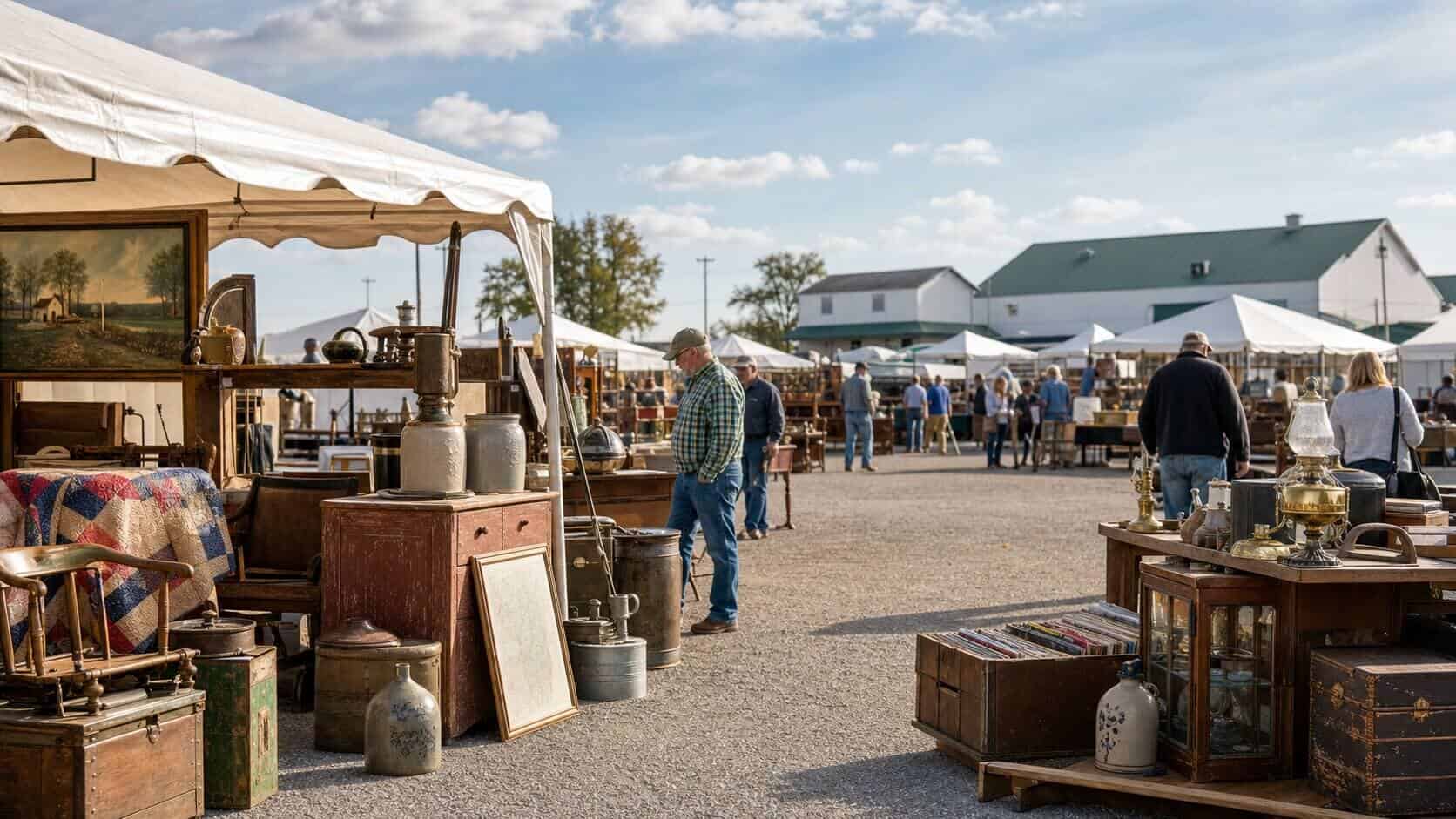

Walk into the Clark County Fairgrounds on a show weekend and the cattle barns are already full. Dealers have driven overnight to claim their spots, and by the time the gates open on Friday morning at the Extravaganza events, the aisles between vendor stalls are already carrying a low hum of negotiation. The Springfield Antique Show and Flea Market, held nine times a year in Springfield, Ohio, is one of the Midwest’s most serious antique events — the kind that rewards early arrivals and repays repeat visits.
Organised by Jenkins & Co., the show has been running for over 40 years at the same fairgrounds off I-70. The format is straightforward: monthly Saturday–Sunday markets from January through November, skipping December, February and July. Three of those shows — held in May, September and November — expand into the Springfield Extravaganza, a materially larger event that pulls vendors and collectors from well beyond Ohio’s borders. Country Living, Martha Stewart Living and CNN have all featured the market over the years.
Nine Shows a Year at Clark County Fairgrounds
The Clark County Fairgrounds gives the Springfield market much of its character. These are working agricultural buildings — cattle barns, poultry houses, open-air pavilions — not a purpose-built exhibition centre, and the unvarnished setting suits the merchandise. Vendors set up under the same roof where livestock is shown at the county fair, and that context has a way of making the furniture, signage, crockery and ephemera feel genuinely embedded in Midwestern American life rather than curated out of it.
The show runs on a monthly rhythm for most of the year, a cadence that has built a reliable regular audience alongside the out-of-state visitors who plan trips specifically around the Extravaganza weekends. With more than 2,000 vendors and around 20,000 shoppers reported per event, the scale is significant enough that most attendees find it useful to have some sense of what they’re looking for before they arrive — though the market is also genuinely navigable for browsers without a fixed list.
The range of dealers reflects the size. On any given show weekend you can move between stalls carrying high-end American furniture, booths stacked with vintage advertising tins, tables of mid-century ceramics, racks of old clothing, and dealers who specialise in specific categories — political memorabilia, farm primitives, Depression glass — with the kind of depth that suggests they’ve been sourcing seriously for years. The show’s long-running reputation acts as a filter: dealers who come back year after year tend to be the ones with stock worth travelling for.
The market also has an online forum that extends the experience beyond the fairgrounds themselves. Attendees can use it to connect with specific vendors before a show, preview incoming merchandise and post wish lists — practical for collectors with a clear target, and useful for anyone who wants to make the most of a single-day visit rather than spending the first hour orientating.
A Market for Everyone — and That’s Not a Cliché
One of the things that sets Springfield apart from many high-profile antique shows is that it hasn’t calcified into an event for a single type of buyer. Walk the fairgrounds on a show weekend and you’ll find serious dealers who’ve driven from out of state to scout stock alongside first-timers who came because a friend mentioned it once. Both groups tend to leave satisfied, which says something about how the show has been run over four decades.
The range of what’s on offer is a large part of that. A collector pursuing a specific category — folk art, vintage sporting goods, mid-century lighting, Depression-era kitchenware — will find dealers who have sourced deeply in that area and can talk knowledgeably about what they’re selling. A casual visitor with no fixed agenda will find the same walk-through rewarding in a different way: the density of objects means there’s almost always something unexpected. The show is large enough that you can spend a full day there and still feel like you’ve only covered part of it.
Springfield has also stayed connected to its audience in practical ways. An online forum allows attendees to engage with vendors before arriving — previewing incoming stock, flagging specific wants, or simply getting a sense of what will be on the floor that weekend. For a collector with a clear target, this kind of pre-show research can make the difference between a productive trip and an expensive drive for nothing. For more casual visitors, it’s a useful way to plan a first visit without feeling overwhelmed when you arrive at a fairgrounds with several thousand vendors spread across multiple buildings.
The community dimension matters here. Springfield has been running long enough that many of its regulars — both vendors and buyers — have been coming for years. That continuity builds the kind of informal knowledge that makes a market genuinely useful: dealers who know each other’s stock, buyers who know which stalls to check first, and a general atmosphere that feels less like a commercial event and more like a recurring gathering around a shared interest. New visitors tend to get pulled into that fairly quickly.
More Than a Market: Springfield and American Material Culture
Spend enough time at Springfield and the commercial dimension starts to feel almost secondary. The sheer range of what passes through the Clark County Fairgrounds across a season amounts to an informal survey of American domestic and working life — the objects people made, collected, discarded and valued across the last two centuries. That’s not a marketing line; it’s what you encounter when you move through the buildings and outdoor rows with any attention.
Traditional antiques — furniture, ceramics, silver, textiles — share space with folk art, industrial salvage, advertising ephemera and the kind of vernacular objects that rarely make it into museum collections but carry as much cultural weight as anything behind glass. A painted tin sign from a rural hardware store, a collection of hand-stitched quilts from the Ohio Valley, a run of cast-iron farm tools — these things tell a story about how people actually lived, and Springfield is one of the few markets large enough and well-sourced enough that you can find all of it in the same place on the same weekend.
The fairgrounds setting reinforces this. The cattle barns and exhibition halls were built for county agriculture shows, not antique fairs, and that utilitarian architecture sits well with the material on offer. There’s nothing polished or gallery-like about the experience, which is part of why serious collectors tend to prefer it over more curated shows. Objects are presented straightforwardly; condition is visible rather than disguised; and dealers, many of whom have been coming for years, are generally willing to talk about provenance, history and the context behind what they’re selling.
That depth of knowledge in the vendor community is one of Springfield’s less-advertised strengths. Because the show has been running in the same location for over four decades, it has attracted a stable core of dealers who specialise seriously — in particular categories, particular periods, particular regions. A collector pursuing early American painted furniture will find vendors who have spent careers sourcing it. Someone interested in mid-century industrial design or Depression-era glass will find the same. The breadth of Springfield’s vendor field means that almost any collecting interest, mainstream or niche, has representation at some point during the show calendar.
For visitors who arrive without a specific collecting focus, the experience is different but no less rewarding. Springfield is large enough that a single day of walking produces a genuine education in American decorative and material history — not through labels and interpretation panels, but through handling, looking and talking to the people who have spent time understanding the objects they sell. That informal, hands-on quality is something no museum can replicate, and it’s what keeps a broad range of visitors — history enthusiasts, interior designers, casual browsers, seasoned dealers — returning to the same fairgrounds year after year.
Planning Your Visit
Springfield’s show calendar runs nine times a year at the Clark County Fairgrounds, with no events in December, February, or July. Three of those dates — typically in May, September, and November — are Extravaganza weekends, when the vendor count expands substantially and a Friday opening day is added. If you’re making a dedicated trip, an Extravaganza weekend gives you more ground to cover and the best odds of finding something specific. That said, the regular monthly shows are considerably less crowded and can be a more relaxed experience for browsers who aren’t working against a checklist. Either way, arriving early on Saturday morning remains the standard advice from experienced attendees — the better pieces move quickly.
Standard monthly shows run Saturday and Sunday, with Sunday hours shorter than Saturday. Extravaganza weekends add a Friday with an earlier opening. Exact dates shift from year to year, so confirm the current schedule directly at the Jenkins & Co. website before making travel arrangements.
Location: Clark County Fairgrounds, 4401 S Charleston Pike, Springfield, OH 45505
When: Monthly Shows – Saturday 8 a.m. to 5 p.m./Sunday 9 a.m. to 4 p.m. Extravaganzas – Friday 7 a.m. to 6 p.m./Saturday 8 a.m. to 5 p.m./Sunday 9 a.m. to 4 p.m.
Website: https://jenkinsandco.com/springfield-antique-show/
Social Media: Instagram, Facebook
Where to Stay
Springfield itself sits in Clark County in west-central Ohio, roughly equidistant between Columbus and Dayton — both of which offer a full range of hotel options if you prefer a larger city base. Columbus is the more practical anchor for most visitors: it’s about 45 minutes east on I-70 and has accommodation at every price point, along with its own strong antiques and vintage retail scene worth exploring before or after the show. Dayton is a comparable drive to the southwest and similarly well-served. Springfield has local lodging as well, which is worth considering during Extravaganza weekends when you want to be close to the fairgrounds across a multi-day visit — options fill up, so booking ahead matters. For those combining the trip with broader Ohio antique hunting, the corridor between Springfield, Yellow Springs, and Xenia rewards an overnight stay.
Frequently Asked Questions
How often does the Springfield Antique Show & Flea Market take place?
The market runs nine times a year at the Clark County Fairgrounds in Springfield, Ohio. There are no events in December, February, or July. Three of those nine dates are Extravaganza weekends — held in May, September, and November — which bring a significantly larger vendor field and an additional Friday opening day.
What are the opening hours?
For standard monthly shows, the market generally opens Saturday at 8 a.m. and runs until 5 p.m., with Sunday hours from 9 a.m. to 4 p.m. During Extravaganza weekends, Friday hours typically begin at 7 a.m. and run to 6 p.m., with Saturday and Sunday following the same schedule as regular shows. Hours should be confirmed against the current Jenkins & Co. listings before you travel, as they can vary.
Is Springfield suitable for first-time antique show visitors?
Yes — the scale of the show is actually an advantage for newcomers. Because the vendor field is so broad, first-time visitors tend to find the experience more educational than overwhelming once they settle into a pace. There’s no obligation to buy, and many of the long-standing vendors are genuinely happy to talk about what they sell. A Sunday visit to a regular monthly show is often the gentler introduction; Extravaganza weekends are better once you have a sense of how the fairgrounds are laid out.
What should first-time visitors know about getting around?
The Clark County Fairgrounds cover a substantial area, and the layout can surprise first-timers. Comfortable shoes matter more than most people expect. Seasoned regulars also recommend bringing cash for smaller vendors, a phone for quick price research, and a tape measure if furniture is on your list. Arriving early — especially on Extravaganza Saturdays — gives you the best pick before the crowds thicken and the larger pieces start moving.