

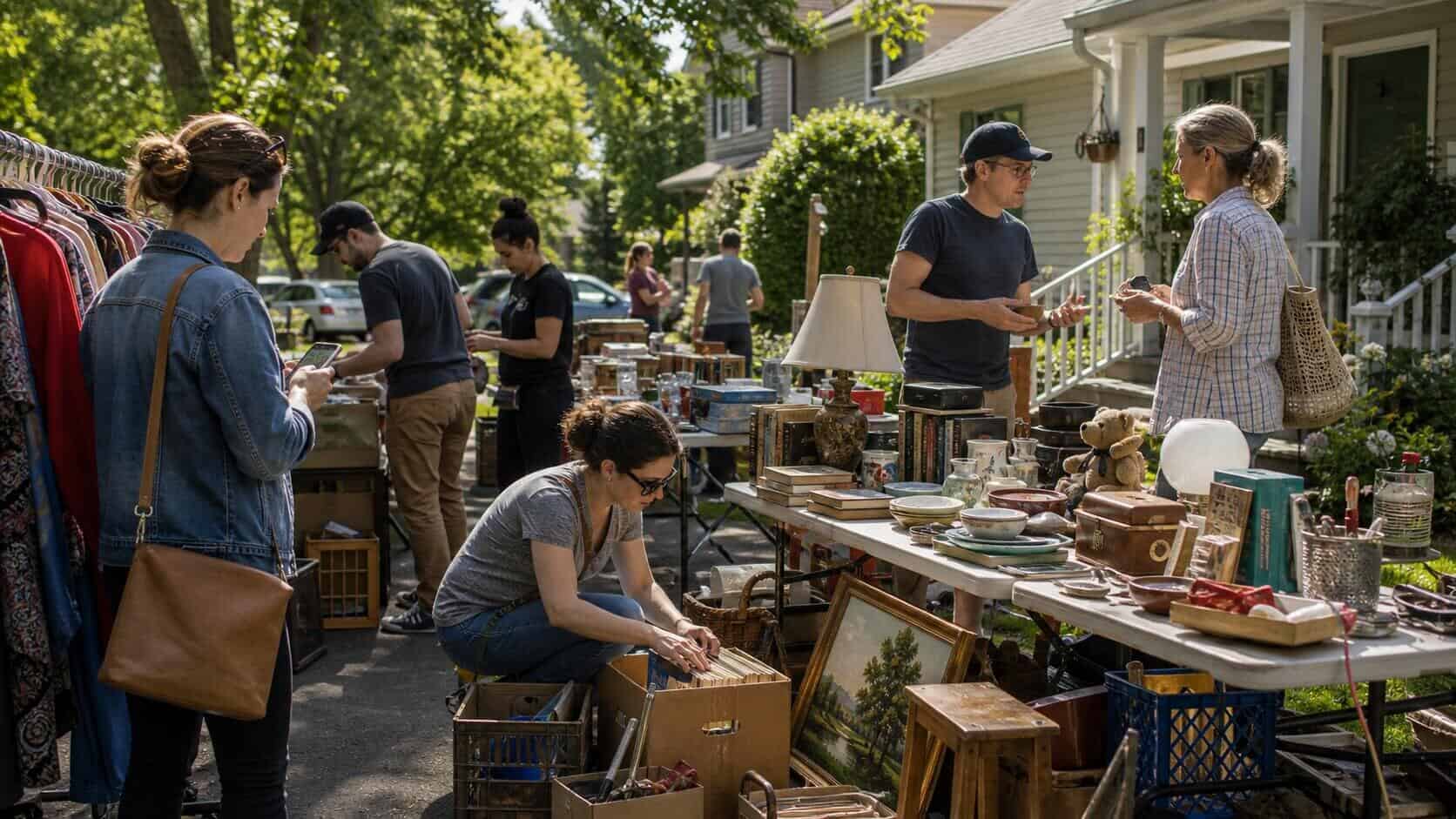

Vinted and Craigslist are genuinely useful. Listing an item takes five minutes. You can reach buyers three states away. You don’t have to wake up at 6am, lug boxes to a car park, or sit in the rain until noon hoping someone wants your old bread maker.
And yet, yard sales and flea markets keep filling up. Sellers keep showing up. Buyers keep coming back — and not out of nostalgia. The reason is practical: each format solves a different problem.
Online platforms excel at reach, niche markets and single-item sales. Yard sales excel at moving volume quickly, negotiating face-to-face, and handling the things that don’t photograph well or cost too much to ship. The people who benefit most aren’t choosing sides — they’re matching the item, the time pressure and the price expectation to the right channel.
This guide walks through that decision: when yard sales make genuine financial sense, how to choose between formats, what mistakes cost you money, and why the physical format still has a real edge that no app has fully replaced.
Before You Commit: When Yard Sales Actually Make Sense
Whether you’re a buyer working out where to spend a Saturday morning or a seller deciding whether to drag boxes to a car park instead of posting them online, the honest first question is the same: does this actually make sense for me? The answer depends less on sentiment and more on a clear-eyed look at what each channel costs, what it risks, and what it actually delivers.
For sellers, the upfront calculation looks straightforward. Renting a stall or table at a yard sale or community flea market typically costs money — the exact figure varies by event, region and size of pitch, and stall fees for a community event in the US or Europe can range from modest to surprisingly substantial. That cost comes before you sell a single thing. Online platforms, by contrast, let you list for free or near-free, and you only pay when a sale completes. On paper, that looks like a lower-risk entry point.
But the stall fee tells only part of the story. Online selling carries its own costs: time spent photographing, writing descriptions, answering messages, packaging items, queuing at a post office, and handling returns or disputes. A bread maker that sells in thirty seconds to a neighbour at a yard sale might take three weeks to shift on Vinted, with two lowball offers and a shipping negotiation in between. The real cost of online selling is often paid in time and friction rather than cash — and that matters if you’re clearing out a whole household rather than shifting a single designer jacket.
For buyers, the risk calculation runs in the other direction. Online marketplaces give you search filters, photographs and price comparisons across hundreds of listings in seconds. That looks like lower risk. What it doesn’t give you is the ability to hold the thing, inspect the stitching, check the drawer slides, or ask the seller directly where it came from. At a yard sale or flea market, a two-minute conversation with the seller often tells you more about an item’s provenance and condition than any listing description. That matters more as the price goes up.
Feasibility, finally, is about scale and category. Online platforms work well for small, shippable, photographable items with clear resale value — think clothing, books, small electronics, branded goods. They work less well for furniture, large garden tools, fragile ceramics, or anything that requires a buyer to show up in person anyway. Yard sales and flea markets handle the awkward, the bulky and the hard-to-categorise far more naturally. If what you’re selling — or hunting for — falls into that category, the feasibility calculation shifts quickly in favour of the physical event.
Which Format Works Better — And When
Once you’ve settled that a yard sale or flea market genuinely makes sense for your situation, the next question is how to approach it — and when. The answer looks different depending on whether you’re selling, buying, or doing both, and different again depending on what you’re handling. The three comparisons below are the ones that actually change your decision.
Yard sale versus online marketplace: matching method to category
The cleanest way to decide is by category, not platform loyalty. Online marketplaces — Vinted, Craigslist, Facebook Marketplace — perform well for shippable, photographable items with established resale value: clothing, books, small electronics, branded accessories. The search infrastructure is there, buyers know what to look for, and price comparisons are fast. The trade-off is that listings demand real time. Photographing, describing, fielding messages, packaging and posting can easily consume more hours than the item is worth.
Physical events handle an entirely different inventory more naturally. Furniture, large garden equipment, fragile ceramics, vintage textiles that need to be felt, tools that need to be tested — these categories resist the online format. They either can’t ship affordably, photograph badly, or require a buyer to show up in person anyway. If the bulk of what you’re selling falls here, routing it through a yard sale saves the friction of listings that sit unsold for weeks before you end up meeting the buyer locally regardless.
A hybrid approach often works best: list high-value small items online where the audience and price discovery are better, and bring the rest to a physical event where moving volume in a single morning is the goal.
Timing: when the physical format has the clear edge
Online platforms are available around the clock, which sounds like an advantage — and for selling individual items over days or weeks, it is. But yard sales compress the transaction cycle in a way that online selling rarely matches. A Saturday morning event can clear a car-load of household goods in two to three hours. For sellers facing a house move, an estate clearance, or just a garage that needs emptying by a deadline, that speed has real value that an open-ended online listing can’t replicate.
For buyers, timing works differently. The best finds at any yard sale or flea market go early — often before the event is officially open, to the experienced regulars who know the sellers and arrive first. If you’re buying to resell or hunting something specific, early arrival is less a tip and more a structural advantage. Later in the morning, prices often soften as sellers shift from maximising return to clearing stock before pack-up. Both windows are valid; they’re just optimised for different goals.
Trade-offs neither side advertises
Online platforms create a persistent paper trail — messages, payment records, seller ratings — that physical cash transactions don’t. For buyers, that offers some protection; for sellers, it means exposure to disputes and returns that a completed yard-sale handshake doesn’t carry. That asymmetry is worth weighing honestly, particularly for higher-value items.
The physical format, meanwhile, carries its own hidden cost: the social expectation of negotiation. At a yard sale, haggling is normal and often expected, but it also takes energy and confidence. Buyers who find direct negotiation uncomfortable may actually get better outcomes through online platforms where offers are made in text and at a remove. Sellers who price keenly from the start often find the yard-sale format less stressful than fielding lowball offers on every item. Neither format is inherently fairer — they just allocate the awkwardness differently.
Finally, consider the social return. Online selling is efficient and mostly solitary. A yard sale or community flea market is also, by design, a public event — it brings in neighbours, generates casual conversation, and occasionally turns a buyer into a contact for future sales. That soft return doesn’t appear in any margin calculation, but for many sellers it’s a genuine part of why they keep coming back.
Common Mistakes That Cost You Money
Choosing between a yard sale and an online platform is the easy part. Executing either well is where most sellers lose money and most buyers miss out. The checklist below is organised by the three moments where things most often go wrong: before the sale, during the transaction, and after.
Before: the questions worth answering first
Start with the item, not the platform. Ask yourself: does this sell better seen in person or described in detail? Furniture, clothing and anything with tactile appeal tends to perform well at physical events. Collectibles with a model number, edition or provenance — cameras, vintage audio, ceramics — often fetch more online where the right buyer can find them from anywhere. If you genuinely don’t know, check completed listings on a resale platform to get a realistic price anchor before you commit to either route. Pricing blind is the single most common mistake at yard sales: sellers either undervalue items they’ve been living with for years or overprice out of sentiment.
For sellers planning a physical event, confirm any local permit or neighbourhood association requirements before setting a date. Many municipalities require a permit for garage sales, particularly if they recur or involve multiple households. The paperwork is usually straightforward, but skipping it can result in a fine that wipes out the morning’s takings.

During: safeguards for both sides of the table
Cash remains the dominant currency at yard sales for good reason — it closes transactions instantly, leaves no dispute window, and requires no platform account. If a buyer offers a payment app instead of cash, that’s not necessarily a red flag, but it is worth confirming the payment has cleared before handing over the item. Pending transfers have a way of staying pending.
For higher-value items — vintage jewellery, electronics, anything a buyer might later claim was misrepresented — a brief written note recording the agreed price, the item description and an “as seen, sold as is” condition acknowledgement takes thirty seconds and removes most grounds for a later dispute. It feels formal for a front-lawn transaction, but experienced sellers who deal in antiques or collectibles use some version of this routinely.
On the buying side: inspect before you pay. This sounds obvious, but the social pace of a busy yard sale creates subtle pressure to decide quickly, especially when another buyer is hovering. Test anything electrical if an outlet is available. Check zips, hinges, and seams on clothing and bags. Ask directly whether an item is complete — missing pieces on boxed games, tools or appliances are one of the most reliably disappointing discoveries once you get home.
After: the mistakes that cost you on the next round
The most durable mistake sellers make is failing to note what sold, at what price, and how fast. That record — even just a rough list kept on a phone — becomes the pricing intelligence that makes the next sale or listing significantly more accurate. Patterns emerge quickly: certain categories move immediately at almost any price, others sit all morning regardless of how low you go. Knowing which is which saves real time on future decisions about whether to list online, bundle, donate, or simply reduce on the day.
For buyers who are also resellers, the equivalent discipline is tracking acquisition cost against eventual sale price, including platform fees and the time cost of photography and messaging. Yard sales feel cheap in the moment; the margin only shows up clearly when it’s written down. Many items that looked like strong finds at a Saturday morning sale turn out to break even once fees and time are factored in — which isn’t necessarily a reason not to buy them, but it is a reason to know your numbers going in rather than discovering them later.
Finally, neither format rewards impatience. Online listings often need a week or two to find the right buyer; yard sales need a reasonable weather window and some local footfall. Build that lead time into your planning, and the format you’ve chosen — whichever it is — will work considerably better than if you’re selling under pressure at the last minute.
What to Remember When Choosing
Neither yard sales nor online platforms have won. What the evidence actually shows is that each format does a different job well, and the people who use both deliberately — matching item type, time pressure and price expectations to the right channel — come out ahead of those who default to one out of habit. The physical format still has a genuine edge for bulk clearing, high-touch negotiation and finding undervalued pieces from sellers who haven’t done their research. Online has the edge for reach, patience and niche categories with a global buyer pool. Knowing which is which, before you pack the car or photograph the first item, is the most useful thing you can take from this.
Frequently Asked Questions
Is it still worth selling at a yard sale when apps like Vinted exist?
For most mixed lots of household goods, clothing and everyday objects, yes — a yard sale typically clears volume far faster than listing each item individually online. The time cost of photographing, describing, pricing and posting dozens of separate items is substantial; a single morning at a yard sale can move the same inventory with none of the back-and-forth. Online platforms earn their place when you have a specific item with a demonstrable resale value and a buyer who won’t be walking past your table anytime soon.
Can you really find underpriced items at yard sales that you wouldn’t find online?
Yes, though it requires showing up early and knowing what you’re looking at. Sellers at yard sales often haven’t researched current market values, which means misidentified or underpriced pieces do appear — particularly in ceramics, vintage textiles, print ephemera and decorative objects where condition and maker’s marks require handling in person to assess properly. Online platforms, by contrast, increasingly reflect researched prices, because sellers can check completed listings before posting. The physical hunt still gives collectors a genuine information advantage that no app has fully closed.
Is haggling acceptable at yard sales and flea markets?
At most yard sales and flea markets, negotiation is expected rather than awkward — it is a normal part of the transaction culture, not an imposition. Face-to-face conversation gives buyers more flexibility than a fixed-price online listing, and sellers often prefer a quick cash deal at a slight discount to waiting for a better offer that may never arrive. Reasonable offers made politely are almost always welcomed. For practical tactics that transfer directly from flea markets to yard sales, the guide on how to haggle at antiques fairs covers the approach in detail.