

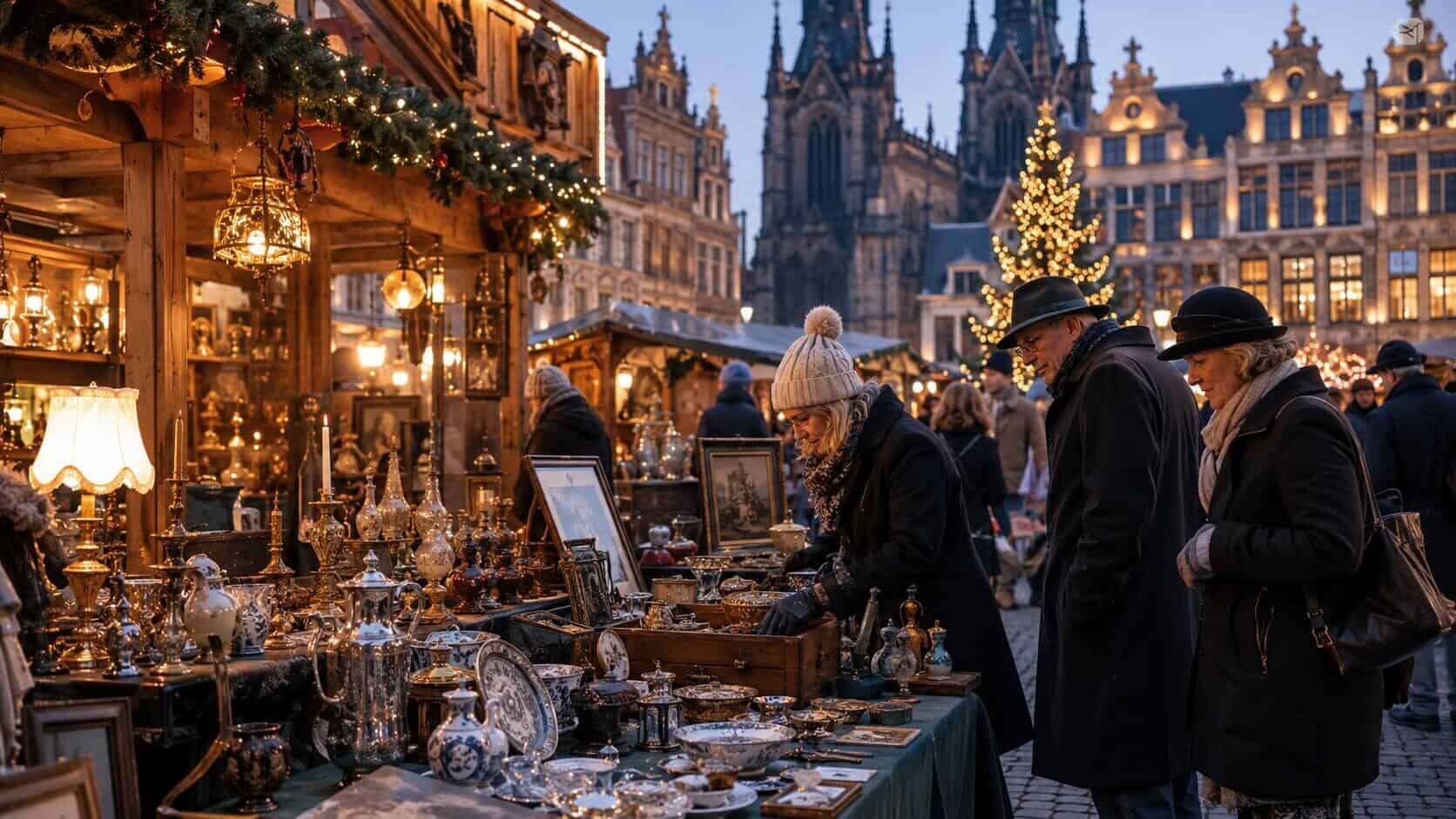

On a Sunday morning in late November, the stalls on Zagreb’s Britanski trg square are already thick with gramophones, old maps and cold-fingered collectors — and the mulled wine stand around the corner hasn’t even opened yet. That overlap, between serious antique hunting and the particular atmosphere of a European Christmas market, is rarer than you’d think. Most cities offer one or the other. A handful offer both.
This guide covers seven cities where antique shopping in Europe during the Christmas market season genuinely rewards a winter trip. The ranking isn’t about which city hosts the biggest flea market — for that, see the 15 best flea markets in Europe. It’s about which cities combine a compelling Christmas atmosphere with real options for collectors: flea markets, antique districts, dealers and shops worth building a weekend around.
One practical note: Christmas market dates shift every year, and opening days for outdoor flea markets can change around public holidays. Verify all dates with each city’s official tourism site before you book.
1. Zagreb, Croatia: the underrated winter find
Zagreb doesn’t always make the shortlist when people plan a winter city break, which is precisely why it’s worth going. The Christmas market here — centered on Ban Jelačić Square and spreading through the surrounding streets — has won recognition from europeanbestdestinations.com multiple times as one of Europe’s best.
The market typically runs from early December into the first week of January, though exact dates shift from year to year. There’s an ice rink, an above-average selection of local food stalls, and enough mulled wine to last the whole of Advent. The handcraft quality is strong — this isn’t a market of imported novelties.
Antique shopping in Zagreb
The real reason collectors should add Zagreb to their winter itinerary is the Britanski trg flea market, held every Sunday on the square of the same name. It’s one of the better all-round antique markets in the region — paintings, jewellery, old currency, gramophones, vintage maps, antique furniture, books and silver all appear regularly. The atmosphere is unhurried and the prices are often more realistic than equivalent finds in Vienna or Brussels.
To combine market and Christmas atmosphere in a single trip, plan for a Saturday arrival, Sunday morning at Britanski trg, then the Christmas market in the afternoon. The two are walkable from each other.
Antique shopping in Zagreb: Britanski trg Flea Market on Fleamapket
2. Strasbourg, France: the one that started it all
Strasbourg’s Christmas market — the Christkindelsmärik, if you want the Alsatian — lays claim to being one of the oldest in Europe, with roots going back to at least the sixteenth century. The “oldest in Europe” claim is widely repeated but contested. What isn’t in dispute is that the market, spreading across Place Broglie, Place de la Cathédrale and several connecting streets in the Grande Île, is one of the most atmospheric on the continent. The pink sandstone cathedral looms over the stalls. In the evening, with the lights up and the vin chaud in hand, it earns its reputation.
The market typically runs from late November until 30 December, but exact dates shift each year.
Strasbourg sits in Alsace, a region that has spent centuries being French, German and French again, and the culture of the market reflects that layered history. The crafts lean toward woodwork, Christmas decorations and regional food — foie gras, bredele biscuits, kougelhopf — rather than the generic novelty-stall output that fills lesser markets.
Antique shopping in Strasbourg
Strasbourg has a small but genuine antique quarter centred on the streets around the Krutenau and Petite France neighbourhoods, with independent dealers offering furniture, faience, regional silverware and the kind of Alsatian vernacular objects — carved kitchen pieces, old linen, folk ceramics — that rarely travel far from the region. It’s browsing territory more than destination hunting, but the quality in the better shops is high.
There is also a flea market, the Marché aux Puces de Strasbourg, typically held on Wednesday and Friday mornings at the Marché de la Brocante near the Vieux-Marché-aux-Vins.
The practical advantage of Strasbourg as a collector’s destination is its proximity to Germany and Switzerland: it sits at the crossing point of three countries, and the surrounding region is historically rich in estate sales and brocantes. If you’re travelling by car, it’s worth building in an extra day to explore outside the city.
3. Vienna, Austria: serious antiques, serious markets
Vienna operates at a different scale. It has more established antique dealers, more auction infrastructure and more serious collector traffic than any other city on this list. The Dorotheum — founded in 1707 and headquartered at Dorotheergasse 17 in the First District — is one of the great auction houses of continental Europe, and its public salerooms and permanent retail galleries are open to anyone.
Beyond the Dorotheum, the First and Seventh Districts hold a concentration of high-end dealers covering everything from Biedermeier furniture to Art Nouveau silver to old master prints. The Seventh — the Neubau — has a younger, more mixed profile: vintage clothing and mid-century design sit alongside traditional antique shops. It rewards an afternoon on foot.
For flea-market hunters, the Naschmarkt’s Saturday market is the main event. Dealers set up along the length of the market, running roughly between Kettenbrückengasse and Schleifmühlgasse U-Bahn stations. The range is wide — prints, maps, vintage jewellery, glassware, coins, furniture — and the early-morning prices are generally more honest than the afternoon tourist trade. Go before 9am if you can.
Antique shopping in Vienna
Vienna’s Christmas markets are numerous and genuinely varied. The flagship Wiener Christkindlmarkt on Rathausplatz — in front of the neo-Gothic City Hall — is the largest and most visited, running from mid-November through to Christmas Eve. It can feel crowded in the evenings, but the stalls are a cut above the average: glass ornaments, handmade wooden decorations, Austrian nativity figures and local food including Maroni (roasted chestnuts), Glühwein and Punsch.
For a slightly quieter experience, the Schönbrunn Palace Christmas Market and the Alte AKH market in the university courtyard are both worth knowing about. The Schönbrunn market benefits from the palace backdrop; the Alte AKH market draws a younger local crowd and has a more relaxed atmosphere.
The combination of the Naschmarkt on Saturday morning, an afternoon in the Dorotheum galleries, and the Rathausplatz market in the evening makes for an exceptionally good single day for anyone travelling for both antiques and Christmas atmosphere. Vienna rewards a weekend, but even a day structured this way delivers.
4. Dresden, Germany: the oldest market and a strong dealer scene
Dresden has a reasonable claim to hosting the oldest Christmas market in the German-speaking world. The Striezelmarkt — the name derives from Striezel, a regional sweet bread — has been running on the Altmarkt since 1434, or thereabouts. Whether that makes it Europe’s oldest or merely one of the oldest is a detail worth checking, but the atmosphere earns its own reputation regardless of the record books. The scale is considerable: several hundred stalls filling the Altmarkt square and spilling into side streets, typically open from late November through Christmas Eve.
Beyond the Striezelmarkt, Dresden is notable for its concentration of Advent markets across the city — the market at the Neumarkt beside the Frauenkirche is particularly good for atmosphere, with the rebuilt baroque cathedral as a backdrop. The Advent market at Schloss Pillnitz, a baroque palace on the Elbe a short distance from the centre, is worth the trip if you have an extra afternoon.
Antique shopping in Dresden
Dresden is a serious city for antiques, largely because of what was lost and what survived the postwar decades. The GDR period meant that a great deal of furniture, porcelain, silver and art remained in private hands longer than it might have in the West — and much of it has found its way into the dealer trade since reunification. The result is a market with genuine depth, particularly in German porcelain (Meissen is made just 25 kilometres up the Elbe), clocks, art and pre-war decorative pieces.
The main dealer concentration sits in and around the Albertstadt district and along Königsbrücker Strasse, though the Neustadt neighbourhood — across the river from the baroque Old Town — has a growing number of independent vintage and antique shops alongside its bars and studios. The Saturday flea market at the Altmarkt operates year-round and expands in scale around the Christmas period, when the broader market infrastructure is already in place.
Meissen porcelain is the obvious collector target here, but condition and provenance vary wildly between the flea market stalls and the specialist dealers. If you’re buying anything significant, the dealers in the Neustadt are worth the extra conversation — most know their stock in detail.
5. Prague, Czech Republic: affordable finds and a classic market
Prague’s Christmas market on Old Town Square is one of the most photographed in Europe — the towers of the Týn Church rising above the stalls, the astronomical clock ticking on the hour, the smell of trdelník and mulled wine in the cold air. It’s also genuinely crowded, especially in the first two weeks of December. That’s not a reason to avoid it, but it is a reason to arrive early in the morning or on a weekday. The market typically runs from late November into early January, with a second site at Wenceslas Square.
The stalls sell a mix: some tourist-facing novelties, but also Czech glass, wooden toys, handmade jewellery and ceramics that are worth a proper look. The food offering is strong — svíčková (beef in cream sauce) and langoše (fried flatbread) alongside the expected hot drinks. Prague rewards the visitor who looks slightly beyond the main square; the smaller neighbourhood markets in Vinohrady or on náměstí Míru often have a more local flavour.
Antique shopping in Prague
Prague is still one of the more affordable cities in Europe for antique hunting, though the gap between Prague and Western European prices has narrowed considerably in the past decade. The best hunting ground for collectors is the area around Týnská ulička — a narrow lane just off Old Town Square — where several specialist dealers cluster within a short walk of the Christmas market itself. Bohemian glass, art nouveau objects, communist-era memorabilia, religious antiques and Central European silver all appear regularly.
For a broader range, the Havelské tržiště (Havel’s Market) on Havelská street operates daily and in December typically includes some antique and vintage sellers among the fruit stalls and souvenir pitches. It’s not a dedicated flea market, but it’s close enough to the Old Town Square market to combine easily.
The Holešovice district, a tram ride north of the centre, has developed into a credible destination for antique and vintage shopping in recent years, with several dealers and the Holešovice market hall. It’s a different Prague to the tourist centre — rougher-edged, more local — and the prices tend to reflect that. For anyone spending more than a long weekend, it’s the part of Prague that rewards a morning’s exploration.
6. Budapest, Hungary: grand markets and serious antique hunting
Budapest is one of those cities that seems purpose-built for a winter weekend. The thermal baths alone justify the trip in cold weather. But collectors have a more specific reason to come: the combination of a genuinely good Christmas market and one of Central Europe’s most rewarding antique scenes is hard to beat at this price point.
The main Christmas market runs along Vörösmarty tér in the heart of Pest, stretching back toward the Danube, and it’s one of the more atmospheric in Central Europe — the neo-classical backdrop helps. A second market near St Stephen’s Basilica has its own appeal. Both typically run from late November through late December, though exact dates change annually.
Antique shopping in Budapest
The Ecseri Piac, on the southern edge of the city near Kőbányai út, is the market that serious collectors come to Budapest for. It’s large, rough around the edges and genuinely unpredictable — the kind of place where communist-era collectibles sit alongside 19th-century furniture, military medals, carved wooden boxes and mid-century porcelain. Saturday mornings are the main event — the market has historically run on weekday mornings too, but days and hours fluctuate.
It’s a long tram and bus ride from the Christmas market, which means you’re unlikely to combine both in a single morning. That’s fine — treat Ecseri as a separate half-day and plan accordingly. Take cash. Bargaining is normal and expected.

Closer to the centre, Falk Miksa utca in the 5th district has earned its reputation as Budapest’s antique street. The block is lined with established dealers selling furniture, jewellery, silverware, paintings and decorative objects — the quality is higher and the prices reflect it. It’s a short walk from the Hungarian Parliament building and easy to thread into a day already centred on the city’s main sights. For anyone who finds Ecseri too chaotic or too far, Falk Miksa gives you a focused, walkable alternative.
Hungarian art nouveau and Zsolnay porcelain appear regularly across both the street dealers and the flea market — pieces that would cost significantly more in Vienna or Paris. The price gap hasn’t vanished, but it hasn’t closed as completely as it has in Prague.
7. Tallinn, Estonia: medieval atmosphere and Baltic antiques
Tallinn is the outlier on this list — further north, harder to reach from most of Western Europe, and colder by a margin that matters. It also has one of the most intact medieval old towns on the continent, and when the Christmas market sets up on Town Hall Square in December, the effect is less staged recreation and more like something that was always meant to be there.
The market is smaller than Vienna or Strasbourg, and that’s part of the appeal. It doesn’t overwhelm. The focus is local craft — knitwear, ceramics, smoked meats, marzipan — rather than the generic Christmas-market merchandise that appears across too many Western European cities in December.
Antique shopping in Tallinn
Tallinn has a small but worthwhile antique scene concentrated in and around the old town. Several dealers operate on and near Müürivahe and Viru streets — the tourist-facing lanes that run along the old city walls — though the better-value shops tend to be in the quieter streets of Kalamaja, the neighbourhood northwest of the old town that has become Tallinn’s main creative and independent-retail district.
Baltic German silver, Soviet-era collectibles, Estonian linen, amber pieces and old maps of the region are among the objects that appear with some regularity. The flea market culture is less developed here than in Central Europe — there’s no equivalent of Ecseri or Brunnenmarkt — but the dealers are worth browsing, and the prices are among the lowest of any city on this list.
Tallinn suits a collector who’s also a genuine traveller: someone who enjoys the search as much as the find, and doesn’t mind a bit of legwork. The city rewards wandering, especially in winter when the crowds that fill the old town in summer have thinned out considerably.
Planning your trip: a few practical notes
Christmas market season in Europe broadly runs from late November through to 24 or 26 December, with a handful of markets extending into early January. Dates vary by city and by year — Zagreb and Vienna tend to run longest; Strasbourg typically begins earlier than most. Always check each city’s official tourism website for confirmed 2026 dates before booking travel.
For outdoor flea markets, December brings additional variables. Some markets reduce their days or close entirely around public holidays. Cold snaps keep stallholders home. Markets that run every Saturday in September may be irregular in December. Confirm directly — a quick look at a market’s social media page the week before you travel is usually the most reliable method.
Cash remains essential at almost every flea market and brocante on this list, regardless of what the official policy says. Bring more than you think you’ll need. Smaller denomination notes help with negotiation.
If you’re buying to bring home, know the airline baggage policies for fragile or oversized items before you’re standing at a stall with a piece of Meissen porcelain in your hands. Some finds are better shipped than carried.
Frequently asked questions
When do Christmas markets run in Europe?
Most European Christmas markets open in late November — often around the last weekend before Advent — and run through 24 December, with some extending to 26 December or into early January. Exact dates shift each year, so check each city’s official tourism site before booking. Zagreb and Vienna tend to have among the longest runs; Strasbourg typically opens earlier than most.
Which city is best for combining antique shopping with a Christmas market?
Vienna offers the deepest combination — the Naschmarkt Saturday flea market, the Dorotheum auction galleries and multiple Christmas markets within a short walk of each other. Budapest comes close if you’re working to a tighter budget: the Ecseri Piac and Falk Miksa antique street both reward a visit, and the Vörösmarty tér market is genuinely atmospheric. Zagreb is the strongest underrated option — Britanski trg on a Sunday morning followed by the Christmas market in the afternoon is a near-perfect collector’s day.
Do European flea markets stay open in December?
Many do, but with less predictability than in warmer months. Outdoor markets sometimes reduce their days, skip public holidays or close entirely during cold snaps. The safest approach is to check the market’s own social media page in the week before you travel — it’s usually the fastest way to confirm whether a market is running on a specific date. Cash is essential at virtually every outdoor flea market regardless of the season.
What should collectors look for in Central European flea markets?
Central Europe has particular depth in certain categories: Meissen and Zsolnay porcelain, Art Nouveau silver and glassware, Biedermeier furniture, communist-era collectibles, old maps and military medals. Hungarian art nouveau pieces and Dresden-area porcelain tend to be better value here than in Western Europe, though the price gap has narrowed in major cities like Prague over the past decade. For anything significant, the specialist dealers — rather than the open-air stalls — are worth the extra time and the higher asking price.