

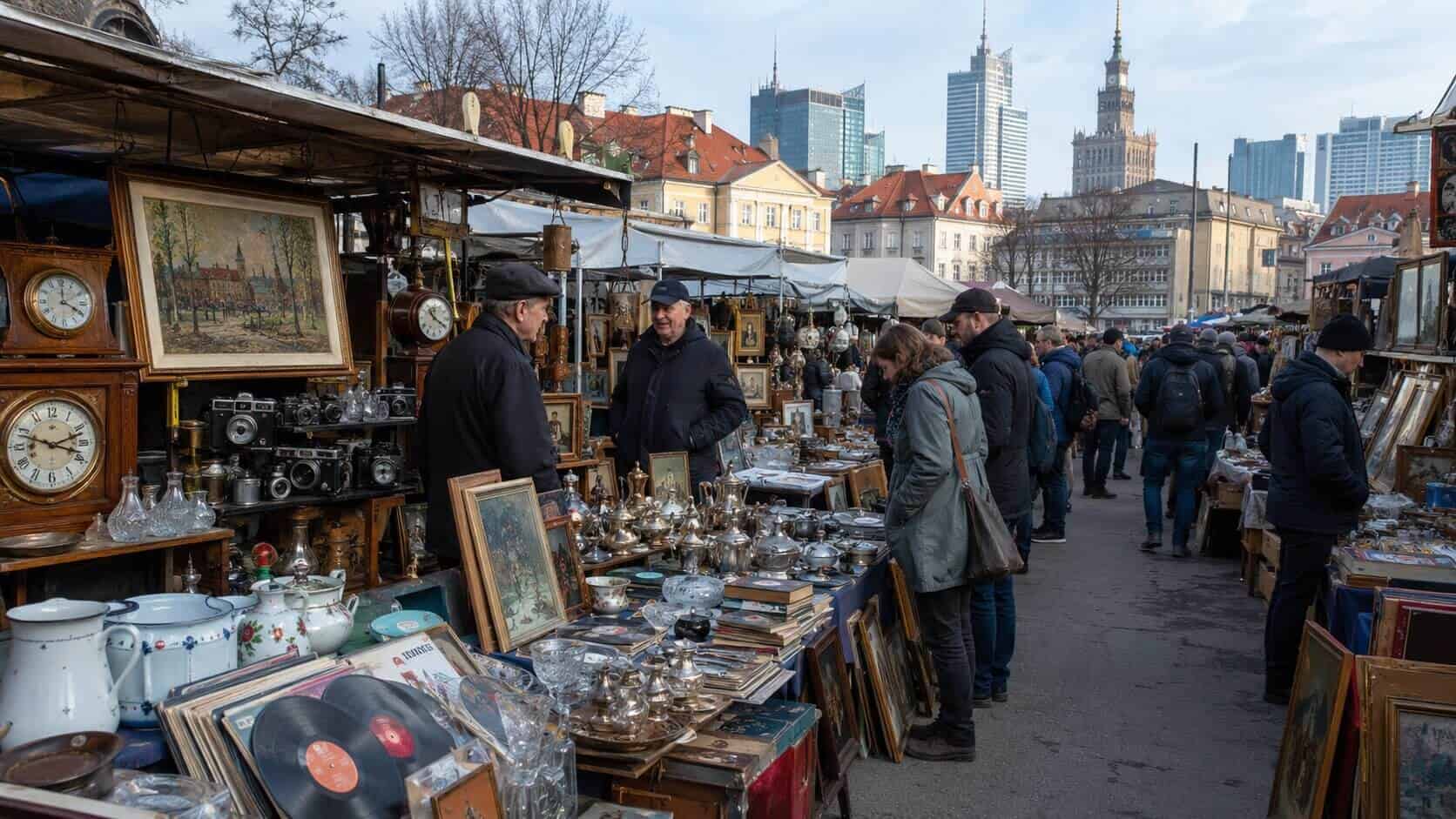

On a Sunday morning at Koło Bazar — a sprawling open-air market in Warsaw’s Wola district — you might find a Prussian helmet, a stack of pre-war postcards and an ornate wall clock all within ten metres of each other. This is flea market shopping in the fullest, most exhilarating sense of the phrase. Warsaw punches well above its weight for serious collectors, and most of Europe still hasn’t noticed.
Poland’s capital gets overlooked on the European antiques circuit — which is precisely why it’s worth making the detour. Three very different markets serve three very different appetites: Koło Bazar for dedicated collectors and dealers, Bazar Różyckiego for authentic neighbourhood atmosphere, and ZOO Market for mid-century design enthusiasts. Beyond the city, Poland’s regional market culture runs deep. Before you go, one practical note: ZOO Market’s current operational status is uncertain, so verify directly before building your itinerary around it. The established markets, however, are well worth your time.
Koło Bazar: Warsaw’s Market for Serious Collectors
Bazar na Kole — known to most visitors simply as Koło Bazar — is the one Warsaw market that dedicated collectors plan their weekend around. It sits in the Wola district at ul. Obozowa 99, a short tram ride west of the city centre, and every Saturday and Sunday it draws dealers from across Poland. Come early. The best pieces disappear quickly, and the atmosphere in the first hour of trading is hard to beat.
The range on offer is genuinely impressive and genuinely strange in the best possible way. Vintage stamps, intricate mechanical clocks, pre-war bathroom fixtures, vinyl records and oil paintings share tables with early 19th-century postcards, rusted German helmets, ammunition boxes and shell casings. For the more committed buyer, the occasional standout piece surfaces — among the more extraordinary examples cited by vendors: a Prussian World War I helmet or hand-carved palace doors imported from India. Haggling is expected and essential; arriving at the asking price without negotiating is considered a rookie mistake. Budget, patience and a willingness to carry something bulky home are the three things Koło Bazar rewards most.
📍 Address: ul. Obozowa 99, Warsaw
📅 Days: Saturday–Sunday
🕐 Hours: Approx. 6:00 am–3:00 pm (sources vary slightly, 7 am–2 pm also reported)
🚇 Metro/Tram: Tram 12, 13 or 24 to Dalibora stop
💰 Admission: Free
📖 More info: Facebook — facebook.com/bazarnakole
Bazar na Olimpii: Everyday Market, Genuine Finds
Where Koło Bazar draws dedicated collectors and weekend dealers, Bazar na Olimpii operates at a more everyday pitch — and that’s part of its appeal. Located in the Mokotów district, it has the feel of a neighbourhood institution rather than a destination market. Locals come here for practical reasons, which means the browsing is less curated and the atmosphere considerably more relaxed. For a visitor, that informality is a gift: vendors here tend to be less guarded about pricing, and the turnover of stock means a return visit rarely looks the same as the last.
The mix leans toward household goods, secondhand clothing and assorted bric-a-brac, but patient browsers do surface vintage glassware, Soviet-era objects and the occasional piece of mid-century Polish ceramics — the kind of thing that commands real money in western European vintage shops. It’s worth pairing a visit with Koło Bazar on the same weekend trip; the two markets offer usefully contrasting angles on Warsaw’s secondhand culture, one built for the trade, the other built for the neighbourhood.
📍 Address: ul. Górczewska 56/60, Warsaw
📅 Days: Sunday only
🕐 Hours: Approx. 6:00 am–3:30 pm
🚇 Metro/Tram: Bus 190 or 171 to PKP Koło stop
💰 Admission: Free
📖 More info: Facebook — facebook.com/targolimpia
Nowy Bazar Różyckiego: Warsaw’s Most Historic Street Market
Bazar Różyckiego has been part of Warsaw’s streetlife for well over a century, making it the oldest continuously operating market in the city. It sits in the Praga district on the right bank of the Vistula — the grittier, more working-class side of Warsaw that has resisted gentrification more stubbornly than the rest of the capital. That resistance is much of its character. Praga has its own accent, its own pace, and Różyckiego feels like a natural extension of both.
The market’s identity has shifted over the decades. In its Soviet-era heyday it was notorious for informal trading, black-market goods and the full chaos of a city economy operating in the gaps. Today the Nowy Bazar — the revived, reorganised version — pulls together a mix of secondhand clothes, vintage housewares, old tools and assorted collectibles alongside fresh produce and everyday goods. It’s less polished than a dedicated antiques market, which is exactly the point. The finds here tend toward the practical and the overlooked: old Polish enamelware, communist-era printed matter, vintage textiles and the kind of anonymous mid-century object that only reveals its quality once you get it home.
For visitors who’ve already worked Koło Bazar, Różyckiego offers something genuinely different — neighbourhood texture and historical depth that a purpose-built antiques market can’t replicate. Combine it with a walk through Praga’s street-art corridors and you have a half-day that feels nothing like the tourist-facing side of Warsaw.
📍 Address: ul. Targowa 54, Warsaw (entrance next to the Praga Museum)
📅 Days: Thursday–Sunday
🕐 Hours: Thu–Fri 12:00–17:00/18:00 (select stalls); Sat–Sun 11:00–17:00
🚇 Metro/Tram: Near Praga district, Targowa Street
💰 Admission: Free
📖 More info: Instagram — @nowybazarrozyckiego
ZOO Market: Warsaw’s Mid-Century Design Scene
ZOO Market occupies a different register from Warsaw’s older bazaars. Where Koło draws hardcore dealers and Różyckiego trades on neighbourhood grit, ZOO built its reputation on curated mid-century design — the kind of market where you’re more likely to find a clean-lined Polish modernist lamp or a well-preserved piece of PRL-era furniture than a crate of rusty tools. It attracted a younger, design-literate crowd and helped position Warsaw as a city with a genuine vintage culture, not just a salvage economy.
The market’s concept leaned into the aesthetic appetite that’s driven similar events across Berlin and Prague — vendors selected for quality, a focus on 20th-century objects, and an atmosphere closer to a design fair than a traditional flea. For collectors interested specifically in postwar Polish industrial design, that focus made it the most efficient stop in the city. The problem is operational: ZOO Market’s current status is genuinely unclear, and it would be a mistake to plan a weekend around it without checking first. If it is running, it’s worth the visit. If not, Koło Bazar remains the strongest alternative for design-minded browsers — the overlap in stock is larger than it might appear.
Keep an eye on Warsaw vintage communities and local event listings for updates before your trip.
📍 Address: Aleja Solidarności 55, 03-402 Warsaw (near Dworzec Wileński)
📅 Days: Previously Saturday–Sunday
🕐 Hours: Previously 11:00 am–5:00 pm
🚇 Metro/Tram: Dworzec Wileński metro station
⚠️ Status: Currently on hiatus / discontinued
Warsaw’s Markets as a Culinary and Cultural Experience
Warsaw’s flea markets are rarely just about objects. Food stalls, street snacks and impromptu social rituals have always been woven into the fabric of Polish bazaar culture, and the city’s markets are as much a window into local life as they are a hunting ground for collectibles. At Różyckiego, fresh produce and hot food sit alongside secondhand housewares in a way that feels entirely unselfconscious — breakfast at a market canteen before combing through a box of enamelware is a distinctly Warsaw experience.

The cultural dimension runs deeper than food. Polish flea markets carry a particular historical weight: the objects on sale — communist-era printed matter, pre-war domestic items, militaria from multiple occupations — are not just collectibles but fragments of a disrupted national memory. Handling a 1930s Warsaw street map or a PRL-era propaganda poster in the place where those histories actually unfolded adds a layer of context that no antiques fair in Western Europe can quite replicate. For visitors with an interest in 20th-century European history, browsing Warsaw’s markets is genuinely educational, even if you leave empty-handed.
That combination — neighbourhood food culture, living social history and serious collector material — is what sets Warsaw apart on the European flea market circuit. Budget time to slow down, eat something and talk to vendors. The best finds and the best stories tend to come from the same place.
Planning Your Visit
Warsaw’s markets are mostly concentrated in the western Wola district, which makes it practical to combine Koło Bazar and Bazar na Olimpii on the same Saturday or Sunday morning. Both are outdoor markets, so weather matters — a grey drizzle dramatically thins the vendor turnout, while a dry weekend in spring or autumn draws the widest range of sellers. Arrive early; the best furniture and collectibles are gone by mid-morning, and many dealers begin packing up well before the advertised closing time. Bring cash in Polish złoty and carry small denominations — haggling is the norm, and exact change makes negotiations smoother. Nowy Bazar Różyckiego operates on weekdays as well, so if your visit falls mid-week, Praga is still worth a trip. Give yourself at least two to three hours per market; rushing defeats the purpose.
Where to Stay
Warsaw has a wide range of accommodation across all price points, and the city centre — Śródmieście — puts you within easy reach of trams and buses serving both the Wola district markets and the Praga neighbourhood across the Vistula. For visitors primarily focused on Koło Bazar and Bazar na Olimpii, staying in or near Wola itself shortens the morning commute considerably, though the neighbourhood is quieter for evening dining. Praga, on the right bank, has grown steadily as a base for travellers who want proximity to Różyckiego and the area’s emerging independent restaurant and café scene. Mid-range hotels along Al. Jerozolimskie or near Warsaw Centralna station offer a reasonable middle ground between transit access and neighbourhood character. Booking well in advance is advisable for peak summer weekends.
Frequently Asked Questions
What is the best flea market in Warsaw for serious antique collectors?
Koło Bazar (Bazar na Kole) on ul. Obozowa is consistently regarded as Warsaw’s — and arguably Poland’s — premier destination for serious collectors. The range of period furniture, pre-war decorative objects, militaria and ceramics is unusually deep for an open-air market, and dealers from across the country bring stock specifically because the buyer base here expects quality. Arrive at opening time on a Saturday for the widest selection.
Do I need to speak Polish to shop at Warsaw’s markets?
You don’t need Polish to get by, but a few basic phrases go a long way in building rapport with vendors, particularly at older markets like Różyckiego where the stall-holders tend to be local traders rather than boutique sellers. Prices are usually written down or tapped into a phone, and gestures cover most of the negotiation. Younger vendors at markets with a design or vintage focus are often comfortable in English.
Is cash the only payment option at Warsaw flea markets?
The majority of outdoor market vendors operate cash-only, and Polish złoty is required — euro are not reliably accepted. Small denomination notes are particularly useful when haggling, since asking for change can complicate a negotiation. Some larger or more design-oriented stalls may accept card payments, but it is safest to withdraw cash before arriving at any of the markets listed here.
Are Warsaw’s flea markets worth visiting outside the summer months?
Yes — autumn in particular can be an excellent time to visit. Vendor numbers at outdoor markets naturally dip in cold or wet weather, but the collectors who do show up in October and November are often among the most knowledgeable, and the competition from casual tourists is lower. Winter visits to Koło Bazar are possible but unpredictable; check conditions before making a special trip in January or February.