

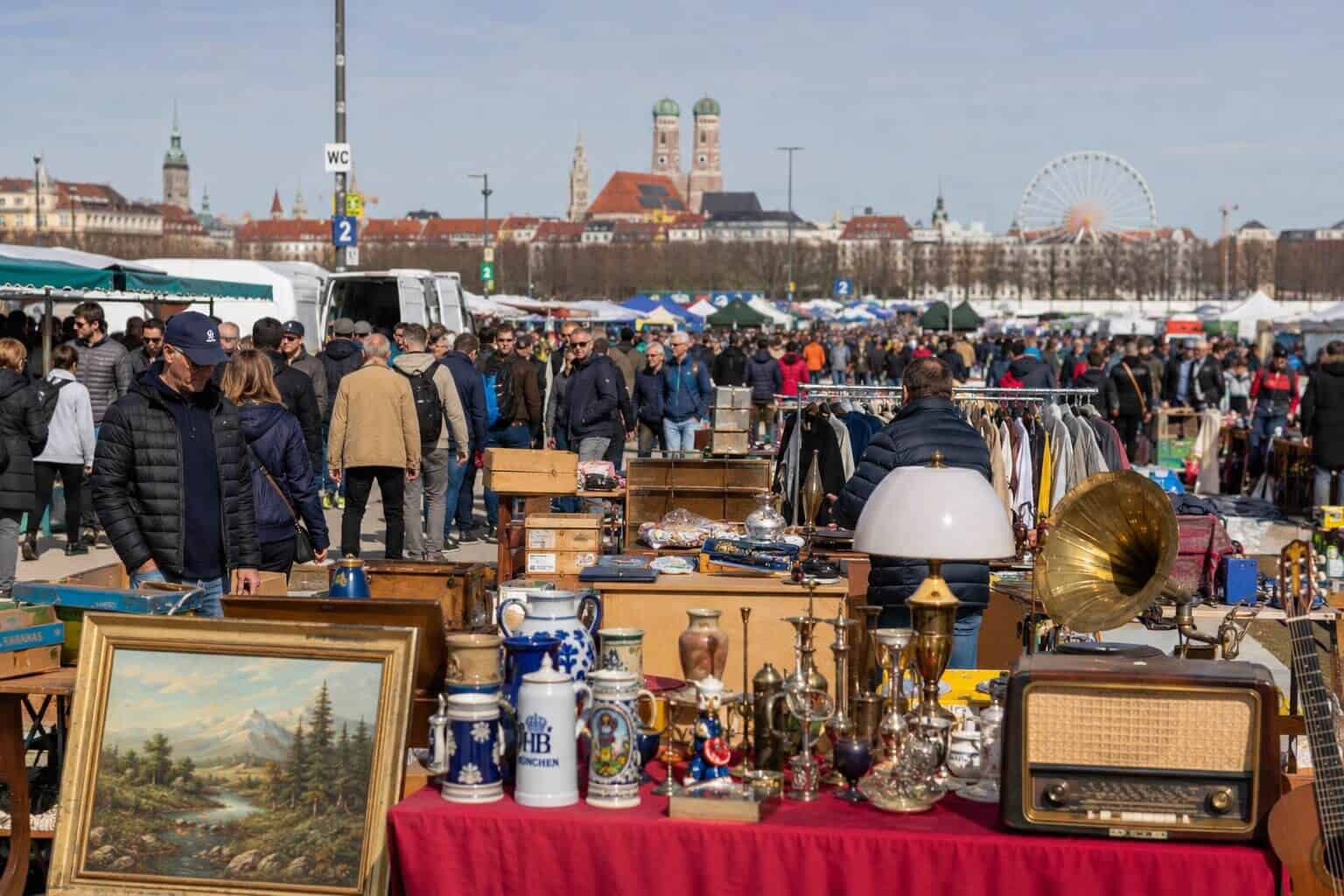

At 4 a.m. on a Friday in April, the Theresienwiese is already alive. Dealers are unloading vans under floodlights, antique furniture is being laid out on tarpaulins, and a handful of obsessive early birds — us included — are already circling the stalls before Munich has had its first coffee. This is the Munich Theresienwiese flea market, the Münchner BRK-Riesenflohmarkt, and it is emphatically not a small affair.
Two thousand retailers. Around 80,000 visitors over the course of a single Saturday. Fifteen miles walked across two days, and two pairs of shoes that did not survive the experience. What follows is a personal account of how we tackled it — the mistakes made on our first visit, the Friday discovery that changed everything, and what you can realistically expect to find when Munich’s private sellers pull genuinely good things out of genuinely good wardrobes.
If you have never been, prepare yourself. This is not a weekend car boot in a school car park. It is a full day’s physical commitment — closer to a sponsored walk than a Saturday browse — and it rewards preparation in direct proportion to the effort you put in before you arrive.
Friday: The Professional’s Advantage
Our first visit, we did what most people do: showed up on Saturday morning, early-ish, pleased with ourselves for beating the crowd. We were not beating the crowd. We were the crowd. The genuinely good pieces — the ones the professional dealers had driven overnight to secure — were already gone by the time we got our bearings.
The second time, a friend gave us better advice. Come Friday evening. Not to buy — the market is not officially open — but to watch. Many of the professional stall holders arrive the afternoon and evening before to set up, and the atmosphere in those hours is something the Saturday crowds never get to see. Crates being unpacked under work lights. Dealers talking prices with each other. The occasional piece of vintage furniture being wrestled off a trailer and into position. It is, in its own way, more interesting than the market itself.
More practically: arriving the night before means you already know the layout when the gates open Saturday morning. You know which end of the site has the dealers worth returning to. You know which stalls are selling the categories you actually care about. When Saturday begins in earnest — and it begins fast, with serious collectors moving at a pace that would shame most morning joggers — you are not spending the first hour getting oriented. You are already working.
We arrived on our second visit equipped the way we should have been the first time: comfortable, broken-in shoes (non-negotiable — learn from our destroyed footwear, not your own), a small rucksack, a torch for the early pre-dawn hour, cash in coins and small notes, and the kind of focused indifference that serves you well at a market this size. Not shopping for everything. Shopping for a few things, with eyes open for the unexpected.
That indifference is harder to maintain than it sounds. The range of goods at Theresienwiese is genuinely staggering: militaria, ceramics, design objects from the mid-century decades, vintage bags and accessories, electronics, books, clothing from what appears to be the wardrobes of people who dressed very well and now need the space. Munich is an affluent city, and it shows in what private sellers bring to the table. The fashion and designer pieces, in particular, are often in a different quality bracket from what you would find at a comparable market in a less prosperous city.
Which is not to say everything is expensive. It isn’t. But you will need to negotiate, and the Friday evening reconnaissance is useful here too: by the time you are standing in front of a stall on Saturday morning, you have some sense of what the dealer values and how they present their stock. That context is worth something when you open a conversation about price. For a more systematic approach to getting the number down, our guide to flea market haggling covers the mechanics in more detail — but at Theresienwiese, the single most useful move is simply being early enough that the seller is still in a good mood and the day’s energy is still high.
By mid-morning on Saturday, the site is dense with people and the dynamic shifts. Sellers become more confident. Crowds make it harder to handle pieces, inspect things properly, or have a real conversation about what something is worth. The window between the official opening and the point at which the market becomes genuinely difficult to navigate is probably two hours, maybe three. Those hours are where the visit either justifies itself or doesn’t.
We stayed for most of both days. We are not recommending that, exactly — fifteen miles is a lot of pavement — but we are also not not recommending it. There is a particular satisfaction in being one of the last people still browsing as the light starts to go, watching dealers pack down and sometimes, suddenly, becoming very willing to negotiate on the pieces that didn’t move. A different kind of opportunity from the Friday-night reconnaissance, but a real one.
Practical Information: What to Know Before You Go
Eighteen hours on a hard surface will teach you things about your own limits. A few things we learned the uncomfortable way, so you don’t have to.
The Munich Theresienwiese flea market — officially the Münchner Riesenflohmarkt or Flohmarkt Theresienwiese — is held at the Theresienwiese, the same open ground that hosts Oktoberfest. The scale of the site is part of why the event can absorb 2,000 stalls without feeling cramped, and also why comfortable shoes are not optional advice.
The market runs across a Saturday, with the official opening historically at 6:00 a.m. Professional dealers are typically on-site and setting up well before that. If you are travelling specifically for the market, arriving in Munich on Friday evening gives you the option of a Friday-night reconnaissance walk — the approach we cover in detail in the section above, and the single biggest advantage available to a visitor who does their homework.
📍 Address: Theresienwiese (Matthias-Pschorr-Straße 1), 80336 Munich
📅 When: Once a year — first Saturday of the Spring Festival (April)
🕐 Hours: 06:00–16:00
💰 Admission: Free
🚇 Transport: U4/U5 to Theresienwiese
⚠️ The event date changes annually. Check the official listing each year before planning travel.
Getting there
Theresienwiese is one of Munich’s most accessible venues. The U4 and U5 U-Bahn lines stop directly at Theresienwiese station, a short walk from the market site. If you are coming from central Munich, you will not need a car — and given the volume of people on a Saturday morning, you probably do not want one.
Eat early, eat on site. Food vendors are part of the market — Bratwurst, pretzels, coffee — and the queues build quickly once the main crowd arrives. If you can eat before 9:00 a.m., do it. By mid-morning you’ll be glad you did.
Plan your exit route before you need it. The Theresienwiese site is large and can be disorienting when it’s full. Agree a meeting point with anyone you’re visiting with, keep your phone charged, and decide in advance where you’ve parked or which U-Bahn exit you’re headed for. The U4 and U5 lines serve Theresienwiese station directly — but on market day the platforms fill up fast in the early afternoon.
What to bring
Cash is essential — small denominations, plenty of coins. Many stalls will not have change for a large note early in the morning, and asking a dealer to break a fifty on a three-euro purchase does not start a negotiation well. A good bag matters too; if you are buying clothing, you want something you can inspect properly against your body rather than holding up in one hand. If designer or vintage fashion is your focus, our guide to spotting a genuine designer bag is worth reading before you go — the Theresienwiese attracts serious sellers, but that does not mean everything is what it is presented as being.
For furniture buyers: come with a plan. The Flohmarkt Theresienwiese regularly surfaces pieces of real quality — and if you are not prepared to transport something the same day, you either need a very accommodating dealer willing to hold a piece, or the discipline to walk away. On the question of whether antique furniture holds its value, our longer piece on that subject is worth reading before you commit to anything large or expensive.
Finally: give yourself permission to walk away from things. The market is large enough that second-guessing a decision and doubling back will cost you real time. If something stops you in your tracks, buy it. The return trip is rarely worth it.
Where to Stay in Munich
The Riesenflohmarkt starts at 06:00, which means an early alarm — and that’s a much easier prospect if you’re already in Munich the night before. The Theresienwiese is well connected to the city centre, and most central Munich hotels are within two U-Bahn stops of the market site. The Hauptbahnhof area has the broadest range of options across budgets, from business hotels to smaller independent places; Schwabing and Maxvorstadt are worth considering if you prefer a quieter neighbourhood with good transit links. Booking early is advisable if your visit coincides with the Frühjahrsfest weekend — Munich fills up quickly during its festival calendar.
Frequently Asked Questions
What time does the Munich Theresienwiese flea market open?
The market historically opens at 6:00 a.m. on Saturday, though professional dealers begin setting up considerably earlier. If you are serious about first pick of the best stock, aim to arrive at or before opening. Friday-evening arrivals will find many professional stalls already in place — with far less competition.
What can I find at the Theresienwiese flea market?
The range is genuinely broad. Professional dealers bring antique furniture, ceramics, militaria, design objects and vintage electronics. Private sellers — who tend to be more active on Saturday — bring clothing, accessories and personal items. Munich’s seller base skews relatively affluent, which means the quality of fashion and designer pieces can be higher than you might expect at a flea market of this size. For anything wearable, bring a critical eye; for anything collectable, bring knowledge or be prepared to research on your feet.
How do I haggle at the Theresienwiese flea market?
The short version: be early, be friendly, and do not open with an insultingly low number. The longer version is in our guide to flea market haggling. At Theresienwiese specifically, the window between opening and peak crowd density — roughly two to three hours — is when sellers are most relaxed and most open to negotiation. Late in the day, as dealers begin packing down, is a second window worth knowing about: pieces that have not sold all day sometimes find their price dropping significantly in the final hour.
How do I get to the Theresienwiese flea market from central Munich?
The U4 and U5 U-Bahn lines stop at Theresienwiese station, which puts you within easy walking distance of the market entrance. Tram and bus connections from the city centre are also available. On a busy Saturday morning, public transport is the straightforward choice.