

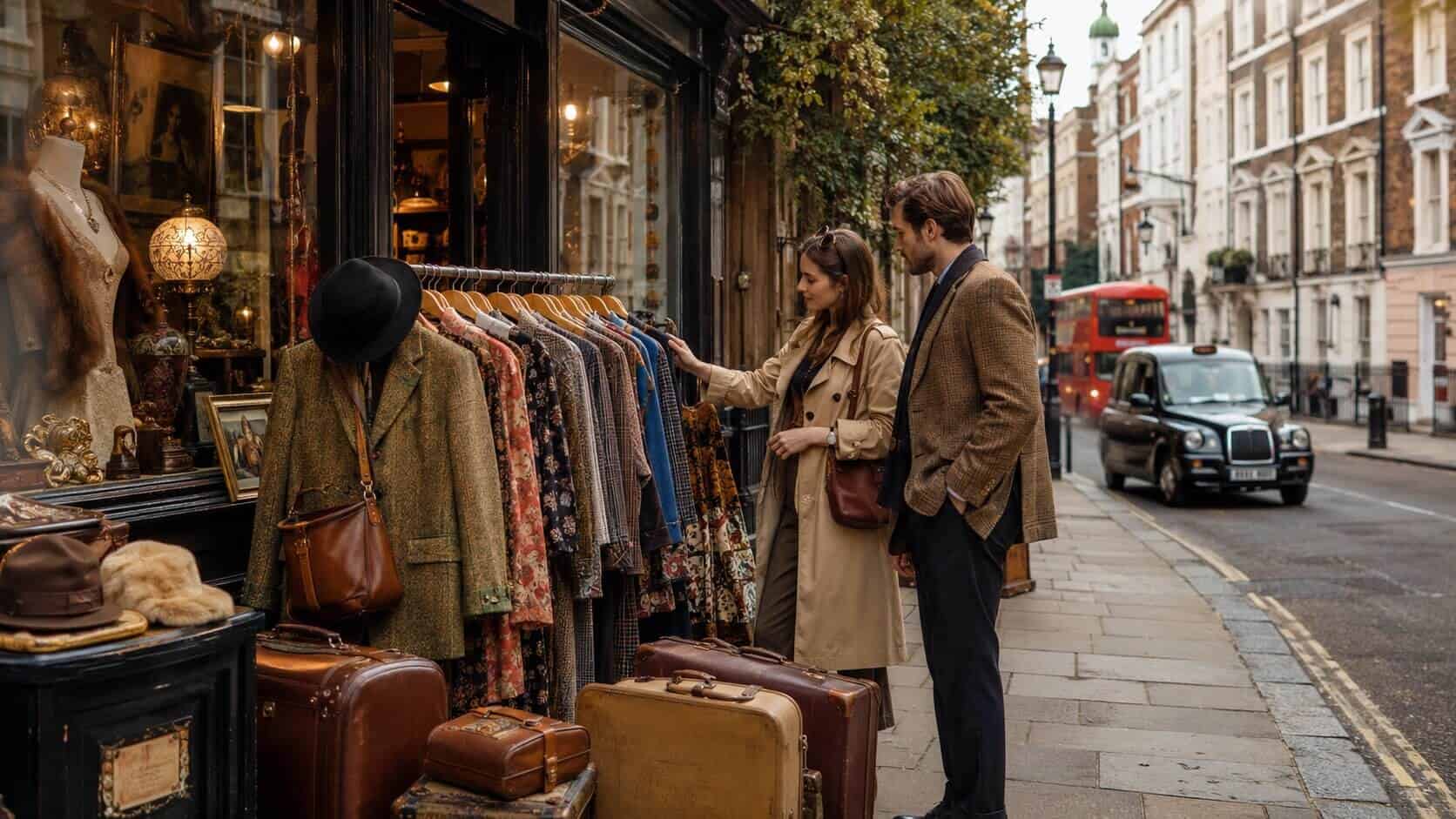

On a Tuesday morning in Chiswick, a former 1908 cinema sells Art Deco lamp bases and mid-century sideboards across 10,000 square feet of floor space. In Hackney, a railway arch stocks European industrial furniture you won’t find on any high street. London’s vintage shops range from appointment-only menswear archives to sprawling antique department stores — and the gap between them is part of what makes the city one of Europe’s most rewarding places to shop for pre-owned pieces.
This guide covers the strongest independent vintage shops currently trading in London, weighted toward editorial quality rather than pure name recognition. Three entries from an earlier version of this list have been removed — they are no longer operating — so every shop below should be open when you visit. That said, always check ahead: hours shift, shops move, and London’s retail landscape moves fast.
If markets are more your style, our guide to the best flea markets in London covers Portobello Road, Brick Lane and beyond.
What Makes London’s Vintage Scene Worth Your Time
London has a depth of vintage retail that most European cities can’t match — partly because of the sheer scale of the city, partly because of the decades of specialist trade that have concentrated knowledge and stock here. The best shops aren’t generalists. They tend to specialise: strictly menswear, or strictly French provincial furniture, or mid-century homewares only. That focus is a good sign. It usually means the buyer knows exactly what they’re looking for — and has passed over a lot to get to what’s on the floor.
The city’s vintage geography is worth understanding before you go. Chiswick and Marylebone carry the more refined end of the market — larger premises, higher price points, furniture-heavy. East London (Hackney, Shoreditch, Brick Lane) skews younger, more fashion-forward, with stronger rails of clothing and accessories. Kensington sits firmly in classic British menswear territory. Covent Garden bridges several worlds.
You’ll find separate atmospheres and separate price expectations in each area. A good trip often combines two or three neighbourhoods — pair a furniture shop in Chiswick with a morning at Portobello Road, or combine an East London clothing archive with Brick Lane Market on a Sunday.
One practical note before the list: several London vintage shops keep irregular hours or reduced Saturday schedules. A few operate by appointment. Check the official website or social channels before making a specific journey — especially midweek. Our guide to shopping for vintage clothes has useful preparation advice if you’re new to this kind of retail.
The 9 Best Vintage Shops in London
Three shops from an earlier version of this list have been removed — they no longer appear to be trading. The entries below are ordered roughly from specialist to destination, with the strongest all-round experiences toward the top. Verify hours before visiting: several of these shops keep irregular schedules or reduced midweek opening.
The Vintage Showroom — Covent Garden
The Vintage Showroom occupies a particular position in London’s vintage world: it’s less a shop than a curated archive of 20th-century menswear, built over years of careful buying across Europe and the US. The stock runs from 1920s workwear to 1980s sportswear, with a particular strength in military, denim and heritage outerwear. Prices reflect that curation — this isn’t a rummage destination.
Access is by appointment, and the shop also sells through its own website. If you’re serious about vintage menswear — provenance, condition, specific decades — this is one of the most focused buying experiences in London. Walk-ins may be accommodated, but check ahead.
Hornets of Kensington — Kensington Church Street
Hornets has been on Kensington Church Street long enough to qualify as an institution. The stock is classic British: tailored suits, overcoats, evening wear — the kind of wardrobe that suggests a life lived at a certain register. It’s one of the few London vintage shops where you might still find a well-preserved Savile Row suit at a fraction of its original cost.
The atmosphere is traditional rather than styled-for-Instagram, which is either a point in its favour or not depending on what you’re after. Worth visiting alongside the antique dealers clustered along Kensington Church Street itself.
Deborah Woolf Vintage — Chiswick
Deborah Woolf runs one of the more personal vintage shops in the city — smaller in scale than some on this list, but tightly edited. The focus is on women’s vintage clothing and accessories, particularly pieces from the mid-20th century. Stock turns regularly and the buying eye is selective, which keeps the quality level consistent.
Chiswick is a manageable combination with The Old Cinema further up the High Road, so this part of west London repays a half-day if furniture and clothing are both on the agenda.
Rokit Vintage — Multiple London Locations
Rokit is the closest thing London has to a vintage chain — branches in Covent Garden, Brick Lane and Camden — but the buying is still coherent enough to justify the visits. The stock leans toward wearable vintage: denim, leather, band tees, 80s and 90s pieces in reasonable condition at accessible prices. It’s not the place for rare finds, but it’s reliably stocked and well-organised.
The Brick Lane branch works well as part of a Sunday East London circuit. Covent Garden suits midweek visits when the market area is quieter.
Past Caring — Essex Road, Islington
Past Caring is the kind of place that takes a few visits to properly understand. The stock is eclectic — vintage clothing, accessories, homewares, curiosities — and the presentation is dense rather than curated. That’s not a criticism: part of the appeal is the sense that you genuinely don’t know what you’ll find.
Essex Road has a low-key concentration of independent shops that makes it worth a browse beyond just Past Caring itself. Give yourself time rather than treating it as a quick stop.
ATIKA — Bethnal Green
ATIKA sits at the more fashion-conscious end of London’s vintage offer. Based in Bethnal Green, it stocks a mix of vintage and deadstock clothing with a bias toward 80s and 90s pieces — the kind of stock that feeds into contemporary styling rather than period dressing. Prices are reasonable for the quality and the buying is consistent.
Arch 389 — Hackney
Under a railway arch in Hackney, Arch 389 stocks the kind of European industrial and utilitarian furniture that rarely surfaces in West London showrooms. Think factory stools, zinc-topped workshop tables, enamel signage, merchant’s shelving — pieces that come with a working life behind them rather than a decorator’s provenance story.
The buying leans heavily toward France and Belgium, which gives the stock a coherence you don’t always find in East London vintage units. If you’re furnishing a warehouse flat or simply want furniture that looks like it was found rather than curated, this is one of the stronger options in the city. Prices sit at the more accessible end of the London vintage furniture market — partly because the overheads of an arch are lower than a Marylebone shopfront, and that tends to show in the ticket prices.
Worth combining with a walk along the canal or a stop at Broadway Market on a Saturday, if the timing lines up. Verify current opening days before visiting — railway arch units in Hackney occasionally keep irregular hours.
Alfie’s Antique Market — Marylebone
Alfie’s on Church Street is London’s largest indoor antique market, spread across four floors of a converted 1920s department store. It has operated since 1976 and currently houses around 75 dealers — a number worth checking, as multi-dealer centres across the city have seen some trader turnover in recent years.
The range is genuinely wide. Twentieth-century jewellery, vintage fashion, ceramics, art, mid-century furniture and decorative objects all have a presence here. The quality varies by dealer, as it does in any market of this scale, but several of the long-standing traders are specialists worth seeking out specifically — particularly in the costume jewellery and 1960s–70s homewares sections.
The rooftop café makes Alfie’s worth an extended visit rather than a quick pass-through. It’s a good base for a morning on Church Street, which also has independent antique dealers running along it outside the market itself. Tuesday to Saturday are the main trading days — but confirm hours on the official website before making the trip, as the market has historically been closed on Sundays and Mondays and individual traders may keep their own hours within those days.

The Old Cinema — Chiswick
The Old Cinema takes its name literally. The building on Chiswick High Road was a cinema in 1909, and it has been repurposed as an antique and vintage furniture destination across what the owners describe as 10,000 square feet of floor space. It is, by some margin, the largest single-site vintage and antique furniture shop in West London.
The stock covers a long sweep of the twentieth century: Art Deco lamp bases, mid-century sideboards, industrial lighting, 1970s upholstered pieces, retro kitchenware. It is pitched toward the interior design trade as much as individual buyers, and the price points reflect that. But the depth of stock means even browsers without a specific brief tend to find something interesting — and the building itself, still carrying traces of its original fit-out, is worth the trip on its own terms.
Chiswick High Road has reasonable transport connections by Tube and bus. For furniture buyers, knowing in advance whether they offer delivery or a recommended courier is practical — pieces here are not small. Check the official website for current details before visiting, as showroom hours and trade services can change.
Practical Notes for Visiting London’s Vintage Shops
Most of the shops in this guide keep Tuesday–Saturday hours, with Sunday trading patchy and Mondays often closed — especially for the smaller independents. East London shops tend toward later opening times; Chiswick and Marylebone shopfronts are often open from mid-morning. Always check directly before making a dedicated journey.
Card payments are widely accepted, but a small number of dealers within multi-trader markets like Alfie’s still prefer cash for lower-value items. Bring both if you plan to browse seriously.
For furniture, factor in transport from the start. The Old Cinema and Arch 389 both carry pieces that won’t fit in a taxi. Several London vintage dealers work with recommended couriers or offer delivery — ask before you commit, especially if you’re travelling from outside the city.
If markets rather than shops are more your pace, the best flea markets in London — Portobello Road, Brick Lane, Bermondsey — operate on different days and with different specialisms. The two itineraries can complement each other well across a long weekend.
Hours, trading days and shop status change — always check the official website or social media before visiting. The entries above reflect the best available information as of the date of this article but require periodic re-verification.
Book Your Stay in London
Frequently Asked Questions About Vintage Shopping in London
What’s the difference between a vintage shop and an antique shop in London?
In practice, the terms overlap — but there’s a rough distinction most traders observe. Antique shops tend to focus on pieces over 100 years old, with an emphasis on furniture, ceramics, silver and decorative arts. Vintage shops usually cover the 20th century: clothing, accessories, mid-century homewares and post-war design. Places like Alfie’s Antique Market and The Old Cinema blur that line deliberately, stocking everything from Victorian dressing tables to 1970s lighting. If you’re looking for something specific, it’s worth calling ahead rather than assuming a label tells the whole story.
Which area of London has the best concentration of vintage shops?
It depends what you’re after. For fashion and wearable vintage, east London — particularly Brick Lane, Bethnal Green and Hackney — has the strongest cluster, with shops like ATIKA and Arch 389 within a short distance of each other. For furniture, lighting and decorative antiques, Chiswick (The Old Cinema, Deborah Woolf) and Marylebone (Alfie’s) are the better bets. Kensington Church Street remains one of the most concentrated antique dealer streets in Europe, though it skews more traditional. A single day in any one of these areas will give you more to look at than most cities offer in total.
Do London vintage shops accept card payments?
Most do, particularly the larger shops and multi-dealer markets. Individual stalls within markets like Alfie’s may still prefer cash for smaller transactions, and it’s always worth carrying some. If you’re planning to spend seriously on furniture or a larger piece, ask about payment options and delivery before you get attached to something — not every dealer can arrange transport on the day.
Are London’s vintage markets and shops worth visiting on a weekday?
For most of the shops on this list, weekdays are genuinely better. You’ll have more time with the dealers, more space to look properly, and a better chance of a conversation that leads somewhere useful. Markets like Portobello Road are quieter Monday to Friday and some stalls only open on specific days — check the guide to London’s best flea markets for schedule details. The vintage shops themselves tend to keep consistent weekly hours, but it’s always worth checking their websites or social media before making a special trip.