

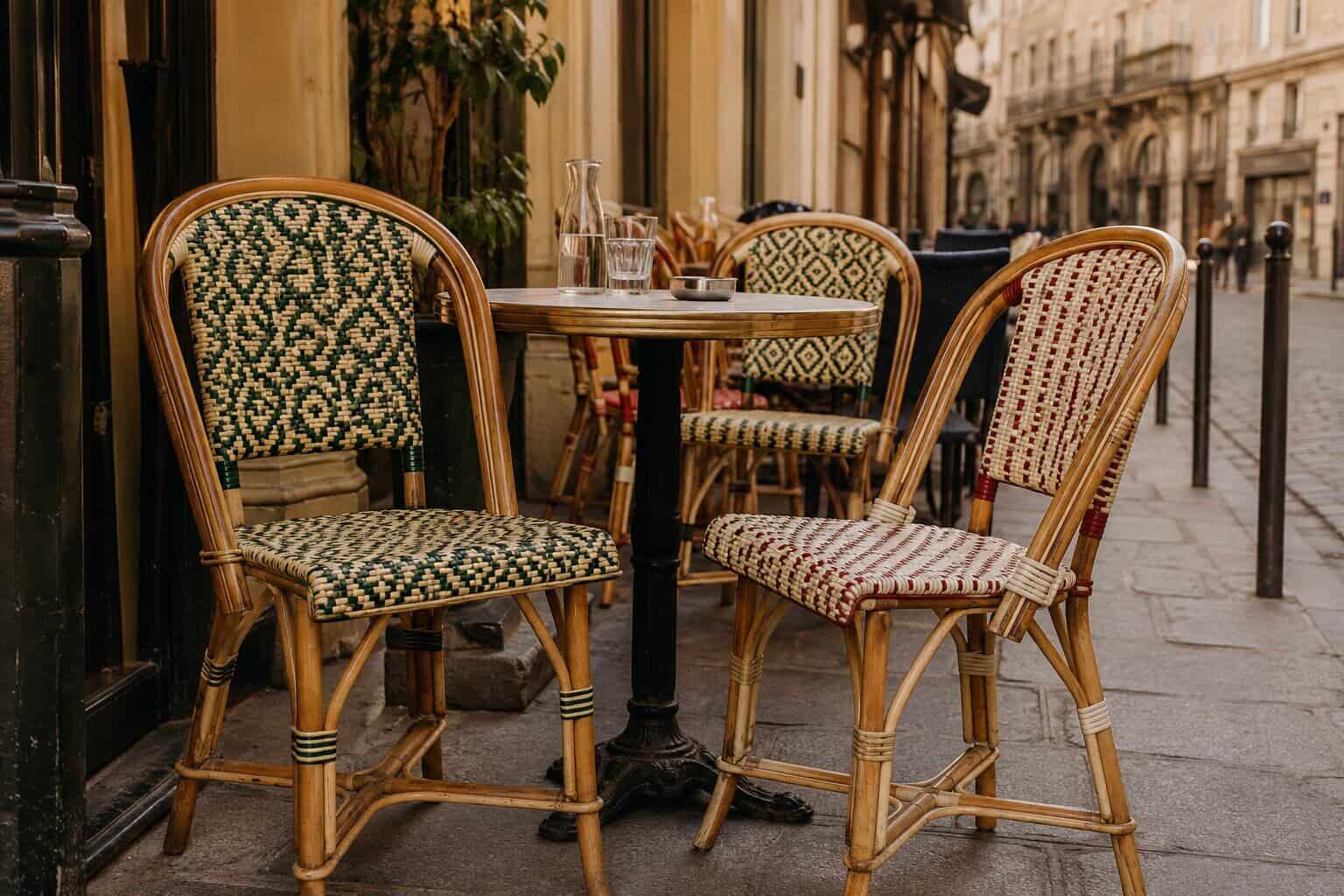

Every warm afternoon in Paris, the same chairs appear. They come out at the Café de Flore in Saint-Germain-des-Prés, woven in red and green. They line the terrace at the Café Français near Bastille in blue, white and red. They turn up at the zinc counters of neighbourhood bistros in the 11th arrondissement and at the formal tables of Fouquet’s on the Champs-Élysées. The Metropolitan Museum of Art in New York has them. So does Château Marmont in Los Angeles. They are, unmistakably, the rattan bistro chair — and most people who have ever sat in one have no idea where it comes from, who makes it, or that there are, in the entire world, only two manufacturers that matter.
The two names are Maison Drucker and Maison Gatti. Both are French. Both have been weaving rattan by hand for well over a century. Both carry the Entreprise du Patrimoine Vivant label — the French government’s designation for living craft heritage — and both are still in production today. The chair that reads as background scenery in a thousand films and photographs is, in fact, a highly specific handmade object with a traceable history, a distinctive construction and a collector market complicated enough to reward careful attention.
The Origins of the Rattan Bistro Chair
The story begins not in Paris but in the equatorial forests of Southeast Asia, where rattan — a vine of the palm family capable of growing to extraordinary lengths — was being harvested long before European traders arrived. Dutch navigators were among the first to bring the material westward, recognising that rattan’s unusual combination of tensile strength and pliability made it unlike anything produced by European woodworking traditions. Heated, it can be bent into almost any form; cooled, it holds that form firmly. It is also, weight for weight, remarkably light.
Europeans encountered rattan in earnest toward the end of the nineteenth century, as colonial trade routes from Indonesia and the broader Southeast Asian archipelago opened wider. Craftsmen in France and the Netherlands began experimenting with the material for domestic furniture — chairs, settees, plant stands — and found that it suited the covered terraces and glassed-in café extensions that were becoming fashionable in Paris’s expanding bourgeois neighbourhoods. The timing mattered: Haussmann’s transformation of Paris had created wide new boulevards lined with establishments that needed outdoor seating able to weather a Parisian spring without rotting, warping or becoming impossibly heavy to move each evening.
Louis Drucker opened his workshop on the rue des Pyrénées in 1885, and Maison Gatti followed in its own right not long after. Both houses built their reputations on a single product made with consistent materials and construction: a beechwood frame, a weave of rattan sourced from the palms of Southeast Asia, and seat and back panels worked in Rilsan, a polyamide fibre derived from castor oil that resists UV fading far better than natural cane alone. The weave patterns the workshops developed became signatures in themselves — chessboard, diamond, sawtooth, staircase — each associated with specific chair models and colour combinations. Drucker eventually developed a palette of more than thirty colours. Gatti gravitated toward richer, deeper tones: orange, aubergine, forest green.
The chairs spread across Paris not through any single act of design promotion but through the practical logic of café culture. Owners discovered that rattan chairs were light enough for a single waiter to stack and unstack each day, durable enough to outlast most wooden alternatives, comfortable enough that customers lingered — and visually distinctive enough to signal a certain Parisian seriousness about the terrace experience. By the early twentieth century, the Drucker and Gatti chair had become so embedded in the city’s café landscape that it was effectively invisible: present everywhere, noticed by almost no one as a designed object with a specific maker behind it.
That invisibility is part of what makes the chairs interesting to collectors and design historians today. Unlike an Eames chair or a Tolix stool, the rattan bistro chair was never sold on the strength of a designer’s name or a modernist manifesto. It arrived and stayed through sheer functional fitness, accumulating cultural weight so gradually that it became, in the words of the trade, an objet de patrimoine — a heritage object — without ever quite meaning to. Maison Drucker received its Entreprise du Patrimoine Vivant designation formally recognising that status, as did Gatti, cementing both workshops’ place in a short list of French craft enterprises considered nationally significant.
The raw material itself has a geography worth understanding. Rattan of the quality used by Drucker and Gatti comes primarily from Indonesia, where the liana palms grow in managed equatorial forest. The stems are harvested, dried, graded and exported — with the best-quality cane reserved for fine weaving. Both houses have maintained direct relationships with their Southeast Asian suppliers across multiple generations, a supply chain that is now, given growing environmental scrutiny of tropical forest products, one of the subtler pressures on the traditional craft. For now, the material remains available and the workshops remain operational. But the supply question is part of why authentic Drucker and Gatti chairs command the prices they do, and why secondhand examples in good condition attract serious interest.
Why Collectors and Secondhand Shoppers Should Pay Attention
The rattan bistro chair occupies an unusual position in the secondhand and vintage market. It is not a rare object in the way that a signed piece of studio furniture is rare — Drucker and Gatti have been producing chairs continuously for generations, and Paris café culture has consumed them by the tens of thousands. And yet a genuine, well-made example in good condition is harder to find than it looks, and considerably more valuable than most buyers expect when they encounter one at a brocante or an estate clearance.
The first reason is straightforward: the chairs are still in active production and still in active use. Most chairs that leave a café terrace do so because they are worn out or damaged, not because the owner is upgrading or clearing stock. A chair that has survived intact — frame sound, weave unbroken, colour still legible — has usually been looked after, or was used sparingly. That alone narrows the pool of genuinely desirable secondhand examples.
The second reason is more interesting: the market for these chairs is genuinely international. French buyers know them from lived experience, but the chairs carry an additional charge for buyers from outside France — they represent something specific about Paris that is difficult to acquire any other way. A Drucker chair on a London balcony or a New York rooftop is not merely secondhand furniture; it is a reference, a quotation. That cultural legibility drives demand well beyond the French domestic market and keeps prices for authentic examples firmly above what a glance at a brocante table might suggest.
Spotting the Real Thing: Construction as Authentication
Both Drucker and Gatti chairs carry a small identifying plaque — this is the most frequently cited authentication point, and it matters. But construction detail is equally telling, and more useful when a plaque is missing or a seller’s provenance is vague.
Genuine Drucker and Gatti chairs are built on a beechwood frame, with a UV-resistant synthetic weave and Rilsan — a polyamide fibre derived from castor oil — used for the seat and back panels. The weave is tight, even and precise; the patterns are specific to each model and house. The most common patterns — chessboard, diamond, sawtooth, staircase — are not decorative decisions made casually. Each is associated with a particular chair model, and the combinations of pattern and colour are documented by both makers. Drucker offers more than thirty colours, from azure blue to dusky rose to mint green. Gatti tends toward deeper, richer tones: orange, aubergine, forest green. If the chair you are looking at has four colours and one weave option, it is almost certainly a copy.
Generic competitors — many produced in Asia and sold at a fraction of the price — replicate the silhouette well enough to deceive at a distance. Up close, the differences become apparent: less precise weaving, lighter frames, fewer colour options and a uniformity across models that the genuine article never has. If anything, the proliferation of convincing-looking copies has made authentic secondhand chairs more desirable to buyers who know the difference, since the gap in quality and cultural legitimacy between a real Drucker and a mass-produced imitation is immediately visible to anyone who has sat in both.
One complication worth noting for buyers: Drucker now produces a portion of its range in Indonesia rather than at its workshop in the Oise region north of Paris, and sells this line at a meaningful discount relative to the French-made production. Both lines carry the Drucker name and identifying plaque. This means that brand authenticity and French manufacture are no longer the same question — a distinction that matters if provenance is important to you, whether for personal, resale or collecting reasons.
Condition, Value and What to Look For
When assessing a secondhand example, start with the frame. Beechwood is durable but not immune to damp; chairs that have spent years on an uncovered terrace may have softened joints or visible warping at the legs. Rock the chair on a flat surface before anything else. A chair with a loose or uneven frame is a restoration project, not a purchase — reweaving is skilled work that is still available from specialist craftspeople in France, but it adds meaningfully to the total cost.
The weave itself should be examined in good light. Look for broken strands, particularly along the seat edges and at the junctions between the back panel and the frame, where stress concentrates. Minor repairs to peripheral strands are acceptable and common in older pieces; a seat panel that is partially unwoven or has been repaired with a different material is a more serious issue. Colour fading is almost inevitable in chairs that have been outdoors, and some buyers actively prefer a patinated example over a pristine one — the sun-bleached look of a well-used terrace chair has its own appeal. What to avoid is uneven fading that suggests the chair has been stored partially covered, or weave that has become brittle and snaps when flexed.
At flea markets and brocantes, Drucker and Gatti chairs tend to appear either singly — a café disposing of a damaged set one piece at a time — or in small matching groups when a bistro closes or refurbishes. A matching set of four or six chairs in consistent condition is considerably more valuable than the same number of mismatched individual pieces, and significantly rarer. If you encounter a coherent set, the premium is usually justified.
Display, Use and Resale Potential
One of the more practical virtues of the rattan bistro chair is that it functions as well as it looks. These are not display objects that happen to resemble chairs — they are working furniture that has been tested across a century of professional hospitality use. A genuine Drucker or Gatti chair in good condition can be used outdoors, stacked, brought in for winter and returned to a terrace the following spring without ceremony. The Rilsan weave resists UV degradation better than natural cane, and the beechwood frame is robust enough for daily domestic use.
For resale, the chairs hold their value well provided condition is sound and authenticity is clear. Interior designers and stylists working on hospitality projects — cafés, hotels, restaurants — buy secondhand Drucker and Gatti chairs regularly, particularly when a project requires a number of matching pieces that new production lead times cannot accommodate. Vintage dealers who supply the trade understand this market and price accordingly. For private buyers who source directly at brocantes or estate sales, there is room between what a chair costs at a general market and what a specialist dealer or an interior project would pay — which is part of what makes them worth knowing about.
Finding Them Today: Markets, Sourcing and What to Pay
The practical question for anyone who has fallen for these chairs is where to find them outside of a café terrace. New chairs from Maison Drucker or Maison Gatti are available direct from each manufacturer, and both companies supply private customers as well as trade accounts. Lead times for bespoke colour and weave combinations can be considerable — these are not objects that come off a production line at volume — so buyers with a specific project in mind should enquire early. The price range for new examples is wide, depending on model, weave complexity and whether the chair is made in France or sourced from the manufacturers’ overseas production.
The secondhand market is more immediate, and for many buyers more interesting. Drucker and Gatti chairs circulate steadily through French flea markets and brocantes, most often when a café closes, a terrace is refurbished or an estate is cleared. The Marché aux Puces de Saint-Ouen at Porte de Clignancourt is the obvious starting point — it is large enough that examples appear regularly, and the dealers who supply interior designers tend to understand the distinction between genuine pieces and generic copies. Regional brocantes, particularly in areas with dense café culture, can yield better prices than Paris simply because the competition among buyers is lower.
When buying secondhand, condition assessment follows a consistent logic. The frame is the first priority. The beechwood structure should feel solid without flex or creak when weight is applied; any give at the joints indicates that the glue or the joints themselves have deteriorated, and structural repair is a job for specialist craftspeople. It is possible, but it adds meaningfully to the total cost.
The weave itself rewards close examination in good light. Look for broken strands along the seat edges and at the junctions between the back panel and the frame, where stress concentrates most. Minor peripheral repairs are common in older pieces and generally acceptable; a seat panel that has been partially unwoven or patched with a different material is a more serious concern. Colour fading is almost inevitable in chairs that have lived outdoors, and some buyers prefer a gently patinated example to a pristine one — the sun-bleached look of a well-used terrace chair has its own quiet appeal. What to avoid is uneven fading that suggests the chair has been stored partially covered, or weave that has become brittle enough to snap when lightly flexed.

Many second-hand sites such as leboncoin en France, Etsy and eBay offer original Gatti and Drucker chairs at a fraction of the new price. It’s not uncommon to find chairs in good condition for €70 ($80) or even less. If you’re looking for original garden furniture, these chairs are an excellent solution.
At flea markets and brocantes, these chairs tend to appear either singly — a café disposing of a damaged set one piece at a time — or in small coherent groups when a bistro closes or refurbishes. A matching set of four or six chairs in consistent condition is considerably more valuable than the same number of mismatched individual pieces, and significantly rarer. If you encounter a coherent set, the premium is usually justified.
Spotting Fakes and Cheaper Alternatives
The chairs’ global reputation has generated a substantial imitation market. Generic rattan bistro chairs — manufactured in volume in Asia, often copying the visual silhouette without the underlying construction — are sold online and through garden furniture retailers at prices that can look tempting alongside genuine Drucker or Gatti examples. The differences are real and, once you know what to look for, not difficult to spot.
Both Maison Drucker and Maison Gatti fix a small metal plaque to their chairs identifying the manufacturer — check for it on the underside of the frame or on a rear leg. Beyond the plaque, the construction itself tells a clear story. Genuine chairs use a beechwood frame, a UV-resistant Rilsan weave — a polyamide fibre derived from castor oil — for the seat and back panels, and weave patterns that are specific to each house: chessboard, diamond, sawtooth, staircase and others. Drucker alone offers more than thirty colour options. Gatti’s palette leans toward deeper, richer tones. Generic copies typically offer four or five colours and a single weave pattern across the entire range.
One further complication is worth understanding before buying. Drucker now produces some chairs outside France as well as at its workshop in the Oise region, and the two lines are priced differently. Both carry the Drucker name and plaque, so the presence of the mark alone does not answer the question of origin. If provenance matters to you — for authenticity, resale or personal preference — it is worth asking the question directly of the seller or manufacturer.
Display, Use and Resale Potential
One of the more practical virtues of the rattan bistro chair is that it functions as well as it photographs. These are not decorative objects that happen to resemble chairs — they are working furniture tested across more than a century of professional hospitality use. A genuine Drucker or Gatti chair in sound condition can be used outdoors, stacked, brought in for winter and returned to a terrace the following spring without ceremony. The Rilsan weave resists UV degradation better than natural cane, and the beechwood frame is robust enough for daily domestic use without special treatment.
For collectors and resellers, the chairs hold their value well provided condition is sound and authenticity is evident. Interior designers and stylists working on hospitality projects — cafés, boutique hotels, restaurants aiming for a specifically Parisian register — buy secondhand Drucker and Gatti chairs regularly, particularly when a project requires a number of matching pieces that new production lead times cannot accommodate. Vintage dealers who supply the trade understand this market and price accordingly. For private buyers sourcing directly at brocantes or estate sales, the gap between what a chair costs at a general market and what a specialist dealer or a hospitality project would pay is part of what makes them genuinely worth knowing about — and worth taking the time to authenticate properly before you buy.
A Collector’s Last Word
Gatti and Drucker chairs occupy an unusual position in the secondhand market: they are common enough to turn up regularly at brocantes and vide-greniers, yet specific enough that most buyers walk past them without knowing what they are looking at. That gap is unlikely to last. As demand from both the hospitality trade and private decorators continues to push retail prices upward, well-preserved examples sourced outside specialist dealers represent some of the better value still available in French vintage furniture. The authentication skills are learnable — look at the weave, check the frame, find the plaque — and the reward for getting it right is a chair that will outlast almost anything sold new at a comparable price point today.
Frequently Asked Questions
How can I tell a genuine Drucker or Gatti chair from an imitation?
Authentic chairs from both houses are hand-woven and carry a maker’s plaque, usually fixed to the underside or rear of the frame. Beyond the plaque, the quality of the weave is the most reliable indicator: genuine Drucker and Gatti chairs use a tight, consistent pattern with clean joins at the frame — a standard that machine-made imitations rarely replicate convincingly. The beechwood frame should feel solid rather than hollow, and the overall weight of the chair is noticeably greater than budget alternatives. Imitations tend to sell new for around €100; a genuine chair at current retail sits considerably higher, so a secondhand price that seems too close to the imitation range is worth treating with caution.
Is it worth buying a Drucker or Gatti chair with damaged weave?
It depends on the extent of the damage and whether the frame is sound. Both houses have historically offered repair and reweaving services for their chairs — a logical extension of a craft tradition built on durability — though current availability and lead times for repair work should be confirmed directly with each maison before committing to a damaged piece. A chair with a broken or unravelling section of weave but an intact beechwood frame and clean plaque can represent good value if restoration is feasible; one with a cracked or warped frame is harder to recommend regardless of weave condition, since the structural repair is less straightforward.
Maison Drucker: https://www.maisonlouisdrucker.com/en/ (Instagram)
Maison Gatti: https://maison-gatti.com/ (Instagram)