

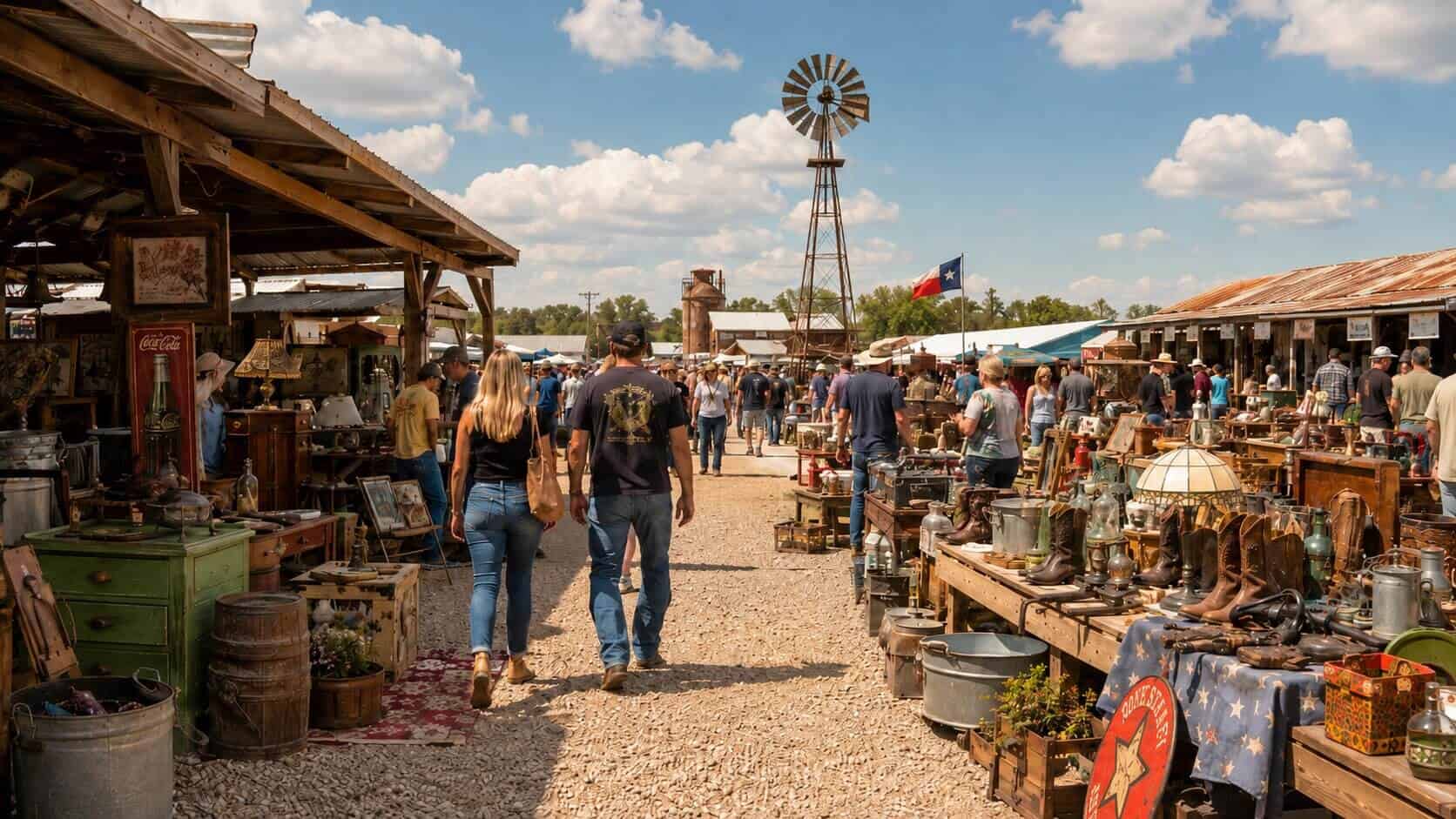

On a single weekend in rural Fayette County, more than 100,000 people converge on a stretch of highway between Round Top and Warrenton to dig through Majolica ceramics, ranch oak furniture and Victorian silverware spread across 30-plus acres of fields and barns. They drive four hours. They book accommodation months in advance. They arrive with a plan and leave with a truck bed full of things they didn’t know they were looking for.
That’s flea markets in Texas — and Round Top is just the beginning. This state has been moving antiques, trade goods and accumulated lives out into open fields since before the Civil War; Canton’s First Monday market pre-dates the Confederacy. What distinguishes Texas from most American antique markets is the cross-border character that comes with a 1,200-mile shared frontier: Taxco silver, hand-painted pottery, embroidered textiles and decorative ironwork from Mexico mix with the German, Czech and Anglo pioneer pieces that filter out of the Hill Country. The inventory is genuinely different from anything you’ll find in New England or on the West Coast.
This guide covers six of the best markets in the state — from a monthly barn sale outside Houston to an 85,000-square-foot vintage show in Dallas. Worth checking distances before plotting a road trip: Texas is roughly the size of France, and these are destination events, not casual drop-ins.
Texas Antique Weekend, Round Top
Twice a year, the small town of Round Top — population: just over 90 — temporarily becomes one of the largest antique events in the United States. Texas Antique Weekend draws more than 100,000 visitors across three weeks, spreading through barns, open fields and roadside tents along a corridor that runs through Carmine, Burton, Warrenton, Shelby and Fayetteville. The event isn’t a single market so much as a loose constellation of shows, all operating in and around Fayette County.
The scale is genuinely difficult to absorb on a first visit. More than 2,000 vendors set up across the stretch, and the goods on offer reflect the full depth of American decorative history: Majolica ceramics, Victorian silverware, hand-painted glassware, ranch oak furniture, chandeliers, early-century textiles, fine china and ornate lamps. Given Texas’s proximity to Mexico, you’ll also find a consistent thread of cross-border material — Taxco silver, painted folk objects, and decorative pieces that blur the line between antique and artisan craft.
Because the event is spread across multiple towns along a rural highway — Carmine, Burton, Oldenburg, Shelby and Fayetteville among them — navigation matters. Most experienced visitors plan by zone rather than trying to cover everything in a single day. Comfortable shoes, a vehicle with boot space, and a rough shopping list will all serve you better here than good intentions alone.
The event runs twice a year, typically in spring and autumn. Specific dates shift from year to year, so check the current schedule directly before booking travel. Accommodation in the area books out early during the event weeks; Round Top itself is tiny, and many visitors stay in nearby larger towns.
Location: Fayette County, TX (Round Top, Warrenton, and surrounding communities along Highway 237)
Frequency: Twice yearly (spring and fall sessions)
More information: Read here our full review of Texas Antique Weekend
First Monday Trade Days – Canton
The name is a red herring. First Monday Trade Days in Canton doesn’t actually run on a Monday — it takes place on the Thursday through Sunday immediately before the first Monday of each month. The confusion is historical: the market’s origins stretch back to the mid-nineteenth century, when monthly court sessions drew traders and buyers into town. The courthouse crowd created the market, and the market outlasted the courthouse crowd by well over a century.
Today, Canton’s First Monday Trade Days is one of the largest flea markets in the United States by any reasonable measure. The site covers hundreds of acres in Van Zandt County, roughly 60 miles east of Dallas, and the vendor count runs into the thousands across indoor pavilions and open-air sections. Visitor numbers are substantial — the market is frequently cited as one of the highest-attended monthly flea markets in the country, drawing crowds that fill local hotels and spill into surrounding towns.
The inventory here is genuinely broad. Serious antique hunters will find furniture, vintage Americana, Depression-era glassware, old tools, cast iron cookware and estate jewellery alongside the usual flea market fare of new goods and imported merchandise. Part of the skill at Canton is learning which sections reward patient digging and which are better skipped on a tight schedule. The indoor pavilions tend to anchor the antique and collectible dealers; the outer fields lean more toward general merchandise and crafts. Going on Thursday or Friday, before the weekend crowds arrive, gives you a cleaner run at the better stalls.
The sheer size of the site means that a single visit rarely covers everything. Many regular attendees focus on one section per trip and return across multiple months rather than attempting the whole market at once. Flat, comfortable shoes and a hand truck or wheeled cart are practical investments if you’re planning to buy furniture or larger pieces — the walk from far pavilions back to the car park is not trivial.
Canton sits close enough to Dallas and its surrounding suburbs to serve as a day trip, but the market’s hours and scale make an overnight stay more comfortable. If you’re already planning a broader Texas antique road trip, Canton pairs naturally with the McKinney Third Monday market to the north — both are monthly events with long histories and substantial inventory, though McKinney skews somewhat more curated by comparison.
Location: 800 1st Monday Lane, Canton, TX
Frequency: Thursday to Sunday, before the first Monday of every month
For more information: Read here our full review of First Monday Trade Days
Texas Pickers 1st Saturday Antique Sale & Flea Market
If Round Top and Canton represent Texas flea marketing at its most sprawling, the Texas Pickers 1st Saturday Antique Sale & Flea Market offers something tighter and more purposeful — a monthly event calibrated for serious collectors rather than casual browsers. As the name signals, it runs on the first Saturday of each month, giving it a reliable rhythm that local pickers and out-of-town regulars can plan around.
The market has built a reputation among vintage enthusiasts in the Houston area for leaning heavily toward genuine antiques and quality second-hand goods rather than the new-merchandise stalls that dilute many large Texas markets. Dealers here tend to specialize: you’ll find booth-holders who focus exclusively on mid-century furniture, others who concentrate on vintage advertising signs and petroliana, and a contingent of textile and clothing dealers bringing in pieces that range from Victorian-era linens to 1970s denim. That specialization makes it a more efficient stop for collectors with a defined focus.
The monthly format also keeps the inventory fresher than a permanent market. Because dealers are packing in and out each time, there’s genuine turnover between visits — what wasn’t there last month may well appear this month, and experienced regulars often arrive early specifically to catch dealers still unloading from their trucks. First Saturday timing means it doesn’t compete directly with the Canton market’s schedule, which makes it viable as part of a broader Texas antique circuit rather than a forced choice.
The cross-border collecting thread that runs through Texas markets surfaces here too. Vintage Mexican silver, hand-painted Talavera-style ceramics and decorative folk art pieces appear with some regularity, reflecting both the state’s geography and the tastes of the Houston collecting community. It’s worth keeping an eye on the jewellery dealers in particular — Taxco silver and estate pieces with Southwestern influences turn up more often at markets within Houston’s orbit than at the more nationally advertised shows further north.
Houston is a large and geographically sprawling city, so it’s worth confirming the specific venue location before making the trip — distances inside the metro area can be deceptively long. If you’re combining this with other stops, the Texas Antique Weekend in Round Top sits roughly to the west, and the two make a natural pairing for a weekend that starts in the countryside and ends in the city, or vice versa. For more on the Round Top event, see our earlier entry above.
Location: Navasota, TX (Grimes County, northwest of Houston)
Frequency: First Saturday of every month
More information: Read our full review of Texas Pickers 1st Saturday Antique Sale and Flea Market
Third Monday Trade Days, McKinney
Canton’s First Monday Trade Days gets most of the national press, but if you’re based in the Dallas–Fort Worth corridor, McKinney’s Third Monday Trade Days has been quietly earning its own loyal following — and for collectors, it’s often the more satisfying day out. The name is straightforward: the market runs on the weekend preceding the third Monday of each month, giving it a predictable calendar anchor that regulars plan around months in advance.
McKinney itself sets a useful tone. The city’s downtown historic district — a stretch of late-19th and early-20th century commercial buildings around the courthouse square — has developed into one of the more coherent antique destinations in North Texas, with a cluster of permanent dealers that rewards a longer visit. Third Monday Trade Days sits within that broader context: it draws vendors and buyers who are already wired into the regional antiques circuit, which tends to raise the average quality of what’s on offer compared to a purely general-merchandise flea market.
The market covers a large outdoor footprint, with dealers bringing in a wide cross-section of Americana, vintage furniture, estate jewellery, farm primitives, glassware and decorative objects. Texas ranch culture shows up in the inventory here — you’ll find weathered signage, old saddle hardware, cast-iron cookware and the kind of utilitarian objects that document working life on the Southern Plains in ways that more curated antique shops often filter out. For collectors who prefer the unedited version of history, that rawness is part of the appeal.
Because Third Monday draws from the DFW metro area’s substantial collector base, competition for the better pieces can be real, particularly among furniture and mid-century dealers who know their market. Arriving early — before the general public is fully through the gates — makes a measurable difference. Dealers are still arranging their booths in the first hour, and that’s often when the most interesting negotiations happen, when a vendor hasn’t yet had time to watch what everyone else is asking for comparable pieces.
One practical note on the McKinney market versus Canton: the scale is considerably more manageable. Canton’s trade days can feel genuinely overwhelming on a busy weekend, with the sheer number of vendors making systematic coverage difficult. Third Monday in McKinney is large enough to offer real variety but compact enough that you can cover the ground thoroughly in a single day without the logistics of Canton — no shuttle buses, no multi-day planning required. That makes it an accessible entry point for visitors new to the Texas antique circuit, and a reliable monthly fixture for experienced collectors who can’t always make the longer drive east.
If you’re building a North Texas antique weekend, McKinney pairs naturally with a stop in Dallas — Buchanan’s Vintage Market on Grand Avenue is covered in the next entry and sits within an easy drive south.
Where: 4550 W University Dr, McKinney, 75071, TX US
When: Friday, Saturday, and Sunday before the third Monday of every month
More information: Read here our full review of Third Monday Trade Days, McKinney
Buchanan’s Vintage Market – Dallas
If Third Monday Trade Days represents the outdoor, open-air end of the Texas antique spectrum, Buchanan’s Vintage Market sits at the opposite pole: a large, curated indoor venue in the heart of Dallas, housed in an 85,000-square-foot building on Grand Avenue. The scale alone makes it one of the more significant permanent vintage destinations in the state, but what distinguishes Buchanan’s from a generic antique mall is the editorial sensibility that runs through the place. The inventory skews heavily toward 20th-century American design — mid-century furniture, industrial lighting, vintage signage, graphic barware, eames-era seating — rather than the Victorian and early Americana that dominates the seasonal shows in Round Top or the trade days further east.
The Grand Avenue address puts it squarely in the East Dallas corridor, a neighbourhood that has developed genuine density as a design and vintage destination over the past decade or so. Dealers who set up at Buchanan’s tend to be specialists rather than general pickers — you’ll find focused collections of mid-century pottery, vintage denim and workwear, retro kitchen objects and carefully sourced decorative arts alongside the larger furniture pieces. That specialist character means prices are generally more fixed than at an outdoor trade days market, but it also means you’re less likely to waste time wading through household clearance to find something worth buying.
Dallas collectors with an eye for post-war American design treat Buchanan’s as a first-stop reference point rather than an occasional event — the kind of place you check before heading elsewhere, because the turnover is consistent enough that something new has usually come in since your last visit. For out-of-town visitors, the indoor environment is a genuine practical advantage in a state where outdoor market browsing in high summer can become genuinely uncomfortable by mid-morning. Buchanan’s lets you take your time regardless of the season.
The market also functions well as an anchor for a broader Dallas vintage day. East Dallas has its own cluster of independent vintage and consignment shops within reasonable distance, and the neighbourhood’s café and restaurant infrastructure means you can build a full afternoon around the area without needing to drive across town between stops. For visitors pairing a Dallas trip with the McKinney market to the north — covered in the previous entry — Buchanan’s makes a natural second day, covering different territory both geographically and in terms of the objects you’re likely to find.
One thing worth knowing before you go: Buchanan’s operates as a multi-dealer venue, which means the experience varies booth to booth. Some sections are meticulously arranged and priced; others are denser and require more patience. That variation is part of what keeps serious collectors returning — the sense that the market rewards careful looking rather than a quick scan. If you’re specifically hunting mid-century furniture or American industrial objects, it’s worth asking staff at the entrance which dealers are currently strongest in those categories. The knowledge is usually freely given, and it saves time.
Where: Dallas Fairpark, 3809 Grand Ave. Dallas, 75210, TX US
When: Saturdays and Sundays, normally monthly
More information: Read here our full review of Buchanan’s Vintage Market
Bussey’s Flea Market
If the seasonal spectacle of Round Top and the monthly trade days of Canton represent one side of Texas flea market culture — event-driven, destination-focused, plan-your-trip-around-it — then Bussey’s Flea Market represents the other: a reliable, year-round operation with deep roots in the Houston-area community and a format built for regular visitors rather than once-a-year pilgrimages.
Located southeast of Houston, Bussey’s has been running long enough to have its own institutional character. It draws a broad mix of sellers — estate clearers, specialty collectors, general traders, vendors with a strong inventory of Mexican and Latin American goods — and the cross-border influence that runs through so much of Texas’s flea market culture is particularly visible here. Hand-painted pottery, decorative metalwork, vintage textiles and the kind of ornamental silverware that traces its lineage back to Taxco workshops all surface regularly. That’s not marketing copy; it’s a function of geography and the demographics of the market’s vendor base, which reflects the wider Houston region.
The scale is substantial. Bussey’s operates across a large outdoor footprint with covered sections, which matters in a region where the Gulf Coast humidity can make unshaded browsing genuinely unpleasant by mid-morning for much of the year. Covered aisles mean you can work through the market methodically without racing the heat — a practical advantage that experienced Houston-area pickers will tell you not to underestimate.

The inventory range is wide enough that it rewards different kinds of shoppers. Furniture hunters will find pieces that turn over frequently; the market isn’t purely a vintage or antiques operation, so you’ll move through sections selling new goods and household surplus before landing in areas where the older material concentrates. That mix can feel unfocused to visitors arriving from the more curated environment of somewhere like Buchanan’s in Dallas, but it’s also where unexpected finds tend to emerge — the kind of object that nobody has specifically priced for the collector market because it arrived bundled in an estate lot. For patient pickers, that’s exactly the point.
Bussey’s is a weekend market, which makes it a practical option for Houston-based visitors building a Saturday or Sunday around a single destination rather than a multi-day road trip. Houston’s size means the drive from different parts of the metro varies considerably, so it’s worth checking your route before you go — southeast Houston and the surrounding areas are a long way from the western suburbs. That said, for anyone staying centrally or on the south side of the city, Bussey’s is genuinely accessible in a way that Round Top — several counties away — simply isn’t on a casual weekend.
As a counterpoint to the heavily styled, dealer-specialist markets that have grown in profile across Texas over the past decade, Bussey’s retains the character of a working community flea market. Negotiation is part of the culture here. Prices are generally not fixed in the way they tend to be at an indoor multi-dealer venue, and sellers are often open to conversation — particularly later in the day when nobody wants to pack items back into a truck. If you’re comfortable talking price, Bussey’s is one of the more negotiation-friendly markets in the Houston orbit, which makes it a useful counterbalance to the fixed-price specialist venues elsewhere on this list.
For collectors building a broader Texas itinerary, Bussey’s pairs naturally with a Houston city day — the area has enough independent vintage shops and antique centres to fill a full weekend without driving more than an hour in any direction. It’s a different experience from the carnival atmosphere of Texas Antique Weekend or the sheer scale of Canton’s Trade Days, but that’s precisely what gives it a place on any honest list of the best flea markets in Texas. Not every great market needs to be an event.
Texas rewards the patient shopper. Whether you’re hauling furniture out of a Fayette County field in October, working the aisles of Canton before the first Monday crowd arrives, or talking price with a Bussey’s vendor on a quiet Sunday afternoon, the state’s flea market scene has enough range to justify more than one trip. The markets on this list are spread across a state the size of France — so treat each one as a destination in its own right, plan your route accordingly, and book accommodation early for anything seasonal.
Where: 18738 S Interstate Hwy 35, Schertz, 78154, TX US
When: Every Saturday and Sunday
More information: Read here our full review of Bussey’s Flea Market
Planning Your Texas Flea Market Trip
Texas geography is the first thing to get straight. Houston, Dallas, and the small towns of the Fayette County antique corridor are each several hours apart. A Round Top–Canton double-header in a single weekend is ambitious; most collectors find it easier to anchor a trip around one market and build day drives from there. If you’re flying in, Dallas–Fort Worth gives you road access to Canton, McKinney and the Buchanan’s Dallas show without significant detours. Houston is the better base for Bussey’s, Texas Pickers and, when the season falls right, Round Top.
For the seasonal events — Texas Antique Weekend in particular — accommodation in Round Top and the surrounding towns sells out well in advance. La Grange, about 10 miles east, is typically the nearest town with reliable availability once the closer options are gone. At Canton, the town itself has a limited supply of rooms; nearby Tyler or Athens offer more choice. Book before you finalize your dates, not after.
A few practical notes that apply across most of these markets: bring cash (many smaller vendors won’t take cards), wear shoes you can walk several miles in on uneven ground, and — for the larger events — arrive early. Canton’s 28-mile spread and Round Top’s 30-plus acres are not exaggerations. Later arrivals at peak weekends will find the best pieces already gone and the car parks at capacity.
Book Your Stay
Accommodation options near these markets vary considerably by location. Round Top is a small rural town, so lodging books out quickly during Texas Antique Weekend — plan well ahead and consider staying in nearby Brenham, La Grange, or even making the drive from Austin or Houston. Canton has more conventional hotel infrastructure given its regular monthly event. For Navasota, Houston is the most practical overnight base if you prefer city amenities, though the town itself and surrounding Grimes County have smaller lodging options that suit an early-morning market start.
Note: accommodation availability and pricing change frequently, especially around major seasonal events. Book as early as possible for Texas Antique Weekend in Round Top.
Frequently Asked Questions
When is the best time of year to visit flea markets in Texas?
It depends on which market you’re visiting. Texas Antique Weekend at Round Top runs twice a year — once in spring and once in autumn — and those editions draw the largest crowds and best dealer selection. Monthly markets like Canton’s First Monday Trade Days, Texas Pickers and Third Monday Trade Days in McKinney run year-round, so there’s no bad season. That said, Texas summers are genuinely hot; if you’re visiting an outdoor or partly outdoor market between June and August, plan for early mornings and bring water.
Which Texas flea market is best for serious antique collectors?
Texas Antique Weekend at Round Top is the benchmark for serious collectors, with more than 2,000 vendors across a wide range of specialisms — including furniture, architectural salvage, Majolica ceramics, Victorian pieces and early American glassware. Canton’s First Monday Trade Days is larger by footprint but broader in scope, mixing genuine antiques with general merchandise. For a more curated, indoor experience, Buchanan’s Vintage Market in Dallas skews toward mid-century and decorative pieces in a controlled setting.
Do I need to book tickets in advance for these markets?
Most Texas flea markets and trade days are free or low-cost to enter, though some premium sections of Texas Antique Weekend charge a fee for early-access days. Ticket policies can change between editions — check each market’s official channels before you go, particularly for the Round Top season events where entry arrangements vary by show and date.
Can I find Mexican and border-influenced antiques at Texas flea markets?
Yes — it’s one of the things that distinguishes Texas markets from those elsewhere in the country. Old Taxco silver, hand-painted pottery, pre-Columbian-style decorative objects and vintage Mexican textiles turn up across the state, particularly at the seasonal shows and larger trade days. The cross-border collecting culture runs deep here, and it’s worth keeping an eye out even if you’re primarily hunting domestic American pieces.
Are these markets good for bargaining?
It varies. Bussey’s Flea Market in Houston and the outdoor sections of Canton’s Trade Days tend to be the most negotiation-friendly — prices aren’t always fixed, and sellers are often open to offers, especially toward the end of the day. Indoor multi-dealer venues like Buchanan’s typically operate on fixed pricing. At the big seasonal events like Round Top, dealer prices are generally firm, though not always — polite conversation doesn’t hurt.
How far apart are the markets on this list?
Considerably. Texas is a large state and these markets are not clustered. Round Top and Canton, for example, are roughly 250 miles apart by road. Houston-area markets (Bussey’s, Texas Pickers) sit in a different part of the state from the Dallas-area ones (Canton, McKinney, Buchanan’s). Build your itinerary around one anchor market per trip rather than trying to chain multiple stops in a single weekend — unless you’re prepared for long drives between them.