

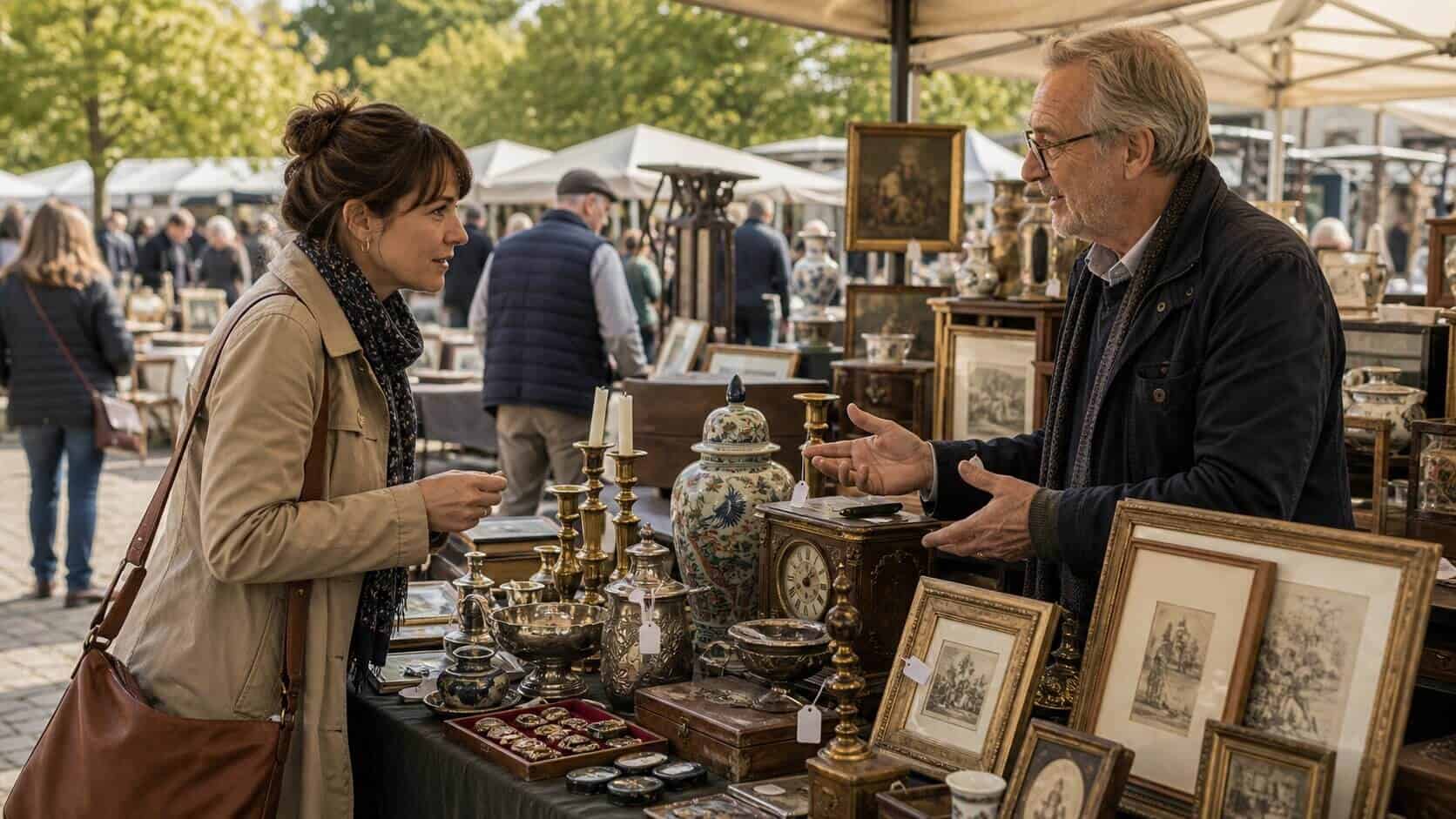

I’ve spent time at fairs watching negotiations play out on all sides — dealers trading with dealers, experienced buyers pushing back, newcomers quietly paying full sticker. The difference in what people paid for the same category of object was sometimes striking. Not because some buyers were luckier, but because some asked and some didn’t.
These six tips come from those observations, from conversations with dealers, and from years of buying at fairs and flea markets. They’re less about aggressive bargaining and more about understanding how the culture at antiques fairs actually works — and why staying silent almost always costs you money.
The Marked Price Is a Starting Point, Not a Final Offer
Dealers at antiques fairs price with room built in. Consider a pendant picked up at an estate sale: depending on who asks and how they ask, that same piece might sell for very different amounts — full sticker to the buyer who says nothing, meaningfully less to the buyer who simply enquires. The gap isn’t random. It reflects the dealer’s expectation that some customers will negotiate and some won’t. The marked price is, in effect, the ceiling.
This is worth internalising before you even approach a stand. You are not being rude by asking. You are participating in a buying culture that has worked this way for generations. As one trader put it plainly: “sellers expect to be asked“. Walking away at full price when a polite question might have saved you twenty or thirty percent isn’t caution — it’s just leaving money on the table.
Dealers Factor Negotiation Into Their Pricing Model
This isn’t guesswork — it’s how the trade is structured. A dealer working a fair has typically bought stock at auction, from estates, or from other dealers, then marked each piece up to cover costs, time, and the expectation that some buyers will push back. That margin isn’t tight. It’s built to absorb a reasonable counter-offer without the dealer losing money. When you pay full sticker, you’re not saving the dealer from a hard sell; you’re simply not claiming the portion of the margin that was always available to a buyer who asked.
Experienced collectors understand this intuitively. The price on a tag at a quality antiques fair is closer to a wish than a contract. Dealers at the top end of the market are often the most comfortable negotiating, because they know their margins and they know the piece. Asking confidently — “Is there any flexibility on this?” — is a normal part of the transaction, not an imposition.
Politeness Is a Negotiating Tool
There’s a version of haggling that dealers dread — the dismissive lowball, the theatrical sigh at the price, the buyer who makes them feel they’ve done something wrong by valuing their stock. None of that works, and most experienced dealers simply stop engaging. What does work is warmth. Commenting genuinely on a piece, asking a question about it, showing real interest before any mention of price — these shift the atmosphere from transaction to conversation, and that’s where flexibility lives.
Dealers spend long days at fairs and remember the people who made the experience pleasant. A buyer who is personable, who treats the stock with care and the dealer with respect, is the kind of person a dealer wants to sell to — and that goodwill often quietly translates into a better price without a word of formal negotiation. It costs nothing and it works consistently.
Buying More Than One Piece Gives You Real Leverage
If you’re drawn to several items at the same stand, mention it. Dealers will often move considerably on price when a single transaction covers two or three pieces — it reduces their selling time, clears stock in one go, and removes the uncertainty of waiting for separate buyers. A bundle offer changes the conversation from “can you do better on this?” to “I’d like to take all three — what’s your best price for the lot?” That’s a different kind of negotiation, and dealers tend to respond to it.
You don’t need to be buying armfuls. Even combining a larger piece with a small accessory or a second minor item can shift the dynamic. The dealer sees a committed buyer rather than a casual browser, and that changes their calculation. This is one of those moments where browsing slowly and noting what catches your eye — before approaching — pays off in a practical, immediate way.
The End of the Day Works in Your Favour
Timing is a quieter form of leverage. Dealers who have been on their feet since early morning are thinking about the drive home, the unsold stock they’ll have to pack and transport, and the cost of another weekend bringing the same pieces out again. A serious buyer who appears in the final hour or two of a fair often finds dealers more willing to move on price — not out of desperation, but out of practical arithmetic. Selling now at a slight reduction beats carrying the piece back unsold.
This works best on bulkier or heavier items — furniture, large ceramics, framed pictures — where transport is a genuine consideration. It applies less to small, easy-to-pack pieces a dealer is confident will sell at the next event. If you spot something early in the day, note the stand number and return later. There’s a mild risk someone else buys it in the interim, but for the right piece at a fair with measured foot traffic, it’s a risk often worth taking.

Knowing the Object’s History Can Shift the Price
Dealers price partly on knowledge and partly on uncertainty. If a piece came to them without clear provenance — a job lot from a house clearance, say, or a bulk buy from another dealer — there’s often more flexibility built into the asking price to account for that ambiguity. When you arrive with genuine knowledge of what something is, its maker, its period, or a comparable recent sale, the dynamic shifts. You’re not just a buyer; you’re a peer, and dealers tend to negotiate differently with someone who clearly knows the material.
This doesn’t require academic expertise. Spending time before a fair looking at auction records, comparable listings, or specialist reference guides gives you enough grounding to ask informed questions rather than vague ones. “Is this marked underneath?” or “Do you know the maker?” signals engagement and can open a conversation about price in a way that a blunt offer never does. A dealer who senses you understand the piece is also less likely to hold firmly to an inflated figure they know won’t stand up to scrutiny.
Haggling at antiques fairs isn’t a performance or a confrontation — it’s a conversation that both sides expect to have. The dealers who price their stock carefully are also the ones most comfortable talking about it. Come prepared, stay curious, stay polite, and treat the exchange as part of the experience rather than something to get through. You’ll leave with better prices and, more often than not, a more interesting day.
Frequently Asked Questions
Is it always acceptable to haggle at antiques fairs?
At most antiques fairs and flea markets, negotiating is expected rather than exceptional. Dealers typically price their stock with room to move, and many are surprised when buyers pay the asking price without question. A small number of dealers do operate on fixed prices — often indicated by signage or a firm early response — and those signals are worth reading. But in the absence of any such cue, asking politely whether there’s any flexibility is entirely normal.
How much of a discount can you realistically expect?
This varies considerably by venue, dealer, item and timing. A modest reduction of ten to twenty percent is a reasonable starting point in most situations; end-of-day buying, bundling multiple pieces, or demonstrating genuine knowledge of an object can sometimes move that further. What matters more than chasing a specific percentage is approaching the conversation as a negotiation rather than a demand — the outcome tends to be better when the dealer feels the exchange is fair to both sides.
What’s the difference between haggling at an antiques fair and haggling at a flea market?
Antiques fairs tend to feature specialist dealers who know their stock well and price accordingly — there’s usually less room for dramatic bargaining, but the dealers are knowledgeable and the conversations can be genuinely informative. Flea markets are more mixed: pricing is less consistent, which can work in a buyer’s favour, but condition and authenticity vary more widely. The core negotiating principles apply to both; the context and the ceiling just differ.