

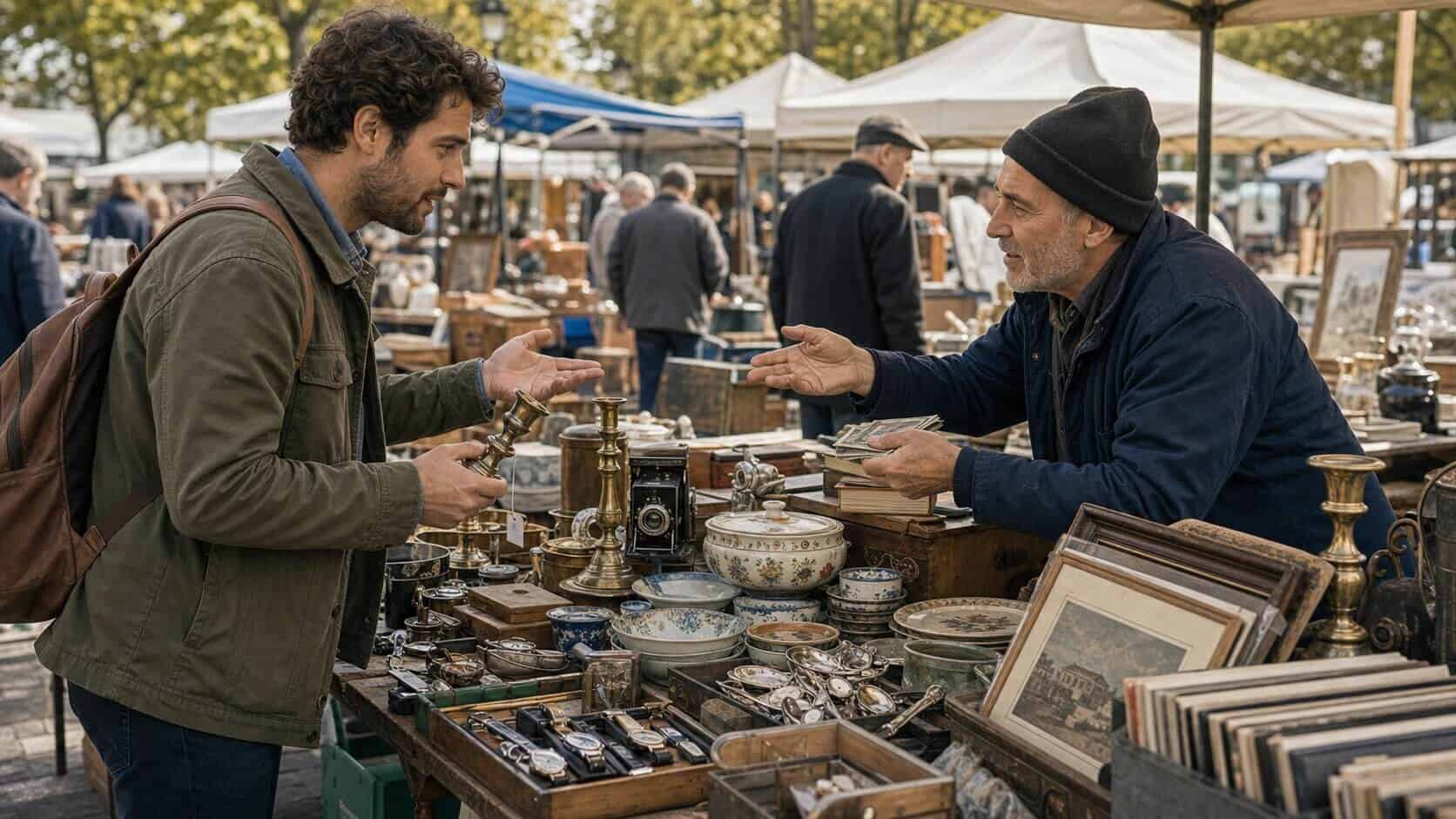

You spot a mid-century ceramic lamp at a Paris brocante. The vendor quotes €80. You pay €80. That, right there, is the mistake — because at most flea markets, the asking price is a starting point, not a final offer. Vendors expect the negotiation. Many enjoy it.
These ten flea market bargain tips cover everything from setting your walk-away price before you open your mouth, to using a chip or a scratch in your favour. They work at a Sunday car-boot in Essex and at a proper brocante in Lyon. The principles are the same.
Flea market tip #1: Put your game face on
When you find something you genuinely want, resist the urge to show it. Picking up an item with wide eyes and an audible gasp is the fastest way to lose your negotiating position. Instead, pick it up calmly, glance at the price tag, set it back down and move on to look at something else on the stall. Then circle back. When you return, express interest — but do it quietly, without urgency.
Vendors read body language constantly. Controlled curiosity reads as a buyer who has options. Obvious excitement reads as a buyer who will pay whatever it takes.
Flea market tip #2: Know your price
Before you say a single word to the vendor, decide the most you are genuinely willing to pay for the item. Not a rough figure — an actual number. Knowing your ceiling in advance means you can make counter-offers smoothly and confidently, without fumbling or visibly calculating mid-conversation. Hesitation at that moment signals inexperience, and experienced sellers notice.
This number is also your exit point. If the negotiation stalls above it, you walk. Having a firm price in your head before bargaining starts turns the whole exchange from an anxious guessing game into a straightforward conversation with a clear ending you control.
Flea market tip #3: Turn on the charm
A vendor who likes you is more likely to move on price than one who finds you cold or transactional. You don’t need to be performatively chatty — a genuine comment about something on the stall, a question about where a piece is from, or a bit of easy small talk about the market is usually enough to shift the dynamic. Sellers at flea markets and brocantes deal with strangers all day; someone who treats them like a person rather than an obstacle tends to stand out.
This isn’t manipulation — it’s how markets have always worked. Think of it as opening a door before you walk through it. Once there’s a small rapport, the negotiation feels less like a confrontation and more like a conversation between two people trying to reach something fair.
Flea market tip #4: Go low
Your opening offer should be roughly half of what you’re actually prepared to pay. That gap gives the negotiation somewhere to go. If you start too close to your real ceiling, you have no room to move — and vendors know it. A low first offer signals that you’re a buyer who knows how to bargain, which often earns a degree of respect in itself, even if the seller comes back with a firm counter.
Don’t apologise for the number. State it plainly and let the silence do some work. The vendor will either engage with a counter-offer or hold firm — either way, you’ve opened a real negotiation rather than a polite exchange that ends at the asking price.
Flea market tip #5: But not too low
Opening low is smart; opening insultingly low is a different thing entirely. If your first offer is so far beneath reason that the vendor feels mocked, the negotiation often ends before it starts — and with it, any goodwill you built through tips three and four. A useful rule of thumb: half your walk-away price is a workable floor, but if an item is clearly rare or the vendor has already told you the provenance, factor that in before you name a number.
Read the stall before you speak. A dealer running a polished, well-organised stand at a covered antiques market operates differently from someone clearing a relative’s house at a Sunday car-boot. Calibrate your opening to the context. The goal is to start a conversation, not to end one.
Flea market tip #6: Hesitate
Once the vendor names a counter-offer, don’t accept it immediately — even if it’s exactly what you wanted to pay. A brief pause, a slight wince, a glance back at the item as if you’re reconsidering: these small signals suggest you’re still weighing it up, and sellers often interpret that as an invitation to sharpen the price a little further without being asked.
Hesitation costs you nothing and occasionally earns you an extra concession. It also keeps the power balance even. The moment you look relieved or eager, the negotiation is effectively over on their terms.
Flea market tip #7: Point out flaws
If an item has a crack, a missing button, a worn patch or a wobbly leg, say so — calmly and without drama. Pointing out a genuine flaw gives the vendor a logical reason to accept a lower price, which is easier for them than simply caving to pressure. You’re not being difficult; you’re giving them a rational justification to move.
This works best when you’ve already built a little goodwill. Raise the flaw after some rapport, not as your opening line. A chipped edge on a piece of Cornishware or a faded label on a vintage tin isn’t a deal-breaker — it’s a negotiating fact. Use it as one.
Flea market tip #8: Be patient
Not every negotiation closes on the first pass. If a vendor won’t budge and you genuinely want the piece, walk the market, look at a few other stalls, then circle back. Sellers who felt stubborn an hour ago sometimes soften — especially as the morning crowd thins and the prospect of carrying stock home becomes more real.
Patience also protects you from impulse decisions. Stepping away gives you a few minutes to confirm that you actually want the item at any price, not just in the heat of the moment. If someone else buys it while you’re gone, that’s the market working as it should — but more often, it’ll still be there.
Flea market tip #9: Be polite
Haggling is a transaction between two people, and how you treat the vendor matters as much as the numbers you trade. A seller who feels respected is far more likely to meet you halfway than one who feels pressured or dismissed. This is especially true at smaller markets where the same dealers return every week — a reputation for being difficult follows you around.

If the negotiation doesn’t go your way, thank the vendor anyway and move on without sour faces. Dealers talk to each other, and basic courtesy costs you nothing while keeping the door open — sometimes literally, if you want to come back for something else on the same stall later in the morning.
Flea market tip #10. Have fun!
Haggling is a game, and the best buyers treat it like one. If you’ve done everything right — stayed calm, pointed out the chip, hesitated at the right moment — and the vendor still won’t move, that’s fine. Not every negotiation ends in a deal, and that’s part of the sport. The market will have another lamp, another chair, another piece of Bakelite jewellery two stalls down.
When the mood is light and both sides are engaged, vendors often throw in small extras — a second item bundled in, a little off a larger purchase — simply because the exchange was enjoyable. That goodwill rarely appears when a buyer is tense or transactional. Bring genuine curiosity about what you’re looking at, and the whole process tends to go better for everyone.
The one habit that ties it all together
Every tip on this list comes back to the same thing: composure. Buyers who stay calm, do a little homework, and treat the vendor as a person rather than an obstacle almost always walk away with a better deal than those who bluster or beg. The asking price really is just an opening move — and now you know how to play the next one.
Frequently Asked Questions
Is it rude to haggle at a flea market?
At general flea markets and car-boot sales, negotiating is expected — most vendors price with a margin for exactly that reason. Specialist antique fairs and curated vintage markets can be more variable; some dealers work at fixed prices and will say so if you ask. A polite “is there any flexibility on the price?” is never offensive and gives you a clear answer without putting either side in an awkward position.
What’s the best time to get a bargain at a flea market?
Late in the day tends to work in a buyer’s favour at general markets and car-boot sales, when vendors are weighing up whether to haul stock home. Early morning has its own advantage at larger markets — you see the best pieces before other buyers do, even if the seller isn’t yet in a flexible mood. The sweet spot varies by market type, so it’s worth visiting at different times if you plan to become a regular.
Should I haggle even if the price seems fair?
If the price already feels right, there’s no obligation to negotiate — and sometimes paying without quibbling is the right call, especially on genuinely rare pieces where the seller knows exactly what they have. That said, a light “is there anything you can do on the price?” rarely offends and occasionally surprises. Trust your read of the situation.
What should I do if a vendor refuses to budge?
Accept it gracefully. Some dealers have a firm floor on certain pieces — particularly anything they know is underpriced or that has personal significance. A simple “no problem, I understand” keeps the door open. If you’re genuinely interested, leave your details or come back near the end of the day. Goodwill is worth more than one stubborn negotiation.
What’s the difference between haggling at an antiques fair and haggling at a flea market?
Antiques fairs tend to feature specialist dealers who know their stock well and price accordingly — there’s usually less room for dramatic bargaining, but the dealers are knowledgeable and the conversations can be genuinely informative. Flea markets are more mixed: pricing is less consistent, which can work in a buyer’s favour, but condition and authenticity vary more widely. The core negotiating principles apply to both; the context and the ceiling just differ.