

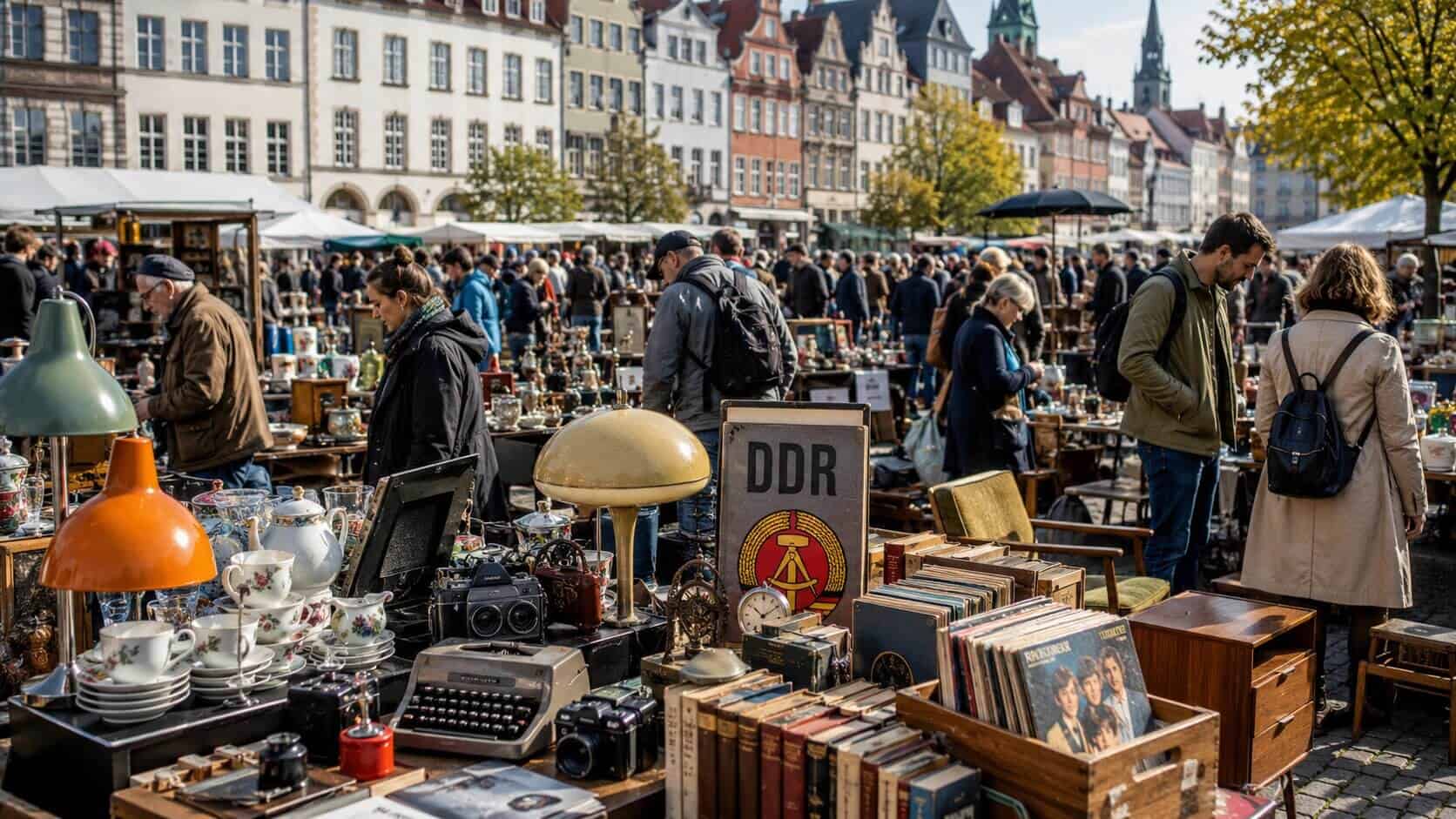

On a Sunday morning at Berlin’s Mauerpark Flea Market, a retired teacher from Prenzlauer Berg sells a crate of East German vinyl next to a professional dealer with a table of Bauhaus-era ceramics. That combination — spontaneous, democratic, occasionally extraordinary — is what makes flea markets in Germany worth planning a trip around. Germany has one of the strongest flea market cultures in Europe, with markets ranging from scrappy neighbourhood affairs to large-scale weekly events drawing tens of thousands of visitors. Whether you’re after mid-century furniture, DDR memorabilia, vintage clothing or just the pleasure of a good rummage, the country delivers.
This guide covers the best flea markets across Germany’s major cities — Berlin, Hamburg, Munich, Cologne, Frankfurt, Dortmund, Bremen, Dresden, Leipzig and Hanover — with practical notes on what to expect at each one. For general shopping advice, our 10 tips to shop like a pro and guide to flea market haggling are good reading before you go.
Most German flea markets run from spring through autumn, peaking between April and October. A few — including Mauerpark — run year-round. For a broader European calendar, see our spring flea markets in Europe guide.
Flea Markets in Berlin
Berlin has a strong claim to being Germany’s flea market capital. Each district runs its own weekend market, and the range is genuinely wide — from 50-cent paperback stalls to dealers selling serious mid-century design. Below are the five markets worth prioritising. For a full breakdown with transport details and neighbourhood context, see our dedicated Berlin flea markets guide.
Mauerpark Flea Market
Every Sunday of the year, rain or shine, up to 40,000 visitors flock to the Mauerpark Flea Market. Spread across roughly 7,000 square metres with up to 500 stalls, the market sits near the former Todesstreifen — the death strip between Wedding and Prenzlauer Berg — which gives it a name and a particular edge that no amount of vintage kitchenware can entirely soften.
Private sellers clearing out attics mix with professional traders offering DDR collectibles, mid-century design pieces and vintage clothing. The antique end of the market is worth working slowly — good finds do surface, especially early. By mid-morning the crowds thicken considerably, and the adjacent Bearpit amphitheatre hosts open-air karaoke from around 3pm — either part of the appeal or a signal to leave, depending on your tolerance. The market is large enough that serious collectors and casual browsers rarely get in each other’s way.
📍 Address: Bernauer Straße 63–64, 13355 Berlin (Prenzlauer Berg)
📅 Days: Sunday, year-round
🕐 Hours: 09:00–18:00 (shorter in winter)
💰 Admission: Free
🚇 Transport: U2 to Eberswalder Straße (10-min walk) · Tram M10 to Bernauer Straße
🌐 Website: flohmarktmauerpark.de
Review on Fleamapket
Arkonaplatz Flea Market
The flea market on Arkonaplatz has been running since 1990, but the site has a longer market history than that — the artist Heinrich Zille painted the bustle of this square in 1912. It sits in Rosenthaler Neustadt, a few minutes’ walk from Rosenthaler Platz, shaded by linden trees and bordered by green space. The atmosphere is noticeably calmer than Mauerpark: well-attended in summer but never overwhelming, which makes serious browsing possible.
Dealers here tend toward furniture, glassware and twentieth-century design objects alongside DDR memorabilia, records, books and the usual range of clothing and accessories. Private sellers and professionals both trade here, which keeps prices honest without sacrificing quality. It’s a five-minute walk from Mauerpark — the two complement each other well on a Sunday morning.
📍 Address: Arkonaplatz 1, 10435 Berlin (Mitte)
📅 Days: Sunday, year-round (except days excluded by law)
🕐 Hours: Summer 10:00–17:00 | Winter 10:00–16:00
💰 Admission: Free
🚇 Transport: U8 to Bernauer Straße (5–10 min walk) · Tram M10 to Wolliner Straße · Bus 247
🌐 Website: troedelmarkt-arkonaplatz.de
Review on Fleamapket
Fehrbelliner Platz Flea Market
The Art and Flea Market at Fehrbelliner Platz in Wilmersdorf is one of Berlin’s more established markets, with a focus that leans toward art, antiques and design rather than general household clearance. Artists, gallery owners and antique dealers show up alongside private sellers, and the policy against new merchandise guarantees a certain level of authenticity. In the warmer months, the art section expands considerably along the esplanade.
The location — directly at the U-Bahn station — makes it one of the easiest Berlin markets to reach, and the nearby Park Café provides a comfortable stopping point between laps of the stalls. Haggling is expected here; vendors have precise price expectations but are generally willing to negotiate on slower-moving stock, especially if you’re buying more than one piece.
📍 Address: Fehrbelliner Platz 1, 10707 Berlin (Wilmersdorf)
📅 Days: Saturday and Sunday, year-round
🕐 Hours: 10:00–16:00
💰 Admission: Free
🚇 Transport: U3 or U7 to Fehrbelliner Platz — market is directly outside the station
🌐 Website: burdack-maerkte.de
Review on Fleamapket
Straße des 17. Juni Flea Market
Founded in 1973, the Straße des 17. Juni market is Berlin’s oldest flea market and arguably still its most celebrated. It runs along the Tiergarten boulevard between the S-Bahnhof Tiergarten and the Charlottenburger Tor, with the Victory Column visible from certain stalls — a setting that no other flea market in Germany can match.
The stock reflects the professional character of the market: most vendors are experienced dealers who price accordingly. You’ll find antique furniture, records, old films and computer games, vintage clothing, porcelain, jewellery and paintings — with new items expressly prohibited. Prices are on the higher side for a flea market, but the quality justifies it on the better stalls. The food stands running alongside are a genuine draw, and Berlin Currywurst shares space with international options. Arrive early — by 10am, guided tour groups are already moving through the alleys.
📍 Address: Straße des 17. Juni, 10623 Berlin (Tiergarten)
📅 Days: Saturday and Sunday, year-round
🕐 Hours: 10:00–17:00
💰 Admission: Free
🚇 Transport: S-Bahn to Tiergarten station — market is alongside the tracks
🌐 Website: berlinertroedelmarkt.com
Review on Fleamapket
Spandau Flea Market
The Trödelmarkt Spandau runs three times a week at Am Juliusturm, near the medieval Juliusturm fortress in west Berlin’s most independent-feeling borough. Five covered halls and an outdoor area mean it operates rain or shine — a practical advantage that the purely outdoor markets can’t offer. Monthly stall rentals mean the indoor vendors present their stock properly, some stalls resembling fully fitted living rooms rather than folding tables of junk.
Private sellers showcase board games, books, furniture and household goods alongside professional traders with well-preserved antiques, vintage furniture, vases and paintings. Stamps, coins and the occasional genuine rarity surface here. It attracts fewer tourists than the central Berlin markets, which tends to keep prices sensible. The market has its own bistro for coffee and the inevitable Bavarian sausage. Wednesday opening is particularly useful for anyone who wants a market day without weekend crowds.
📍 Address: Am Juliusturm 55, 13599 Berlin (Spandau)
📅 Days: Wednesday, Saturday and Sunday, year-round
🕐 Hours: Wednesday 14:00–18:00 | Saturday–Sunday 08:00–16:00
💰 Admission: Free
🚇 Transport: U7 to Altstadt Spandau (short walk)
🌐 Website: troedelmarkt-spandau.de
Review on Fleamapket
Flea Markets in Hamburg
Hamburg doesn’t have Berlin’s volume of markets, but it has character. The city’s flea market scene is shaped by its port identity — there’s a directness to how Hamburgers sell, and an eclecticism in what turns up. Expect nautical salvage alongside Danish mid-century furniture, 1970s German paperbacks next to Soviet-era cameras.
Flohschanze — Schanzenviertel’s Weekly Market
The Flohschanze sits in the heart of the Schanzenviertel, Hamburg’s most energetically creative quarter, and it matches the neighbourhood. The market occupies the courtyard of the Alte Rinderschlachthalle — a former cattle slaughterhouse — and the partially covered setting means it runs every Saturday regardless of weather. The 1,200 square metre surface is large enough to accommodate a serious range of stock without feeling crowded.
The antiques end is particularly strong: 1950s and 1960s West German ceramics appear regularly, as do Scandinavian design pieces that have drifted south over the decades. Bicycles, records, books, furniture and vintage clothing fill out the rest. Dealers from other markets shop Flohschanze before it opens to the public, which tells you something about the quality of the stock. By mid-morning the best pieces tend to have moved on — first-come-first-served in the most literal sense.
📍 Address: Neuer Kamp 30, 20357 Hamburg (Schanzenviertel / St. Pauli)
📅 Days: Saturday, year-round
🕐 Hours: 08:00–16:00
💰 Admission: Free
🚇 Transport: U3 to Feldstraße — market is directly at the station exit
Review on Fleamapket
Hamburg Fischmarkt — Sunday Morning Ritual
The Fischmarkt on the Elbe waterfront is primarily a fish and produce market, but the antiques and second-hand section running alongside it is worth the early alarm. It starts at dawn — genuinely at dawn, before most of the city is awake — which gives it an atmosphere unlike any market in Germany. Dealers set up in the shadow of the Fischauktionshalle, the grand old fish auction hall, and by 9am the crowd is several layers deep.
The mix runs from genuine antiques to cheerful junk, with old Hamburg harbour memorabilia appearing more often than anywhere else in the city. It’s an impractical hour for most visitors but a memorable one. The market closes sharply — at 09:30 in summer, 09:00 in winter — so there’s no easing into this one.
📍 Address: Große Elbstraße 9, 22767 Hamburg (Altona waterfront)
📅 Days: Sunday, year-round
🕐 Hours: Summer (Apr–Oct) 05:00–09:30 | Winter (Nov–Mar) 07:00–09:00
💰 Admission: Free
🚇 Transport: S1/S3 to Reeperbahn (15-min walk along the Elbe) · Bus 112 to Fischmarkt
Hamburg rewards an unhurried approach. The city’s Altona and Eppendorf districts both have antique shops worth exploring between weekend market days. Also worth noting: the Bahrenfelder Trabrennbahn Flea Market at Hamburg’s harness racing track (Wednesday and Saturday 09:00–17:00), the Flohdom an der Horner Rennbahn (Saturday 07:00–15:00), and the seasonal Spielbudenplatz Flea Market near the Reeperbahn (Sundays in June and September, 09:00–16:00).
Flea Markets in Munich
Munich runs a tighter flea market scene than Berlin or Hamburg, partly because Bavaria enforces stricter rules on commercial street trading, and partly because the city’s antique trade has historically favoured proper shops and auction houses over open-air markets. That said, the markets that do exist are well-organised and consistently stocked.
Münchner Flohmarkt auf der Theresienwiese
Once a year, on the first Saturday of Munich’s Spring Festival in April, the Theresienwiese transforms into the largest flea market in Germany. Around 2,000 merchants and more than 80,000 visitors from across Europe descend on the famous fairground for a single day of haggling. The scale is genuinely extraordinary — it’s the kind of market where you can spend an entire day and still feel you’ve only covered a fraction of what’s on offer.
The range covers everything from vintage clothing and furniture to antiques, collectables, vinyl and kitchen goods. Serious collectors tend to arrive before official opening; by mid-afternoon the best pieces are long gone and the crowd thins. Cash only at virtually every stall.
📍 Address: Theresienwiese (Matthias-Pschorr-Straße 1), 80336 Munich
📅 When: Once a year — first Saturday of the Spring Festival (April)
🕐 Hours: 06:00–16:00
💰 Admission: Free
🚇 Transport: U4/U5 to Theresienwiese
⚠️ Verify exact 2026 date before travelling.
Münchner Olympiapark Flea Market
Munich’s largest regular flea market runs every Friday and Saturday at the Parkharfe between the Olympic Tower and the Werner-von-Linde Hall. Around 460 exhibitors spread across 35,000 square metres under the supervision of the Bavarian Red Cross — the combination of outdoor scale and charitable management gives it a distinctly different character from the commercial Berlin markets.
The range is broad: vintage clothing, furniture, antiques, collectables, electronics and the usual flea market miscellany. The unique setting of the 1972 Olympic Park adds atmosphere that most German markets can’t match. The market can be combined with a shopping trip to the nearby Olympia Shopping Centre, which makes it particularly practical for a full day out.
📍 Address: Spiridon-Luis-Ring 21, 80809 Munich
📅 Days: Friday and Saturday
🕐 Hours: 07:00–16:00
💰 Admission: Free
🚇 Transport: U3 to Olympiazentrum
🌐 Website: brk-muenchen.de
Trabrennbahn Daglfing Flea Market
The Daglfing flea market at the harness racing track on the eastern edge of Munich is a family-oriented affair with more substance than its cheerful reputation suggests. It runs every Friday and Saturday with both an outdoor general market and two covered areas dedicated to antiques and vintage — the latter is where serious collectors spend their time, hunting for old furniture, crystal chandeliers and quality porcelain.
The outdoor section has the democratic feel of a proper garage sale: baby prams, children’s toys, bikes, household items and the usual cascade of everyday objects looking for new homes. The on-site restaurant serves Bavarian food and operates a beer garden in good weather, which makes it a realistic full-day destination rather than a quick browse.
📍 Address: Rennbahnstraße 35, 81929 Munich (Daglfing)
📅 Days: Friday and Saturday
🕐 Hours: Friday 08:00–15:00 | Saturday 06:00–16:00
💰 Admission: Free
🌐 Website: flohmarkt-daglfing.de
Auer Dult — Munich’s Oldest Market Tradition
The Auer Dult is a different proposition from a standard flea market. First mentioned in 1310, it’s a centuries-old fair held three times a year on the Mariahilfplatz in Au, one of Munich’s older inner districts. The antiques and second-hand section draws collectors from across Bavaria and beyond, with stock ranging from Bavarian folk art and old porcelain to silver, vintage toys, glassware and occasionally significant furniture.
Prices are generally higher than at a standard flea market — dealers know what they have. But the concentration of quality antiques in one place, three times a year, makes it one of the better arguments for timing a Munich visit carefully. The Jakobidult in late July is the summer edition; the Maidult in late April and the Kirchweihdult in late October complete the annual cycle.
📍 Address: Mariahilfplatz, 81541 Munich (Au)
📅 When (2026): Maidult 25 Apr–3 May | Jakobidult 25 Jul–2 Aug | Kirchweihdult 17–25 Oct
🕐 Hours: Approximately 10:00–20:00
💰 Admission: Free
🚇 Transport: U1/U2 to Fraunhoferstraße or Kolumbusplatz · Tram 18 to Mariahilfplatz
⚠️ Construction work around Mariahilfplatz in 2026 — allow extra time.
🌐 Website: muenchen.de
Flea Markets in Cologne
Cologne’s flea market scene is among the most active in western Germany, with most districts running their own regular market. The city’s proximity to Belgium and the Netherlands means dealers sometimes bring stock across the border, which keeps the selection unpredictable in the best way. The two most established markets are the racecourse and the city market.
Trödel an der Kölner Galopprennbahn
The flea market at Cologne’s galop racecourse is one of the city’s most consistent venues, running Wednesday, Friday and Saturday and once a month on Sundays. The racecourse setting gives it a distinctive atmosphere — stalls spread across the grounds with more space than most urban markets, which makes it easier to assess larger items like furniture. Antiques and collectables are well represented alongside the usual range of clothing, records and household goods. The mid-week Wednesday option makes it unusually accessible for visitors who aren’t in the city on a weekend.
📍 Address: Rennbahnstraße, 50737 Cologne-Weidenpesch
📅 Days: Wednesday, Friday, Saturday and one Sunday per month
🕐 Hours: Approximately 07:00–16:00 (verify current hours before visiting)
💰 Admission: Free
🚇 Transport: U5 to Bocklemünd or bus routes to the racecourse
⚠️ Confirm current schedule via Cologne tourism sources before visiting.
Kölner Stadtflohmarkt
The Cologne City Flea Market runs every Saturday and draws a broad mix of private sellers and professional dealers to a central location. It’s more general in character than the racecourse market — clothing, books, electronics and household goods dominate — but regulars know which stalls are worth returning to for higher-quality finds. The central location makes it easy to combine with a walk through the Altstadt or a visit to the cathedral quarter.
📍 Address: Verifying — confirm current location via koeln.de before visiting
📅 Days: Saturday
🕐 Hours: Approximately 08:00–16:00
⚠️ Cologne also runs markets at Klettenberggürtel, the Alte Feuerwache and the Südstadion. See our dedicated Cologne flea markets guide for the full list.
Flea Markets in Frankfurt — Schaumainkai
The Frankfurt flea market runs every Saturday (except public holidays) at a location that alternates weekly between two riverfront sites: the Schaumainkai in Sachsenhausen, along the south bank of the Main, and the Osthafen at Lindleystraße, near the former eastern harbour. Both are within easy reach of the city centre and both offer something the majority of German flea markets can’t — a genuinely beautiful riverside setting with Frankfurt’s distinctive skyline as a backdrop.
The Schaumainkai site sits along the Museumsufer, flanked by nine museums including the Städel. The stock runs from books, records and vintage clothing through to porcelain, paintings and the occasional piece of antique furniture. Private sellers mix with professionals; prices reflect that mix. The Osthafen location has a rougher industrial charm — the former harbour buildings give it a different register from the polished Sachsenhausen embankment.
Neither location is primarily an antique market, but both reward patient browsing, and the Saturday timing suits a longer Frankfurt visit well.
📍 Address: Alternating between Schaumainkai 60594 Frankfurt (Sachsenhausen) and Lindleystraße 1, 60314 Frankfurt (Osthafen)
📅 Days: Every Saturday except public holidays
🕐 Hours: 09:00–14:00
💰 Admission: Free
🚇 Transport (Schaumainkai): Tram 14/15/16/19 · U1/2/3/8 to Schweizer Straße
🚇 Transport (Lindleystraße): Tram 11 to Osthafenplatz · U6 to Ostbahnhof
🌐 Website: See frankfurt.de for current weekly location
Flea Markets in Dortmund
Dortmund has several regular weekly markets, including the Trödelmarkt Dortmund-Dorstfeld at the University of Dortmund (Saturday 07:00–14:00) and the City Trödelmarkt Hildastraße (Wednesday and Saturday 06:00–14:00). The most recommended is the Mehrzweckplatz Flea Market.
Mehrzweckplatz Flea Market
The Mehrzweckplatz market runs every Tuesday in the Wambel district, about 30 minutes from downtown Dortmund by metro. The mid-week timing keeps it local — this is primarily a neighbourhood market rather than a destination for tourists or professional collectors — which means prices are realistic and the sellers are generally relaxed about negotiation. The mix covers kitchen appliances at a third of department store prices through to oddities, collectables, vintage toys and old books.
Because it’s an open-air market, stall numbers vary with the weather. On good days the selection is genuinely wide; on grey Tuesday mornings in October it’s a more compact affair. Food and drink are available on site and along the Wambeler Hellweg nearby.
📍 Address: Wambeler Hellweg, 44143 Dortmund (Wambel)
📅 Days: Tuesday
🕐 Hours: 07:00–14:00
💰 Admission: Free
🚇 Transport: Metro to Rüschebrinkstraße (approx. 30 min from city centre)
For a larger seasonal event, the Flohrian at the Westfalenpark is one of the biggest flea markets in the Ruhr region, held four Sundays a year between April and October (09:00–17:00). It’s almost always fully booked for sellers and draws significant crowds. The Fredenbaum-Park market runs five times a year around the lake (07:00–16:00, Saturday or Sunday).
Flea Markets in Bremen
Bremen has two well-established regular markets that between them cover most days of the weekend — one Sunday indoor/outdoor hybrid, one Saturday riverside event.
Bürgerweide Flea Market
The Sunday Bürgerweide market near Bremen Central Station is one of the largest and most prominent flea markets in northern Germany, drawing up to 600 vendors and 20,000 visitors on peak days. Its central location makes it genuinely easy to reach — which explains why sellers travel from the Ruhr, Schleswig-Holstein and even the Netherlands. The organizers maintain quality by prohibiting large electrical appliances and car accessories, keeping the focus on genuinely interesting stock.
The flexible format — outdoor on sunny days at the Bürgerheide, covered in the Hansa Carré when it rains — means it virtually never cancels. Private and professional sellers mix well here; family treasures from old Bremen estates appear alongside professional antique dealers with properly curated stock.
📍 Address: Pfalzburger Straße 41, 28207 Bremen
📅 Days: Sunday
🕐 Hours: 07:00–14:00
💰 Admission: Free
Antik- und Trödelmarkt am Weserufer
The Saturday Antique and Flea Market on the Banks of the Weser runs rain or shine along the historic city centre waterfront. The stock ranges from music and fashion items to household goods, porcelain and the kind of old books and records that always seem more interesting when you’re standing beside a river. Sellers can arrive by car via Tiefer or Erste Schlachtpforte — no pre-registration required, which keeps the selection unpredictable in a good way.
📍 Address: Weserufer, 28197 Bremen
📅 Days: Saturday (except holidays)
🕐 Hours: 08:00–14:00
💰 Admission: Free
Flea Markets in Dresden
Dresden’s flea market scene is underrated — partly because the city is less visited by international tourists than Berlin or Munich, and partly because its markets specialise in material that doesn’t travel: DDR-era ceramics, socialist graphic design ephemera, technical instruments and the everyday objects of East Bloc apartment clearances. For collectors with a specific interest in mid-twentieth-century Eastern European material culture, Dresden is a genuinely productive stop.
Albertbrücke Flea Market (Dresdner Elbemarkt)
The Albertbrücke Flea Market has been running for over a decade on the Käthe-Kollwitz banks, directly on the Elbe near the Albert Bridge in the heart of old Dresden. More than 500 dealers gather every Saturday and Sunday, and the location — arguably the most beautiful setting of any flea market in Germany — draws visitors who might not otherwise seek out a market. The stock is particularly strong for antiques: porcelain, paintings, jewellery, antique books and furniture all appear regularly, alongside the usual vintage clothing and records.
New items are prohibited, which preserves the authentic character. Private sellers are especially welcome — no reservation required, which means the selection is genuinely varied from week to week. On Saturdays, the Dresdner Kunst, Antik und Trödelmarkt is also held at the Haus der Presse, focusing on art, antiques and crafts.
📍 Address: At the Albert Bridge (Albertbrücke), banks of the Elbe, Dresden
📅 Days: Saturday and Sunday
🕐 Hours: 07:00–16:00
💰 Admission: Free
🌐 Website: elbeflohmarkt.de
Flea Markets in Leipzig
Flea Market at the Alte Leipziger Messe
The flea market at the former Leipzig Trade Fair grounds is set against one of the more distinctive backdrops in Germany — the oversized Double M emblem of the GDR exhibition era looms over the entrance, and the People’s Palace (now the Pantheon) provides a backdrop that few markets can rival for sheer historical density. The market runs on the first Sunday of every month between March and November, with 50 to 100 exhibitors on the outdoor area.
The focus is squarely on quality rather than volume: second-hand furniture, genuine antiques and GDR-era nostalgic memorabilia dominate. Records of old East German pop groups, rare porcelain, cult objects from the Wall period — this is where that material surfaces most reliably in Leipzig. Dealers who want to participate are expected to offer something that stands out by rarity or value, which keeps the standard consistently higher than most monthly markets of this size.
📍 Address: Alte Messe (Old Fairgrounds), 04103 Leipzig
📅 When: First Sunday of the month, March–November
🕐 Hours: 08:00–15:00
💰 Admission: Free
🚇 Transport: Bus lines 70 and 74
Flea Markets in Hanover
Old Town Flea Market (Altstadt-Flohmarkt am Hohen Ufer)
For over 45 years, the Old Town Flea Market has been running every Saturday on the High Bank of the Leine, within the historic centre of Hanover. The location is one of the market’s main assets: a picturesque riverside setting with views of the Schlossstraße and Goethestraße, and the famous Nanas sculptures by Niki de Saint Phalle nearby. The combination of an attractive setting and a strict focus on antiques, art and vintage gives it a different character from most German weekly markets.
New merchandise and mass-produced goods are prohibited, as are footwear and apparel — this is a market for those after antiques, kitchenware, old books, CDs and tools. Electronic items are accepted if produced before 1975, which means the retro technology section is particularly interesting. Vinyl specialists are regular attendees, making it a reliable destination for record hunters. Summer hours run April to October; reduced winter hours apply November to March.
📍 Address: Am Hohen Ufer, 30159 Hanover
📅 Days: Saturday, year-round
🕐 Hours: Summer (Apr–Oct) 08:00–16:00 | Winter (Nov–Mar) 09:00–15:00
💰 Admission: Free
Tips for Visiting Flea Markets in Germany
Arrive Early — and Know When Not To
At most German flea markets, the best stock moves in the first ninety minutes. Professional dealers and experienced collectors typically arrive before the official opening time. If you’re after a specific category — vinyl, silver, mid-century furniture — earlier is always better. That said, the last hour before closing often brings price drops from sellers who don’t want to pack everything back into the van. If you’re flexible and happy to browse, the end of the day has its own logic.
Cash Is Still King
Germany remains more cash-dependent than most of Western Europe, and flea markets are no exception. The majority of private sellers and many professional dealers at German markets won’t accept card payment. Bring more cash than you think you’ll need — there’s rarely a convenient ATM once you’re inside a large market, and leaving to find one means losing your place at a good stall. Smaller denominations make negotiation easier.
Haggling Is Expected, Not Rude
Negotiating at German flea markets is entirely normal, but the approach matters. A calm, direct offer works better than drawn-out theatre. Most sellers respond well to a straightforward “Würden Sie zehn Euro nehmen?” (Would you take ten euros?) rather than an elaborate performance. If you’re buying more than one item from the same stall, asking for a combined price is almost always worth trying. For more, our guide to flea market haggling covers the basics in detail.
Know What You’re Looking For — But Stay Open
Germany’s flea markets have particular strengths depending on the city and market type. Berlin skews towards DDR memorabilia, vintage clothing and design objects. Munich and the south lean towards Bavarian folk art, silver and quality antiques. Hamburg’s markets reflect the city’s trading history — international objects, maritime pieces and a strong book culture. Going in with a rough category in mind helps you move efficiently, but the best finds at any flea market are usually the ones you weren’t expecting.
Frequently Asked Questions About Flea Markets in Germany
When is the best time to visit flea markets in Germany?
The peak season runs from April through October, when markets are fullest and outdoor conditions are reliable. That said, some of Germany’s best markets — including Mauerpark in Berlin and Flohschanze in Hamburg — operate year-round. If you’re visiting in winter, check each market’s schedule directly, as some reduce frequency or close between November and February. Sunday mornings are the most common market day across the country.
Do I need cash at German flea markets?
Yes — the overwhelming majority of private sellers and many professional dealers accept cash only. Card readers are becoming more common at established markets, but you can’t rely on them. Bring more cash than you think you’ll need, ideally in smaller denominations. ATMs near popular markets can have queues on Sunday mornings, so withdraw before you arrive.
Is haggling acceptable at German flea markets?
Generally yes, and most sellers expect it — particularly from private vendors clearing household items. Professional antique dealers are usually firmer on price but still open to a reasonable offer on slower-moving stock. A polite, direct approach works best: ask the price, make a counter-offer, and don’t be surprised if they meet you somewhere in the middle. Aggressive or dismissive haggling tends to go down poorly.
What can I realistically find at flea markets in Germany?
The range is wide. Berlin’s markets are particularly strong for DDR-era objects, vinyl records, vintage clothing and mid-century furniture. Munich and the south produce quality silverware, Bavarian folk art and well-preserved antiques. Hamburg has a pronounced book culture alongside maritime and international objects that reflect its port history. Across all cities, look out for West German pottery, Meissen porcelain seconds, East German enamelware and 1960s–70s design pieces — these consistently appear and consistently attract collector interest.