

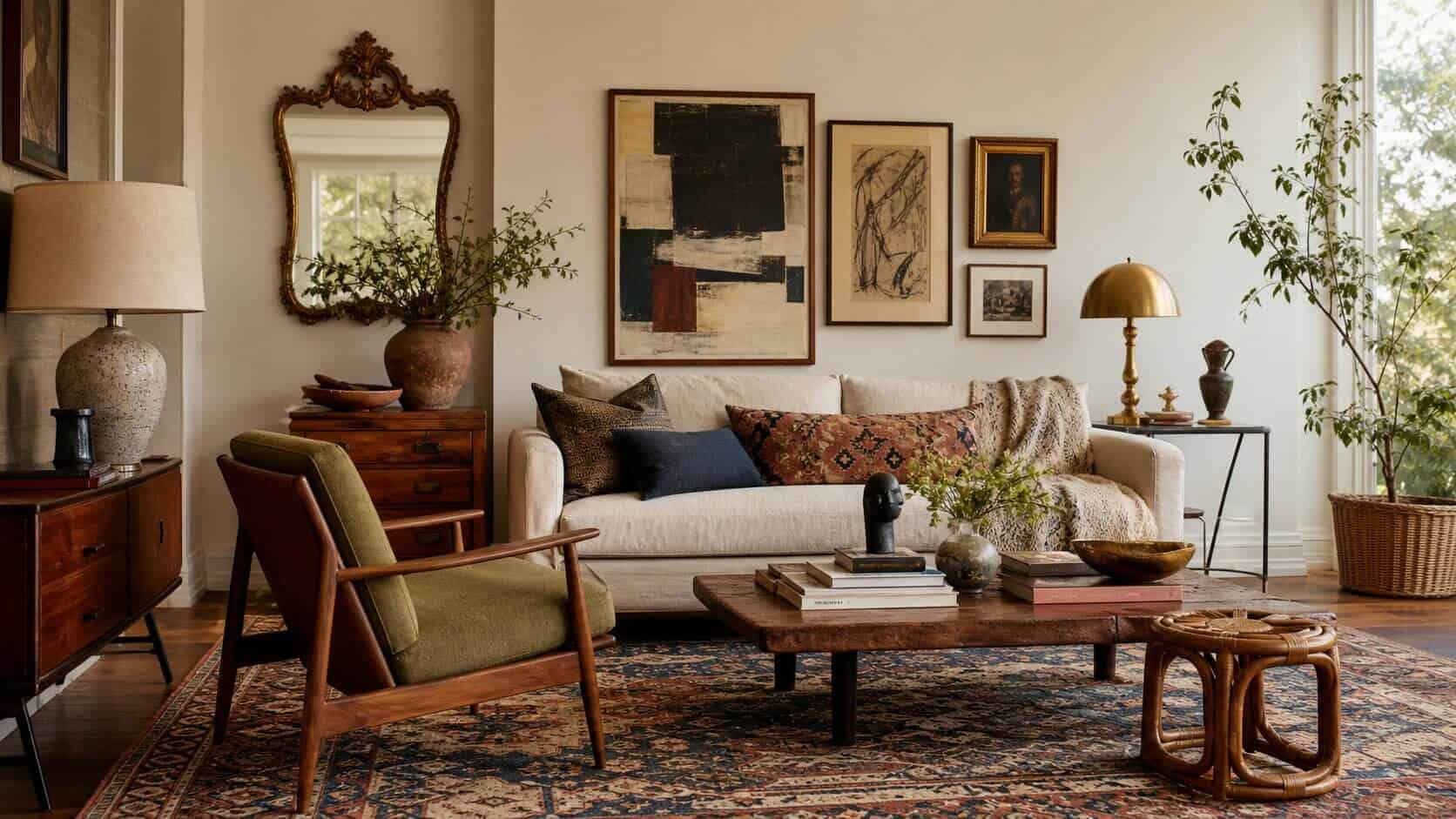

Most interior design advice defaults to coherence: same era, same palette, same mood throughout. Eclectic design pushes back. Done well, it’s one of the more personal — and affordable — approaches to furnishing a home. Done carelessly, it just looks like clutter. The difference comes down to a few principles worth understanding before you start hauling things home from the flea market.
Where Eclectic Pieces Come From
Flea markets and brocantes are the natural habitat of eclectic sourcing — not because everything there is cheap (it isn’t always), but because the range is genuinely unpredictable. One stall will be selling 1970s Italian glass; the next has a pile of enamelware and a stack of old botanical prints. That unpredictability is part of the appeal. You’re not shopping to a brief; you’re staying open.
Yard sales, estate sales and online marketplaces are equally valid hunting grounds. The key is patience rather than urgency. A piece you walk past three times before finally buying is almost always a better acquisition than one grabbed on impulse. If something genuinely stops you — an odd shape, an unexpected colour, a texture you haven’t seen before — that reaction is usually worth trusting.
One practical note: don’t wait for mint condition. A dented brass lamp or a chair with worn upholstery is likely to cost significantly less than a pristine equivalent, and it’s often more interesting to look at. If the form is strong, a little wear adds rather than subtracts. Restoration, reupholstery or even just a thorough clean can do the rest. It’s worth reading our guide to haggling at flea markets before you go — knowing when and how to negotiate makes a real difference, particularly at estate sales where pricing is rarely fixed.
Making Eclecticism Work: The Design Principles
Eclecticism doesn’t mean anything goes. The spaces that genuinely work — where a mid-century lamp sits comfortably beside a worn linen armchair and a stack of old ceramics — tend to share a few quiet principles underneath all that apparent variety.
The first is restraint within abundance. Mixing eras and materials works when you give each piece enough room to be seen. Crowding a shelf with finds from a dozen different stalls rarely reads as curated; it reads as storage. A single striking object — an unusual glass vase, a piece of enamelware in an unexpected colour — will do more work with space around it than surrounded by ten others competing for attention.
The second principle is material consistency. Even when the objects themselves come from wildly different periods, rooms tend to hold together when there’s a recurring texture or finish running through them. Raw wood, aged brass, matte ceramics — choose one thread and let it reappear in different forms across the room. It doesn’t need to be obvious; it just needs to be there.
Colour is the third lever, and arguably the most forgiving. A room with a loose, neutral base — raw plaster, linen, faded white — can absorb almost any vintage find without looking chaotic. Introduce colour through the objects themselves: a deep blue bottle, a rust-red textile, a picture frame with the original painted finish still intact. Let the finds set the palette rather than forcing the palette onto the finds.
Customisation is worth taking seriously here too. If a piece is the right shape but the wrong colour, paint it. If the upholstery is tired, reupholster it. The object’s form and age are usually what make it interesting; the surface is often the easiest thing to change. Treating vintage finds as raw material rather than finished product opens up a much wider range of what’s usable — and considerably widens what’s affordable at the market.
What to Look For — and What to Overlook — at the Market
The practical side of eclectic sourcing rewards a certain flexibility of eye. At a flea market or brocante, the useful habit is learning to separate form from surface condition. A piece of enamelware with a chip along the rim, a wooden chair with a cracked rung, a picture frame whose gilt is rubbing off at the corners — these are all negotiating points, not reasons to walk away. What matters is whether the object’s shape, scale and character still hold up. Surface damage is almost always the cheapest problem to solve.
Old mirrors are a particularly good example. A vintage mirror with some foxing or a slightly clouded edge tends to sell for a fraction of what a clean equivalent would fetch, and the aged quality of the glass is often exactly what makes it work in a room. The same logic applies to ceramic pieces with hairline cracks, textiles with minor fading, or metal objects with patina that a seller might apologetically describe as tarnish. That patina is frequently the point.
Eclectic crockery and glassware — the kind where nothing quite matches — are among the easiest categories for a first-time market buyer. Mismatched sets of pressed glass, earthenware plates from different decades, old tumblers: none of these need to be rare or valuable to work well together. What they share is the quality of being genuinely made, with the slight irregularities that come with age and use. That’s harder to fake and easier to find than most people expect once they start looking.
Rugs are worth a particular mention because they do heavy lifting in an eclectic room — grounding furniture groupings, adding texture underfoot, softening hard surfaces. At markets and estate sales, older rugs with wear patterns and slightly faded dyes often read as more interesting than anything new, and they tend to be priced accordingly. Check for structural damage rather than surface wear: a rug with a worn pile is usually fine; one with holes through the foundation needs more thought.
The broader principle across all of these categories is the same one that runs through eclectic design generally: trust the reaction you have in front of an object over any preconceived idea of what your home needs. The finds that end up working hardest are rarely the ones you went looking for.
A Few Things Worth Remembering Before You Go
Eclectic interiors work because they reflect genuine choices made over time — not because everything was purchased at once with a unified scheme in mind. The best rooms in this style tend to accumulate slowly, and the best market finds tend to arrive unexpectedly. Go with a loose sense of what a room needs rather than a fixed list, and leave room for the object that stops you mid-aisle for a reason you can’t immediately explain. That instinct is usually worth following.
If a piece needs some work — a re-glue, a clean, a new coat of paint on the back of a frame — that’s rarely a reason to leave it behind. It’s usually a reason the price is lower than it should be.
Frequently Asked Questions
Is decorating with flea market finds actually affordable?
It depends on patience and sourcing rather than category. Everyday pieces — crockery, frames, small furniture, rugs with wear — are often significantly cheaper at markets and estate sales than comparable new items, and generally more interesting. Genuine antiques or sought-after mid-century pieces can carry real value, so the range is wide. Going in without a fixed budget ceiling on any one item, but with a clear sense of what you already own and what a room actually lacks, tends to produce better results than hunting for bargains by category alone.
Where’s a good place to start if I’ve never bought at a flea market before?
Smaller, lower-stakes categories are the easiest entry point: glassware, ceramics, picture frames, textiles. They’re portable, they’re usually affordable, and the downside of a misjudged purchase is low. Once you’ve developed a feel for what condition looks like in person — and how quickly you can assess a piece in a crowded stall — larger furniture and rugs become less intimidating. Our guides to flea markets by country and city are a useful starting point for finding markets worth the trip.