

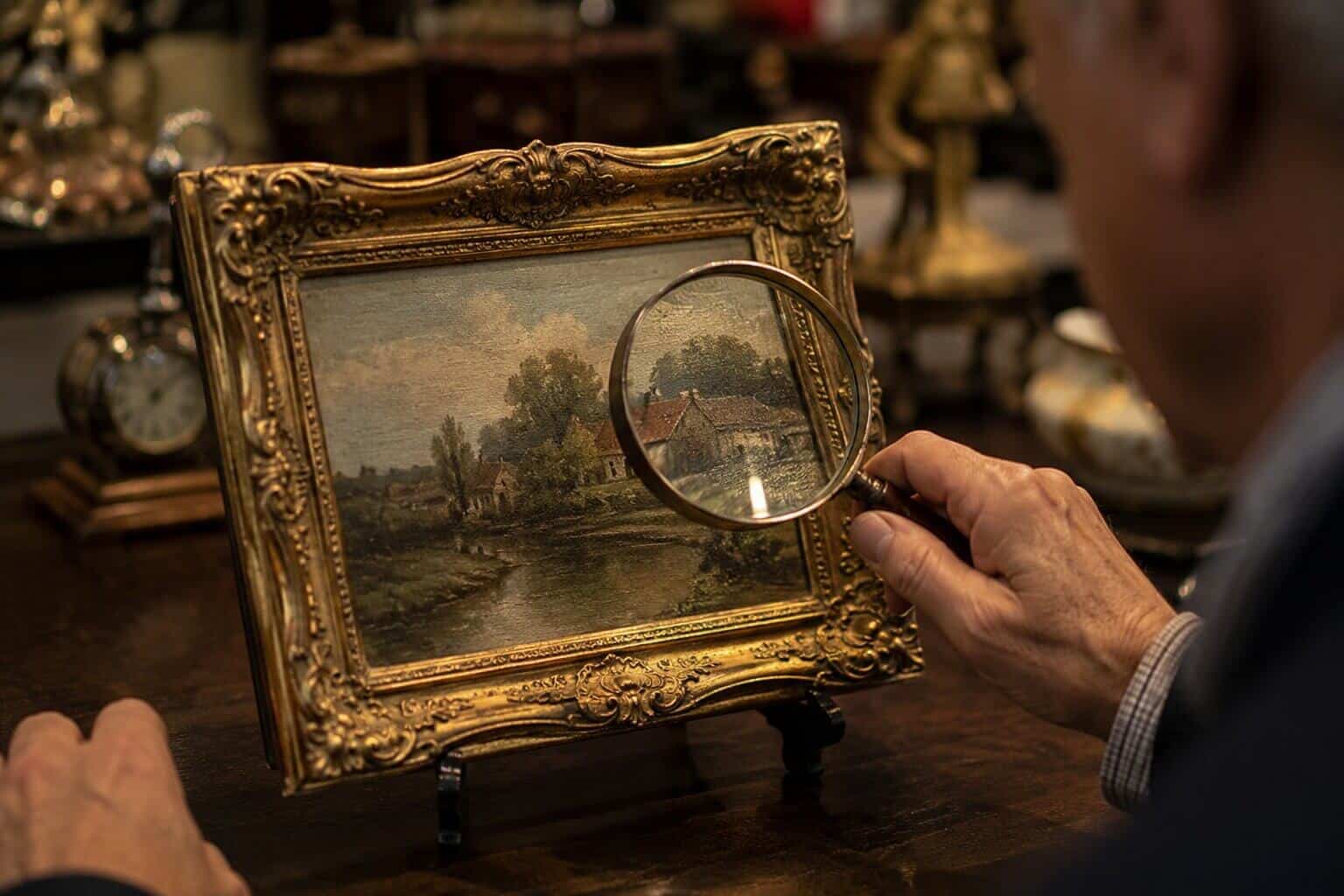

A Fabergé egg worth a reported $33 million was sitting on a kitchen counter next to Dunkin’ Donuts cupcakes. A scrap metal dealer nearly melted one of the century’s great discoveries down for gold. A painting stolen from a Baltimore museum decades earlier turned up at a Virginia flea market, bought by someone who just liked the look of it. That detail — the casualness of it — tells you everything about how extraordinary flea market finds actually happen. Not through expertise, but through ordinary people stumbling into extraordinary things.
Most flea market treasure stories end modestly: a vintage lamp resold for three times what you paid, a designer jacket found for a song. These nine are different. Purchased for anywhere between $3 and a few thousand dollars, they turned out to be paintings, documents, eggs, bowls, and negatives worth millions. Here are the stories.
1. A Stolen Renoir Found at a Virginia Flea Market (Estimated: $75,000–$100,000)
In 2012, a woman browsing a flea market in rural Virginia paid $7 for a small painting she liked the look of. It was a Pierre-Auguste Renoir — Paysage Bords de Seine, a river landscape dated to around 1879 — and it had been stolen from the Baltimore Museum of Art in 1951. The buyer had no idea. She simply packed it up, took it home, and at some point tucked it away in a box. Years later, an appraiser flagged the work as potentially authentic. The trail led back to the FBI’s Art Crime Team, which confirmed both the attribution and the theft.
The legal tangle that followed was complicated: the woman had bought it in good faith, but stolen art doesn’t transfer clean title, and the museum had never relinquished its claim. The painting was estimated at $75,000 to $100,000 — a modest figure by Renoir standards, but the story itself illustrates something the art world prefers not to advertise: a surprising number of works stolen in the mid-twentieth century simply vanished into the secondary market, turning up decades later at estate sales, attic clearances, and yes, flea market tables.
2. A $4 Newell Convers Wyeth Painting (Sold for: $191,000)
N.C. Wyeth is one of the great American illustrators — the man behind the vivid, muscular images in early twentieth-century editions of Treasure Island, Robin Hood, and The Last of the Mohicans. His originals turn up at auction regularly, and collectors pay serious money for them. Which makes it all the more remarkable that one of his works spent years at a thrift sale before anyone looked closely enough at the signature.
A buyer picked up the painting for $4 — a landscape, oils on board, the kind of thing that blends into a table of miscellaneous artwork without announcing itself. It wasn’t until the piece reached an appraiser that the attribution was confirmed and the full weight of the find became clear. The work eventually sold at auction for $191,000. The gap between $4 and $191,000 is so extreme it almost reads as fiction, but it’s a straightforward illustration of how illustrators — even celebrated ones — can be undervalued outside specialist circles.
Wyeth’s work occupies an interesting collecting category: too commercial for some fine art collectors, too painterly for others, and therefore consistently mispriced by generalist sellers who don’t know what they’re looking at. That blind spot is exactly where flea market finds happen.
3. A $5 Warhol (Estimated: $1.5 Million)
Andy Warhol’s work commands serious auction room attention, which makes it easy to forget that his output was enormous — prints, sketches, polaroids, small studies — and that not every piece was carefully catalogued and tracked through the decades. Some of it drifted. A shopper in the United States picked up a piece attributed to Warhol at a flea market or sale for around $5, apparently unaware of what they had. The work was later assessed by experts and estimated to be worth in the region of $1.5 million.
What makes the Warhol case particularly instructive is the question of authentication. The Andy Warhol Art Authentication Board — which for years served as the official gatekeeping body for disputed works — was notoriously difficult to satisfy, and its decisions were sometimes contested. A $5 street-market find would face intense scrutiny before any major auction house would touch it. The gap between “this looks like a Warhol” and “this is a confirmed, saleable Warhol” can be enormous, and the authentication process itself can cost thousands. That said, an estimated $1.5 million valuation suggests experts found the attribution credible.
Warhol worked prolifically across media — silkscreen, acrylic, pencil, ballpoint — and that variety is part of why unsigned or lesser-known works can slip through unrecognized. A small sketch on paper looks very different on a flea market table than it does framed on a gallery wall.
4. A 1,000-Year-Old Chinese Bowl (Sold for: $2.2 Million)
In 2007, a New York family paid $3 for a small ceramic bowl at a garage sale. It sat in their home for several years — an unremarkable object, the kind that gets moved from shelf to shelf without much thought. When they eventually brought it to Sotheby’s for appraisal, experts identified it as a Northern Song dynasty bowl, dating back roughly a thousand years. It sold at auction for $2.23 million.
What makes this find so striking is the object itself. Song dynasty ceramics are among the most admired in the history of Chinese art — prized for their restrained glazes and precise forms, qualities that read as almost anonymous to an untrained eye. A rare piece can look, to anyone without specialist knowledge, like any other old bowl. That invisibility is exactly what allowed it to end up at a garage sale in the first place.
The case is a reminder that Chinese ceramics remain one of the most actively collected and frequently misevaluated categories in the secondary market. Auction records for Song and Ming dynasty pieces have climbed sharply over the past two decades, driven in part by demand from mainland Chinese collectors. A bowl that passed unnoticed in 2007 would attract very different attention today.
5. Original Copy of the Declaration of Independence (Sold for: $2.42 Million)
In 1989, a man browsing a flea market in Pennsylvania paid $4 for a framed picture — not for the picture itself, but because he liked the frame. When he got home and removed the backing, he found a folded document tucked behind the print. It turned out to be one of the original printed copies of the Declaration of Independence, produced in the famous 1776 print run ordered by the Continental Congress. He eventually sold it at Sotheby’s for $2.42 million.
The print run itself is the key context here. John Dunlap, the official printer to Congress, produced an estimated 200 broadsides on the night of July 4th, 1776 — the first official copies of the document. By the late twentieth century, fewer than 30 were known to survive. Finding one inside a flea market frame wasn’t just luck; it was the kind of discovery that rewrites the provenance of a national artifact. The buyer had no idea what he had until he examined the document more closely and consulted experts.
It remains one of the most dramatic examples of a flea market find with genuine historical — not just monetary — weight. The frame cost $4. The document inside helped fund the seller’s retirement.
6. The Lost Third Imperial Easter Egg by Carl Fabergé (Estimated Value: $33 Million)
A Midwestern scrap metal dealer bought a decorative golden egg at some point before 2014, paying around $14,000 with the intention of melting it down for its gold content. The profit margin, he calculated, would be minimal — maybe a few hundred dollars. He nearly went through with it. Instead, he did an internet search on the object and stumbled across a reference that changed everything: the egg was identified as one of the missing Imperial Easter Eggs made by the House of Fabergé for the Russian royal family. Specifically, it was the Third Imperial Egg, commissioned by Tsar Alexander III and given to Empress Maria Feodorovna in 1887. It had been missing from the historical record for nearly a century.
Fabergé’s Imperial eggs are among the most recognizable luxury objects in existence — only a few dozen were ever made, and most are held in museums or major private collections. The Third Imperial Egg is notable not just for its provenance but for what it contains: a miniature golden hen, itself concealing a tiny diamond replica of the imperial crown. Experts at Wartski, the London dealership with deep expertise in Russian decorative arts, authenticated the piece. Estimates place its value at approximately $33 million. The dealer, who had carried it to antique fairs trying to find a buyer before the identification, sold it in 2014 — almost certainly the most valuable object ever to sit quietly on an anonymous flea market table without anyone knowing what it was.
The story is an extreme case of what collectors call “sleeper” finds — objects whose identity has simply been lost to time, circulation, and the chaos of estate dispersals following the Russian Revolution.
7. A Drawing by Albrecht Dürer (Estimated Value: $50 Million)
Albrecht Dürer is one of the most revered draughtsmen in Western art history — his works command extraordinary prices at auction, and authenticated drawings are exceptionally rare on the open market. Which makes the story of a Dürer sketch turning up at a French flea market all the more startling. The drawing, attributed to the German Renaissance master, was reportedly purchased for a modest sum before experts identified it as a genuine work. Specialists examining the piece pointed to characteristic details in the linework and materials consistent with Dürer’s known output, placing an estimated value in the region of $50 million.
What tends to happen with works of this caliber is that they disappear from the historical record during wartime dispersals, estate breakups, or simple misattribution — filed away as “school of” or “follower of” and sold accordingly. A drawing that looks like a study sketch to an untrained eye can represent decades of a master’s practice compressed into a single page. The Dürer case is a reminder that authentication is everything: the same object, with and without a verified name attached, can be worth a few euros or a museum acquisition budget.
For collectors, the lesson is less about learning to spot Dürer and more about taking unfamiliar works on paper seriously — old ink, unusual paper stock, and confident draughtsmanship are worth a second look, and a third.
8. A Pollock (Estimated Value: At Least $50 Million)
The story of a possible Jackson Pollock surfacing at a thrift store is one of the most contested and compulsively followed treasure narratives in recent art history. In the early 1990s, a man named Teri Horton — a retired truck driver from California — paid five dollars for a large abstract canvas at a thrift shop, intending it as a gag gift. It was too big to fit through a friend’s door. She ended up keeping it, and eventually a local art teacher suggested, half-seriously, that it might be a Pollock. That offhand comment set off decades of authentication battles, forensic investigation, and institutional resistance that became the subject of a documentary film.
What makes the case genuinely gripping — and genuinely unresolved — is the nature of the evidence. Fingerprint analysis reportedly identified a partial print on the canvas consistent with prints found in Pollock’s studio. Forensic art analyst Peter Paul Biro conducted infrared and microscopic examination of the work. The major auction houses and mainstream art establishment, however, declined to authenticate it, and the Pollock-Krasner Foundation has not endorsed the attribution. Authentication in the absence of provenance documentation is notoriously difficult, and with Pollock especially — whose drip technique has been widely imitated — the bar is exceptionally high. Horton turned down a reported $9 million offer, holding out for what she believed the painting was genuinely worth: estimates from those who believe it authentic have reached upward of $50 million.

The case remains open. It is a useful counterpoint to the cleaner stories elsewhere on this list — a reminder that a flea market find’s value can hinge entirely on whose opinion you trust, and that institutional authentication and forensic evidence do not always point in the same direction.
9. The Lost Negatives of Ansel Adams (Estimated Value: $200 Million)
In 1940s California, a man named Rick Norsigian paid $45 at a garage sale for two boxes of glass plate negatives. He had no particular reason to think they were remarkable — old photographic plates turn up in estate sales and yard sales with some regularity. It took years of investigation, forensic analysis, and expert opinion before a credible case emerged that the negatives were the work of Ansel Adams, the photographer whose images of Yosemite, the Sierra Nevada, and the American West became some of the most recognisable photographs of the twentieth century. The plates were believed to have been among those destroyed in a 1937 darkroom fire at Adams’s studio — which is precisely why their reappearance, if genuine, was so significant.
The story attracted serious attention and serious dispute in roughly equal measure. A team of analysts — including handwriting experts, paper specialists, and photographic historians — was assembled, and in 2010 a press conference declared the negatives authentic, with estimates of their value reaching $200 million. Adams’s official estate pushed back firmly, disputing the attribution and raising questions about the methodology used to authenticate them. The contested status has never been fully resolved to the satisfaction of the broader photographic community, which makes this find simultaneously the most spectacular and the most unresolved entry on this list.
What the Norsigian case illustrates — beyond the obvious — is that photographic archives are among the most vulnerable categories of cultural material. Unlike a painting with exhibition history or a document with institutional provenance, glass plate negatives can pass through estate sales, storage units, and garage sale boxes without anyone recognising what they are. Whether or not these particular plates are ultimately confirmed as Adams’s work, the story is a genuine argument for slowing down at the photographic ephemera table.
What To Do If You Think You’ve Found Something
The stories above are exceptional by any measure, but they share a practical lesson: none of these finds became valuable the moment they were purchased. They became valuable because someone paused, asked questions, and sought expert opinion rather than assuming they were wrong.
— a signature that looks too confident for an amateur, a material that feels older than the price tag suggests, a subject or style you half-recognise — the right move is always the same. Buy it if the price is low enough to absorb the risk of being wrong. Photograph it thoroughly before handling it further. Then take it to a specialist auction house; Christie’s, Sotheby’s, Bonhams, and many strong regional houses offer free initial appraisals for items with genuine potential. Above all, avoid cleaning or restoring anything before an expert has seen it. More than one significant find has been quietly devalued by a well-meaning polish.
FAQ
Has anyone actually made millions from a flea market find?
Yes — several times, based on documented cases. The Declaration of Independence copy sold for $2.42 million, the Chinese bowl fetched $2.2 million at Sotheby’s, and the Fabergé Easter Egg was acquired by a scrap metal dealer for a few hundred dollars before being valued at an estimated $33 million. These are rare outcomes, but they are real ones with verifiable auction records behind them.
How do auction houses authenticate a flea market find?
Authentication typically involves provenance research, materials analysis, stylistic assessment by specialists, and sometimes scientific testing such as X-ray or infrared imaging. For works on paper, handwriting experts and paper historians may be brought in. The process varies by category — a painting follows different protocols than a glass-plate photograph or a decorative object — and even rigorous authentication can remain contested, as the Ansel Adams negatives case demonstrates.
What kinds of flea market finds are most likely to have hidden value?
Works on paper — drawings, prints, photographs, documents — are consistently undervalued at flea markets because they are fragile, often unsigned, and easy to overlook. Decorative objects without obvious maker’s marks (like the Chinese bowl) can conceal significant age and origin. Oil paintings in older frames, especially those with labels, stamps, or inscriptions on the reverse, are worth a second look. Estate sales and rural markets, where contents of older households pass through with little curation, tend to produce the most significant discoveries.
Is it legal to sell a flea market find that turns out to be stolen?
Not if you know it is stolen — and once a theft record is confirmed, the piece is generally returned to its rightful owner or institution regardless of how much was paid for it. The Renoir case is the clearest example on this list: the painting was withdrawn from auction when the Baltimore museum identified it as the piece stolen from their collection in 1951. Good-faith purchase offers some legal protection in certain jurisdictions, but cultural property and stolen art laws vary significantly by country and are worth understanding before selling anything of potential significance.