

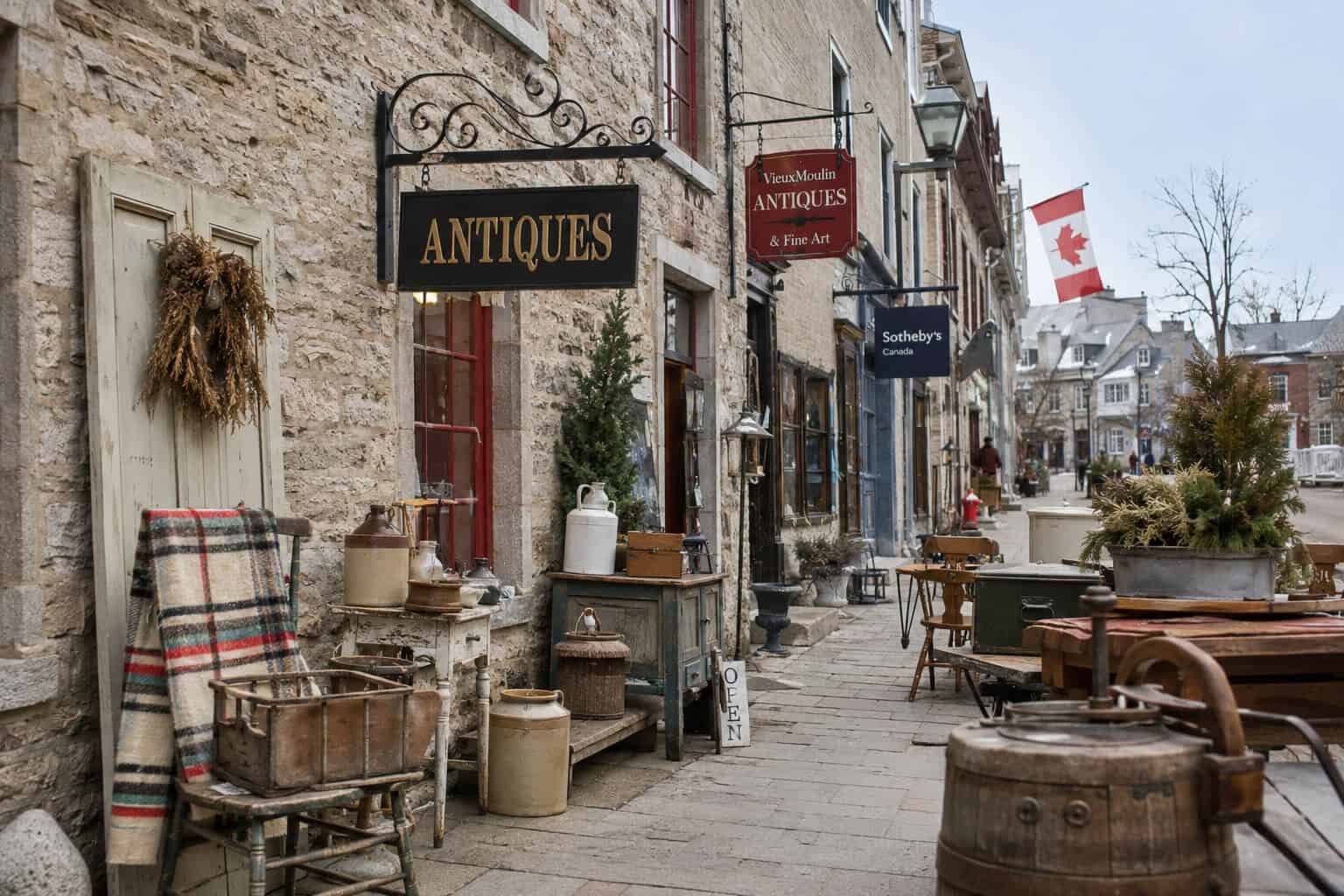

Canada’s antique trade runs deeper than most visitors expect. The country has its own distinct material culture — Quebec pine armoires, early Maritime painted blanket boxes, Ontario transferware, Doukhobor woodwork from the Interior — alongside the British and European imports that arrived with successive waves of settlement. Spring and summer open up the outdoor markets and antique fairs, but permanent dealer shops run year-round, and some of the best antiquing in North America happens on ordinary Tuesday afternoons in neighbourhoods that barely register on the tourist map.
This guide covers the strongest areas province by province, from Vancouver Island’s Fort Street to Montreal’s Notre-Dame West and the Lighthouse Route along Nova Scotia’s south shore. Independent dealers relocate and close more often than guidebooks acknowledge, so treat named shops as starting points and verify current status before you make a long drive.
British Columbia
British Columbia’s antique trade splits neatly between Victoria and Vancouver, with the two cities offering quite different experiences. Victoria has a concentrated dealer street that rewards a focused half-day walk; Vancouver spreads its best shops across a handful of distinct neighbourhoods, each with its own character and price range. Further afield, the Fraser Valley and the Okanagan hold their own quiet surprises for anyone willing to get off the highway.
Victoria
Fort Street is where most serious antiquing in Victoria begins. Running east from downtown toward the Rockland neighbourhood, it has been the city’s dealer corridor for the better part of a century. The trade has softened over the years — collectibles and mid-century furnishings have edged out some of the finer Georgian and Victorian pieces — but several genuinely serious shops remain among the lifestyle boutiques. Faith Grant The Connoisseur’s Shop is the oldest and most consistently cited: a well-organised multi-room dealer carrying formal British furniture, silver, porcelain and estate jewellery. The stock turns over slowly and the prices reflect serious trade rather than weekend browsing, which is usually a good sign. Nearby, Vanity Fair Antiques & Collectibles operates as a multi-dealer space with a broader, more eclectic range — useful for scanning quickly across categories, from vintage glassware and pressed linens to early Canadian ceramics.
Fort Street’s walkability is its main advantage. A few hours on foot will cover most of what’s there, and the street’s café density means there’s no pressure to rush. The city’s general antique market operates separately and is worth checking for current dates and location, as outdoor-format events in Victoria tend to shift seasonally.
Vancouver
Vancouver doesn’t have a single antique street to match Fort Street, but South Granville — the stretch of Granville Street between roughly 7th and 16th Avenues — comes closest. The neighbourhood is better known for high-end interior design showrooms, and the antique shops that remain here tend toward the formal and expensive: European furniture, decorative arts, estate silver and the kind of serious Chinese export porcelain that once filled the old BC merchant families’ dining rooms. It’s a neighbourhood for looking as much as buying, but the quality is consistently high and the shops are knowledgeable.
For a different kind of dig, Main Street through Mount Pleasant and the Antique Row stretch around 30th Avenue offers more accessible, lower-overhead dealers carrying vintage clothing, records, mid-century furniture and the sort of accumulated domestic objects that don’t make it to the South Granville showrooms. Prices are lower, turnover is faster, and the atmosphere is closer to a working market than a gallery. The Trout Lake Flea Market, held on weekends in East Vancouver, adds an outdoor layer to the city’s second-hand geography — chaotic, unpredictable and occasionally excellent for the patient hunter.
If you have time to push out of the city, the Fraser Valley corridor east of Vancouver holds a scattering of rural antique shops and barn-sale operations that open seasonally. Towns like Cloverdale, Abbotsford and Chilliwack have all supported dealer clusters at various points, though the landscape changes frequently. Ask locally; a good shop in South Granville will often point you toward the Fraser Valley contacts they use themselves.
Quebec
Quebec has a furniture and decorative arts tradition that’s genuinely distinct from the rest of Canada. The province’s early colonial workshops produced pine armoires, commodes and buffets with a robustness and regional character that serious collectors have pursued for generations. That tradition gives Quebec’s antique trade a depth that goes beyond the usual mix of imports and estate clearances — here, the local material culture is often the main event. Montreal is the obvious starting point, but the antique density along the province’s rural roads, particularly in the Eastern Townships and along the south shore of the St. Lawrence, rewards anyone willing to drive.
Montreal
Notre-Dame Street West, running through the Saint-Henri and Little Burgundy neighbourhoods, is Montreal’s best-known antiquing corridor. The strip has been home to dealers for decades and still holds a respectable concentration of shops ranging from formal, gallery-style operations to more casual multi-dealer floors. The stock reflects Quebec’s collecting preoccupations — habitant pine furniture, silver church pieces, early painted objects, Quebec pottery — alongside the European silver, porcelain and decorative furniture that the city’s anglophone merchant families accumulated across two centuries. The mix is genuinely interesting, and the better shops on this street are knowledgeable about provenance in a way that matters when you’re buying early local material.
Notre-Dame West is walkable in a dedicated morning or afternoon, though the blocks between Atwater and the Village des Antiquaires cluster reward the most attention. It’s worth noting that the strip has thinned somewhat over the years — as with antique rows everywhere, a few long-running shops have closed or relocated — so arriving with a short list of specific dealers to prioritise is sensible. The neighbourhood itself has become one of Montreal’s more interesting food and café corridors, which at least ensures that pausing between shops doesn’t mean settling for bad coffee.
Beyond Notre-Dame, the Marché aux Puces Saint-Michel in the city’s north end operates as a large indoor flea market with a mix of antique dealers and general second-hand vendors. It’s a different register from the Notre-Dame shops — noisier, more unpredictable, better for bric-à-brac and low-cost vintage than for furniture or serious decorative arts — but the sheer volume of material means patient hunters occasionally find things that would otherwise never surface in the dealer trade. Weekends are when the market operates at full capacity.
The Eastern Townships and Rural Routes
The Eastern Townships — the region southeast of Montreal running toward the Vermont and New Hampshire borders — has long attracted Montrealers looking for weekends of antiquing alongside the covered bridges and lac-side villages that define the landscape. Towns like Knowlton, Sutton and Bromont have all supported antique shops at various points, and the rural character of the region means the occasional barn sale or estate auction reaches the market before the city dealers get there. The Townships were settled heavily by United Empire Loyalists arriving after the American Revolution, which means the decorative arts tradition here draws on both the British colonial furniture trade and the earlier Quebec habitant craft tradition — a combination that produces interesting hybrid material when you find it.
Further east, the Chaudière-Appalaches region on the south shore of the St. Lawrence holds a quieter scattering of dealers and occasional markets that rarely appear in general travel guides. This is slower, more localised antiquing — the kind where the best shops are on unmarked rural roads and the inventory hasn’t been picked over by scouts from the city. The tradeoff is that hours are irregular and it genuinely helps to speak some French; shopkeepers here are less oriented toward English-speaking tourism than their Montreal counterparts, but that tends to mean the merchandise is priced for local buyers rather than visitors.
Quebec City and the Surrounding Region
Quebec City has antique shops concentrated in the Lower Town, particularly around Rue Saint-Paul in the Vieux-Port district. The street has a relaxed, year-round rhythm — tourist trade keeps it active even outside the warmer months — and the shops carry a good range of Quebec country pieces, early pottery, maps, prints and the kind of decorative Canadiana that is harder to find in Montreal at reasonable prices. The atmosphere is different from the Montreal dealer strip: quieter, more browsable, with individual shopkeepers who often have strong knowledge of their own inventory.
The deeper opportunity in Quebec, though, is the countryside. The Eastern Townships — the Cantons-de-l’Est, running east and south of Montreal toward the Vermont border — have a long history of antique hunting. The towns of Knowlton, Sutton and Bromont have attracted serious shops over the years, in part because the Townships drew wealthy Montrealers as a second-home destination and the trade followed the money. Country pine furniture, early Canadian ceramics, painted folk pieces and Victorian parlour furnishings all appear in the region’s shops and fairs.
Heading north from Quebec City into Charlevoix, the aesthetic shifts toward a rougher, more rural tradition — early habitant furniture, hand-forged ironwork, carved wooden objects — and the prices can be lower than in the city shops, though the best pieces have long since been bought by Montreal and Quebec City dealers. The drive itself, along the north shore of the St. Lawrence, is one of the more spectacular routes in eastern Canada, and combining it with a day or two of rural shop-hopping is a natural fit.
Across the St. Lawrence on the south shore, the road through Montmagny and L’Islet-sur-Mer has a scatter of shops and barn sales that produce country Quebec furniture and early domestic objects. These are less convenient to reach without a car, but for buyers willing to cover ground, the south shore corridor between Quebec City and Rivière-du-Loup has rewarded the effort for generations of pickers and collectors.
Ontario
Ontario’s antique trade is the most geographically spread of any Canadian province — a function of its size, its population density and the sheer range of settlement history compressed between the Great Lakes shoreline and the Shield country to the north. The serious collector can spend days working through Toronto’s dealer strips, then follow Highway 7 east through a string of small towns toward Kingston and the St. Lawrence, each with its own rhythm and price level. The province also has one of Canada’s most active outdoor antique market circuits, concentrated in the summer months when farm properties and fairgrounds open up to dealers.
Toronto
The most reliable concentration of permanent antique dealers in Toronto runs along Leslieville, the stretch of Queen Street East roughly between Carlaw and Jones Avenues, and through the side streets immediately off it. The neighbourhood has gentrified considerably over the past two decades, but the antique and vintage trade took root early and enough shops have stayed to give the strip genuine character. The merchandise tends toward the decorative and the design-forward — mid-century furniture, industrial salvage, painted country pieces — rather than the strictly formal antiques you’d find in an older dealer district, which reflects the neighbourhood’s buyer base as much as anything else.
The Distillery District and its surroundings host occasional antique and vintage fairs, and the west end’s Dundas Street West corridor has produced a scattering of vintage and antique shops as the neighbourhood has matured. Neither is as consistent as Leslieville for a dedicated antiquing afternoon, but both are worth knowing if you’re already in the area. The Toronto Antique Centre on King Street West has been one of the city’s more durable multi-dealer operations, bringing together a range of specialists under one roof — useful on a tight schedule or in poor weather.
The Highway 7 Corridor and Eastern Ontario
The real depth of Ontario antiquing lies outside the city. The corridor running east from Toronto through Oshawa, Port Hope and Cobourg — and then inland along Highway 7 through Peterborough toward Havelock, Marmora and beyond — is one of the province’s most productive antiquing routes, and one that rewards unhurried travel. Port Hope in particular has built a modest but genuinely good antique trade along its main street, with a handful of shops that carry the kind of serious Canadian country furniture and early transferware that serious collectors are looking for. The town’s Victorian streetscape adds something to the experience.
Further east, the Kingston area and the villages of Prince Edward County — the peninsula between Lake Ontario and the Bay of Quinte — have developed a wine and food tourism economy that has brought with it a parallel antique and vintage shopping culture. Picton and Wellington, the two main villages on the County, have both supported antique dealers, and the proximity to Kingston means the picker trade is active enough that decent material circulates through the region regularly. Prince Edward County sits at an interesting intersection of United Empire Loyalist settlement history and more recent creative economy migration, which produces an unusually eclectic mix of merchandise.
Outdoor Markets and Antique Fairs
Ontario’s outdoor antique market season runs roughly from May through October, with the largest and best-attended events clustered in summer. The Aberfoyle Antique Market, held on weekends at a property near Guelph southwest of Toronto, is among the longest-running outdoor markets in the province and draws dealers from across Ontario and into Quebec. The scale makes it possible to cover a broad range of material in a single morning — furniture, glassware, jewellery, militaria, vintage clothing and Canadian paintings all appear regularly. Arriving early is the standard advice, and it holds.
The town of Almonte in the Ottawa Valley, west of the capital, hosts an antique market that draws a mix of serious collectors and casual browsers, and the broader Ottawa region has its own dealer infrastructure centred on the ByWard Market area and the residential streets north of it. The Ottawa Valley settlement pattern — a mix of Irish, Scottish and French-Canadian communities moving through the same landscape over successive generations — has left an unusually layered material culture, and pieces that surface here often don’t appear elsewhere in the country.
Nova Scotia
Nova Scotia’s antique trade is shaped by geography as much as anything else. The province’s long coastline, its history of British and New England settlement, and the steady rhythm of estate clearances in small coastal communities have all contributed to a material culture that is genuinely distinctive. Early painted furniture, ship’s instruments, hooked rugs, ironware and the occasional piece of early Acadian domestic ware circulate here in a way they simply don’t elsewhere in the country. The main antiquing corridor follows the south shore — the so-called Lighthouse Route — but Halifax itself has a cluster of dealers worth knowing.
Halifax and the Surrounding Area
Halifax is the logical starting point. The city has supported a permanent antique trade for decades, with dealers concentrated along and around Agricola Street in the north end as well as in the older residential areas close to the downtown peninsula. The north end has evolved considerably as a neighbourhood — coffee shops and design studios have moved in alongside long-established businesses — but the antique trade has held its footing. Shops here tend to carry a reasonable mix of maritime-inflected material alongside the more generic mid-century and collectibles merchandise that surfaces everywhere. The quality varies, as it does in any urban dealer concentration, but the better shops have genuine depth and proprietors who know their inventory.
The city also benefits from being close enough to the surrounding rural counties that picker traffic keeps the dealer floors reasonably fresh. Lunenburg County, Annapolis County and the Annapolis Valley to the northwest are all productive picking territories, and material from those areas finds its way into Halifax shops with enough regularity that return visits are worthwhile.
The Lighthouse Route and the South Shore
The stretch of Highway 3 running southwest from Halifax through Chester, Mahone Bay, Lunenburg and Bridgewater toward Shelburne is among the most rewarding antiquing drives in Atlantic Canada. The towns along this route have the architectural stock — largely intact nineteenth-century streetscapes — and the visitor economy to support working antique shops, and several have done so for generations. Mahone Bay in particular has a concentration of dealers relative to its small size that is disproportionate and genuinely impressive. The town’s three churches and its harbour setting have made it a tourist destination in its own right, but the antique shops here are not tourist traps: they carry serious Canadian country furniture, early glass, quilts and the maritime hardware and navigational material that characterises the best Nova Scotia dealing.
Lunenburg, a UNESCO World Heritage site and one of the best-preserved British colonial planned townscapes in North America, has fewer dedicated antique dealers than Mahone Bay but rewards browsing. The town’s history as a centre of shipbuilding and deep-sea fishing has left a legacy of related objects — logbooks, instruments, model vessels, painted sea chests — that occasionally surface in local shops and at the area’s seasonal sales. Further southwest, the Shelburne area carries strong Loyalist settlement history, and the furniture and decorative arts that come out of Shelburne County reflect that — New England-influenced forms made in Nova Scotia, often in the same painted and grained finishes that characterise early Maritime work at its most appealing.
The Annapolis Valley
The Annapolis Valley runs roughly from Windsor in the east through Wolfville, Kentville and Annapolis Royal to Digby in the west, and it has its own distinct antiquing character. The Valley was settled early — Acadian communities were established here in the seventeenth century before the British colonial period, and the mix of cultural influences has produced a material record that serious collectors find compelling. Annapolis Royal itself is a small town with an outsized sense of historical identity and a handful of dealers and multi-vendor spaces that reflect it. Wolfville, home to Acadia University, draws an educated year-round population that supports a more eclectic range of vintage and antique merchandise than you might expect from a town of its size.
Outdoor sales and community auctions are the other major source of material in this part of the province. Nova Scotia has a functioning auction culture — estate auctions held in rural communities along the Valley and down both shores move the kind of early provincial furniture and decorative material that rarely makes it into fixed shops. Following the auction listings is its own discipline, but for collectors with the time and patience it remains one of the most direct routes to genuinely good Nova Scotia antiques at realistic prices.
Antiquing in Alberta
Alberta’s antique trade is concentrated in its two major cities, Calgary and Edmonton, with a secondary layer of smaller-town dealing scattered across the rural stretches between them. The province’s collecting culture is younger than that of Quebec or the Maritimes — Alberta was settled comparatively late, and its material history reflects that — but serious dealers have been working here for decades, and the range of Western Canadian furniture, Indigenous-influenced decorative arts, ranch hardware and early homesteader material gives Alberta antiquing a distinct character that collectors from eastern Canada often find genuinely surprising.
Calgary has a handful of established dealer concentrations, with Inglewood — one of the city’s oldest neighbourhoods and its earliest commercial district — functioning as the natural hub. The area has attracted antique and vintage dealers precisely because its older building stock and walkable streetscape suit the trade. The mix here leans toward mid-century furniture and decorative objects alongside the kind of Western Canadiana — cattle brands, ranch signage, early settler photographs, painted and grained prairie furniture — that is difficult to find well-represented elsewhere. Inglewood also hosts periodic antique and vintage markets that draw a broader range of dealers than the fixed shops can accommodate alone.
Edmonton’s antique scene is more dispersed, though the city rewards patient exploration. The Old Strathcona neighbourhood on the south side of the river has long been associated with independent retail and second-hand trade, and antique and vintage shops have historically been part of that mix. The city also has multi-dealer malls and estate-sale culture that moves the kind of household accumulations — pressed glass, silver plate, furniture from the early and mid-twentieth century — that characterise prairie estate sales at their most productive. For collectors interested in early Alberta material specifically, the estate auction circuit is often more fruitful than fixed retail: furniture and objects from original homestead families still surface through rural Saskatchewan and Alberta auctions in a way that has largely dried up in older provinces.
The stretch of Highway 2 between Calgary and Edmonton passes through smaller communities where the occasional shop or seasonal market operates, and the communities along the older Highway 1 corridor to the east of Calgary — towns with strong Ukrainian and Central European settlement histories — occasionally yield decorated furniture, embroidered textiles and folk objects that are well outside the mainstream of Canadian antique dealing. These finds are not guaranteed, and the logistics of rural Alberta antiquing require patience and flexible timing, but the reward for collectors willing to cover ground can be material that would command serious prices if it surfaced in a Montreal or Toronto dealer’s stock.
New Brunswick
New Brunswick sits at the hinge of the Maritime provinces, and its antique trade reflects that position — shaped by Loyalist settlement in the south, Acadian heritage in the north and east, and a long tradition of self-sufficient rural life that left behind functional, well-made objects in wood, iron and painted wood. The province tends to be overlooked by collectors who head straight for Nova Scotia or Prince Edward Island, but that relative obscurity is part of its appeal. Prices are generally modest, competition from out-of-province buyers is lighter, and the material — early painted furniture, stoneware crocks, ironstone, hooked rugs and maritime tools — is genuinely regional.
Saint John, the province’s largest city, is the natural starting point. The uptown area and the surrounding streets have supported antique and second-hand dealers for years, with a mix of multi-dealer co-operatives and independent shops. The city’s Loyalist roots mean that Georgian and early Victorian household objects turn up with some regularity — transfer-printed ironstone, silver-plate, mahogany and walnut furniture pieces that arrived with families relocating from the American colonies after 1783. The Saturday City Market, one of the oldest farmers’ markets in North America, sits in a historic train-shed building in the centre of uptown and draws a mix of produce vendors, craftspeople and dealers in antiques and collectibles. It rewards early arrival, and the quality of the antique material varies from week to week.
Fredericton, the provincial capital, has a quieter but steady antique presence. The city’s compact downtown and its proximity to the St. John River valley — historically one of the province’s most densely settled agricultural corridors — means that country furniture and early household objects move through local shops with some regularity. The valley towns between Fredericton and the Quebec border have produced painted blanket chests, Windsor chairs and early pine case furniture that sits stylistically between the Quebec tradition and the English Maritime one, and collectors who work this corridor carefully tend to find strong material at prices that still reflect local rather than metropolitan demand.
The broader rural landscape is worth treating as part of the hunt rather than just transit between urban stops. New Brunswick’s secondary roads pass through small towns where general antique shops, barn sales and occasional roadside dealers operate on seasonal schedules. The province’s antique fairs and outdoor markets tend to concentrate in summer, when the tourist season opens up and dealers emerge from the quieter winter months with accumulated stock. If you are driving through the province between Nova Scotia and Quebec, it is worth building in a half-day for unplanned stops rather than treating the province as simply a corridor.

Prince Edward Island
Prince Edward Island punches well above its size for antique hunting. The province’s compact geography and its long history as a settled agricultural community — farms established by Acadian, Scottish and Irish settlers over several centuries — mean that early rural material has stayed close to where it was made. Painted country furniture, early ironstone and decorated stoneware, hooked rugs, butter moulds and farm implements all circulate through the island’s shops and seasonal markets with a frequency that surprises first-time visitors. The scale is small, but the density of material relative to the number of collectors working the territory makes PEI one of the more rewarding Maritime destinations for anyone with a focused collecting interest.
Charlottetown, the provincial capital, is the logical base. The city’s downtown and the surrounding blocks hold a mix of antique shops and multi-dealer spaces where the stock leans toward island-specific pieces — early pine furniture in the vernacular Maritime tradition, transfer-printed ceramics, silver-plate and the kind of modest household objects that accumulated on working farms over a century or more. The quality varies, as it does anywhere, but patient browsing tends to reward the collector who is looking for functional, honest country pieces rather than high-style furniture.
Outside the capital, the island’s secondary roads connect a scatter of rural antique shops and occasional barn sales that operate primarily through summer. The tourist season concentrates dealer activity and brings out stock that has been held through the winter, so late spring through early autumn is the most productive window. Driving the island’s quieter routes — through the central agricultural belt or along the north shore — turns up roadside shops that would not appear in any directory, and that element of unplanned discovery is part of what makes PEI worth taking seriously as an antiquing destination. The province’s relatively modest profile among out-of-province collectors keeps prices grounded, and the material remains genuinely regional rather than the curated, already-picked stock that moves through busier urban markets.
Annual antique fairs and outdoor sales also draw dealers from across the Maritimes to the island during summer, concentrating otherwise dispersed stock in one place. These events are worth timing a visit around if your schedule allows, since they bring together dealers who do not maintain permanent shop fronts and occasionally surface pieces that would otherwise take multiple road trips to find.
Bonus: Canada’s Flea Markets on a Map
Canada’s antiquing landscape stretches across an enormous geography, and even a dedicated road trip will only cover a fraction of it. To help you plan — whether you’re targeting a specific province or mapping a cross-country route through dealer streets and summer fairs — Fleamapket’s interactive Canada map brings together flea markets and outdoor antique sales from British Columbia through to the Maritimes in one searchable resource. Use it to find markets close to wherever your travels take you, spot seasonal events worth timing a visit around, and identify areas where several markets cluster close enough to combine in a single day.
The map is particularly useful for the regions where permanent shops are thin on the ground but seasonal outdoor markets fill the gap — rural PEI in summer, the back roads of New Brunswick, Alberta’s smaller centres beyond Calgary and Edmonton. Markets that don’t maintain a strong web presence, or that operate only a few weekends a year, are often easier to find through the map than through a conventional search.
Explore the full map at Fleamapket.com before you set off, and check back as you plan each leg of your trip — the database is updated regularly as new markets open and seasonal dates are confirmed.
Planning Your Antiquing Trip to Canada
Spring and summer are the most rewarding seasons for antiquing across Canada. As the weather lifts, dealers who spent winter months quietly building their stock begin to open seasonal shops, outdoor markets fill their stalls, and the country’s most scenic antique routes — the Lighthouse Route in Nova Scotia, the back roads of Prince Edward Island, the Highway 7 corridor in Ontario — become genuinely pleasurable to drive. The shoulder seasons can be worth exploring too, particularly in cities like Montreal, Toronto and Victoria where permanent shops trade year-round, but if you’re planning a road trip with markets and rural dealers in mind, late May through September is the sweet spot.
A few practical considerations will sharpen any trip. In the larger cities, antique districts tend to cluster — Fort Street in Victoria, Lonsdale Avenue in North Vancouver, the Laurier district in Montreal, Queen Street West and the suburbs east of Toronto — so it’s worth mapping a loose morning circuit rather than driving individually to each shop. Outside the cities, particularly in the Maritimes and rural Alberta, distances between good dealers can be significant; building in flexibility and a picnic lunch makes those drives far more enjoyable than trying to hit a rigid schedule. Arriving early at outdoor markets pays off almost everywhere in Canada, as the best pieces rarely last past mid-morning. And because many smaller dealers keep irregular hours or close seasonally, a quick phone call or email before making a long drive is always time well spent.
Where to Stay
Canada’s main antiquing corridors are well served by accommodation in the cities that anchor them. Victoria and Vancouver are the obvious bases for British Columbia, with Victoria offering easy walkable access to Fort Street and Vancouver placing you within reach of both the city’s dealer neighbourhoods and the North Shore shops across the bridge. In Quebec, Montreal is the natural hub — the Plateau and Mile End neighbourhoods put you close to the city’s best dealers and within day-trip range of Quebec City and the Eastern Townships. Toronto covers the heart of Ontario’s permanent antique scene, though travellers working the Highway 7 corridor or the Kawartha Lakes area may prefer a smaller base in Peterborough or Lindsay to avoid city traffic on market days. In Nova Scotia, Halifax is the anchor for the south shore route; staying in the city lets you day-trip the Lighthouse Route in either direction, and the Annapolis Valley is manageable from Halifax as a longer day out. For New Brunswick and Prince Edward Island, Fredericton and Charlottetown are the most practical bases — both are small enough to explore on foot and central enough to reach the rural routes without long drives. Calgary and Edmonton serve Alberta’s main auction houses and dealers, with Calgary convenient for the foothills antique trail and Edmonton for the larger permanent shops in the north. Whatever base you choose, booking accommodation a few weeks ahead during summer is advisable — the same good weather that draws antiquers also fills hotels during peak tourist season across the country.
Frequently Asked Questions
When is the best time of year to go antiquing in Canada?
Late spring through early autumn — roughly May to September — is ideal across most of the country. Outdoor markets, seasonal dealers and antique fairs are concentrated in these months, and driving the rural routes in Nova Scotia, Ontario and British Columbia is considerably more enjoyable when the roads are clear. City-based shops in Montreal, Toronto and Vancouver trade year-round, making them viable destinations in any season.
Which Canadian province has the best antiquing?
That depends on what you’re after. Quebec, and Montreal in particular, is widely regarded as the strongest province for French-Canadian furniture and decorative arts — pieces that are difficult to find anywhere else. Ontario has the greatest density of permanent shops and the largest auction infrastructure. British Columbia punches above its weight for British furniture and silver, especially in Victoria. Nova Scotia offers the most scenic antiquing road trip, with a long coastline of dealers, markets and architectural salvage specialists.
Are there good flea markets and antique shows in Canada, not just shops?
Yes — and for many collectors, shows and outdoor markets are the more interesting hunting ground. Nova Scotia has a strong tradition of church sales, barn sales and community events, particularly along the south shore. Ontario hosts some of the country’s largest antique fairs. Quebec’s brocante culture produces good outdoor events in the warmer months. The Fleamapket Canada map covers flea markets and antique shows across all provinces and is worth consulting before planning a specific route.
Are Canadian antique dealers open on weekends?
Most permanent shops in the cities keep regular weekend hours, though hours vary widely between dealers and can change seasonally. Outdoor markets and antique fairs typically run on weekends only. Smaller rural and Maritime dealers often have limited or appointment-only hours, so it’s worth checking ahead — particularly if you’re making a special journey to a specific shop.
What kinds of antiques are most associated with Canada?
Quebec pine furniture — armoires, harvest tables, blanket boxes — is the most distinctively Canadian category and tends to be the one collectors travel specifically to find. Maritime painted furniture, Indigenous art and craft objects, early Canadian ironware, and decorative pieces tied to the British colonial period are also significant. British imports are common in the older cities of Victoria, Halifax and Toronto, reflecting historic trade connections. Western Canadian dealers often carry strong selections of early agricultural and homesteading objects alongside more conventional antiques.
How do I find flea markets and antique fairs beyond the shops listed here?
The interactive map at Fleamapket.com is the most practical starting point for locating outdoor markets and seasonal fairs across Canada, including smaller events that don’t maintain a strong web presence. Local tourism boards, provincial antique dealer associations, and community notice boards in smaller towns are also useful — some of the best rural markets are advertised primarily through signage and word of mouth rather than online listings.
Should I haggle at Canadian antique shops?
Polite negotiation is generally accepted at antique shops and flea markets throughout Canada, particularly when buying multiple pieces or paying in cash. The culture is generally less overtly bargaining-focused than some European markets — a respectful enquiry about the best price is more effective than aggressive haggling. At formal auction houses, prices are obviously determined by bidding rather than negotiation.
Should I verify shop details before visiting?
Yes, always. Independent antique dealers relocate, reduce hours seasonally, and occasionally close — sometimes with little online notice. Before making a dedicated trip to any specific shop, it’s worth a phone call or a check of the dealer’s current web or social presence. This is especially true for smaller rural operations and for any dealer that has been in business long enough to be a local institution — those shops sometimes change hands or scale back without much fanfare.
Can I bring antiques back across the Canadian border?
Generally yes, though the specifics depend on your destination country and the nature of the items. Antiques over 100 years old are often exempt from import duties in many countries, including the United States, but documentation helps — a receipt showing the item, its approximate age and the purchase price is useful at the border. Items made from protected materials (certain woods, ivory, tortoiseshell) may face additional restrictions regardless of age. When in doubt, ask the dealer for whatever provenance or documentation they have.