

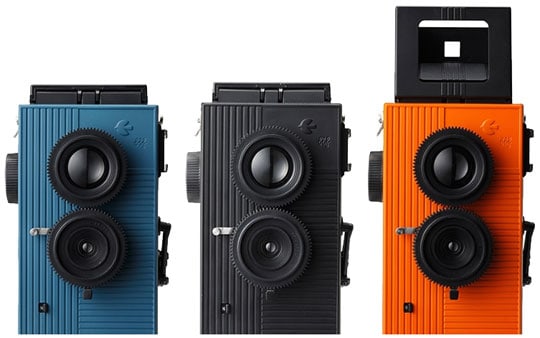

Six months ago, I was walking down a street in Brooklyn and stopped at the window of a so-called “design” shop that sold “must-have” items for decorating one’s home. As I looked at the contents of the shop from the outside, my eyes were drawn to three small coloured objects on a shelf. I walked into the shop and approached the shelf; to my surprise, I realised that these candy-like blue, red and green boxes were actually cameras — Twin Lens Reflex cameras, to be precise.
Well, they said they were. After having a closer look at one of them, I realised that they were just VERY cheap copies of a Lubitel (and Lubitel is already a cheap TLR; so try to imagine what a cheap-cheap TLR might look like… Yes, like something CHEAP): they were made of plastic, plastic and plastic. Well, not all plastic — there were some screws to hold all the plastic together in one piece, and the lenses were made of glass (well, I’m not even sure about that). And to add insult to injury, these cameras used 35mm film. In my opinion, a TLR should only use 120 film: those square images you never get with a 35mm are the whole point of a twin lens reflex camera.
In short, a piece of crap that costs $90. Yes, that’s right, $90.
Why would some people spend $90 on a TLR-like plastic camera to look cool, when they could get a real camera for a few bucks and actually be cool?
I don’t get it.
Flea Markets: The Best Places to Find TLR Cameras
Brooklyn is by far one of the coolest places in NYC: it has everything to do with fashion, authenticity and vintage. Most of the people there aren’t pretending. They just are. Nothing fake, just really good old stuff. And I think it would give you more of a headache to try and find new clothes to dress like in the 70s, 60s, 50s or even 40s than to find real stuff from that era. The Brooklyn Flea Market, The Garage, and The Hell’s Kitchen Flea Market are some of the places where you can find genuinely cool vintage clothes for a few bucks.
The same goes for cameras.
I challenge anyone reading this to name a flea market where they cannot find a toy camera or a genuine medium format twin lens reflex camera for less than $50. I tried and didn’t succeed.
My Experience with TLR Cameras
I found hundreds of them during a two-week trip to NYC. I ended up buying three TLRs — models I’d never seen before or thought I’d ever find on a flea market stand — and brought them back to Europe. I’ve since tested and compared two of the three (the other one needs 620 film and I didn’t have time to rewind a 120 film onto a 620 spool). I’m very happy with the purchase, especially the Mamiya C330: it gives fantastic image quality compared to the Rolleiflex T or the Yashica Mat 124G, which I use regularly. Although it’s quite bulky, I don’t mind carrying it around because it just takes great pictures. And it makes quite an impression on the people around me.
Whatever your reason for buying a twin lens reflex camera — to rediscover analogue photography, to have something cool and authentic to carry around, or simply to put something interesting on your shelf — you will eventually find your ideal TLR. It’s just a matter of time and being an early bird at the flea market. And whatever you pay for it, as long as you believe in your heart of hearts that this is the one, it’s a great buy.
I now have a dozen or so TLRs, all from different manufacturers, and I choose them the same way you choose your outfit in the morning: depending on the weather, my mood, or my inspiration. Sometimes I use my imprecise Lubitel 2 because it’s beautifully simple and because it reminds me of a great trip I once took to Venice.
My Rolleiflex T is to me what a 1965 Shelby 289 Cobra is to a classic car enthusiast: sheer pleasure in the form of the beast and the melody of the mechanics.
And when I leave home with my Mamiya C330 in my rucksack, I’m sure that I’m putting something worthwhile — something of pure inspiration — in the box.
And that is the other pleasure of shooting with an analogue camera: you live for days with the exhilaration of that “anything is possible” feeling, until you finally get your negative. That feeling is priceless.
7 Reasons to Buy a Real Twin Lens Reflex Camera
1. You can find a genuine TLR at almost any flea market
Lubitel, Rolleicord, Diana, Kodak Brownie, Anscoflex, Voigtländer, Agfa, Mamiya, Bronica — and even a Hasselblad or Rolleiflex if you’re lucky. You can start a collection if you’re patient enough and willing to spend $10–$20 each time you find one.
2. Most old TLRs still work perfectly
Most use 120 film, which can be found and processed almost anywhere. There is a wide range of professional films available: Kodak Ektar 100, Kodak Portra 160 and 400, or Fuji films in 100, 160, and 400 ISO. B&H Photo and eBay are reliable sources. For 620 film cameras like the Anscoflex, you can rewind a 120 film onto a 620 spool — they are the same width.
3. A real TLR performs better than any “design store” reproduction
The plastic imitations in design shops and museum gift shops cost up to $90 — or $350 for a new Lubitel 166 at the Metropolitan Museum of Art in New York. They use 35mm film, which misses the entire point of a twin lens reflex camera. A genuine medium format TLR found at a flea market for $20 will outperform all of them.

4. TLRs are great to carry around
During my NYC trip I had to keep my Rolleiflex in my backpack because every hundred metres someone would stop me to ask about it. TLR cameras are genuine conversation starters — and the conversations are always worth having.
5. You will actually enjoy taking photographs again
The fun I had with photography disappeared the day I realised it was my digital camera taking great pictures, not me. A digital camera makes you lazy — you can shoot the same scene three times without thinking. With 12 exposures of 120 film, you think before you shoot. That discipline changes how you see.
6. You will learn photography properly
Before I started using TLRs, I had no idea what to do with aperture and shutter speed on my digital camera — I spent 80% of my time in automatic mode. I learned photography with a Lubitel 2. It is a better teacher than any online course.
7. The physical experience of shooting with a TLR is unlike anything else
With a twin lens reflex camera, you don’t aim at your subject like a sniper. You hold the camera close to your stomach, watching the world through the viewfinder as if in a mirror — discovering a reality your eyes don’t see on their own. The physical distance between your eyes and the lens gives you the feeling of watching a film that you’re somehow directing. Pure pleasure.
FAQ: Twin Lens Reflex Cameras
What is a twin lens reflex camera?
A twin lens reflex (TLR) camera uses two lenses of the same focal length — one for the viewfinder and one for taking the photograph. You compose by looking down into the viewfinder on top of the camera rather than through the lens itself, which gives a distinctive reversed image and a different relationship between the photographer and the subject. Most TLRs use 120 medium format film, producing square negatives significantly larger than 35mm — which means better image quality, more detail, and a different aesthetic that no digital filter accurately replicates.
What is the best twin lens reflex camera for beginners?
The Yashica Mat 124G is the most commonly recommended starting point — reliable, relatively easy to find, well-built, and capable of excellent image quality. The Lubitel 2 is cheaper and less precise but has its own charm and is genuinely good for learning. The Rolleiflex and Mamiya C-series are more serious cameras with correspondingly better results, and both surface regularly at flea markets at prices considerably below what specialist dealers charge.
Where can I find a twin lens reflex camera?
Flea markets are the best source — and significantly cheaper than specialist camera shops or eBay. Major antique markets in New York (Brooklyn Flea, Hell’s Kitchen Flea Market, The Garage), London, Paris, and Amsterdam all produce TLRs regularly. Expect to pay $10–$50 for a working Lubitel or Yashica; a Mamiya or Rolleiflex in good condition will cost more but still considerably less than its market value at a specialist dealer. Estate sales and garage sales are equally productive, particularly in the northeastern United States where medium format cameras were common through the mid-20th century.